Clear Sky Science · en
Generation of single-mode and two-mode quantum squeezed states of light by degenerate four-wave mixing in a plasmonic waveguide
Light with less noise
Imagine listening for the faintest whisper in a crowded room. Now replace the whisper with a passing gravitational wave or a single photon in a computer made of light. Ordinary laser beams are too noisy for such delicate tasks. This paper explores a way to tame that noise by engineering special "quiet" light inside a device so small it fits within a few thousandths of a millimeter.
Why quiet light matters
Light is made of tiny packets called photons, and quantum physics says their arrival and strength always jitter a little. This jitter sets the standard quantum limit, a basic noise floor that affects precision measurements and optical communication. In a special kind of light called a squeezed state, the uncertainty in one property of the light is reduced below this limit at the cost of increasing it in another. Such states already help detectors like LIGO search for gravitational waves, and they are central to many quantum technologies. However, existing devices that produce squeezed light tend to be relatively large and require long interaction lengths, which limits how small future quantum-optical circuits can be.
A tiny metal waveguide for quantum light
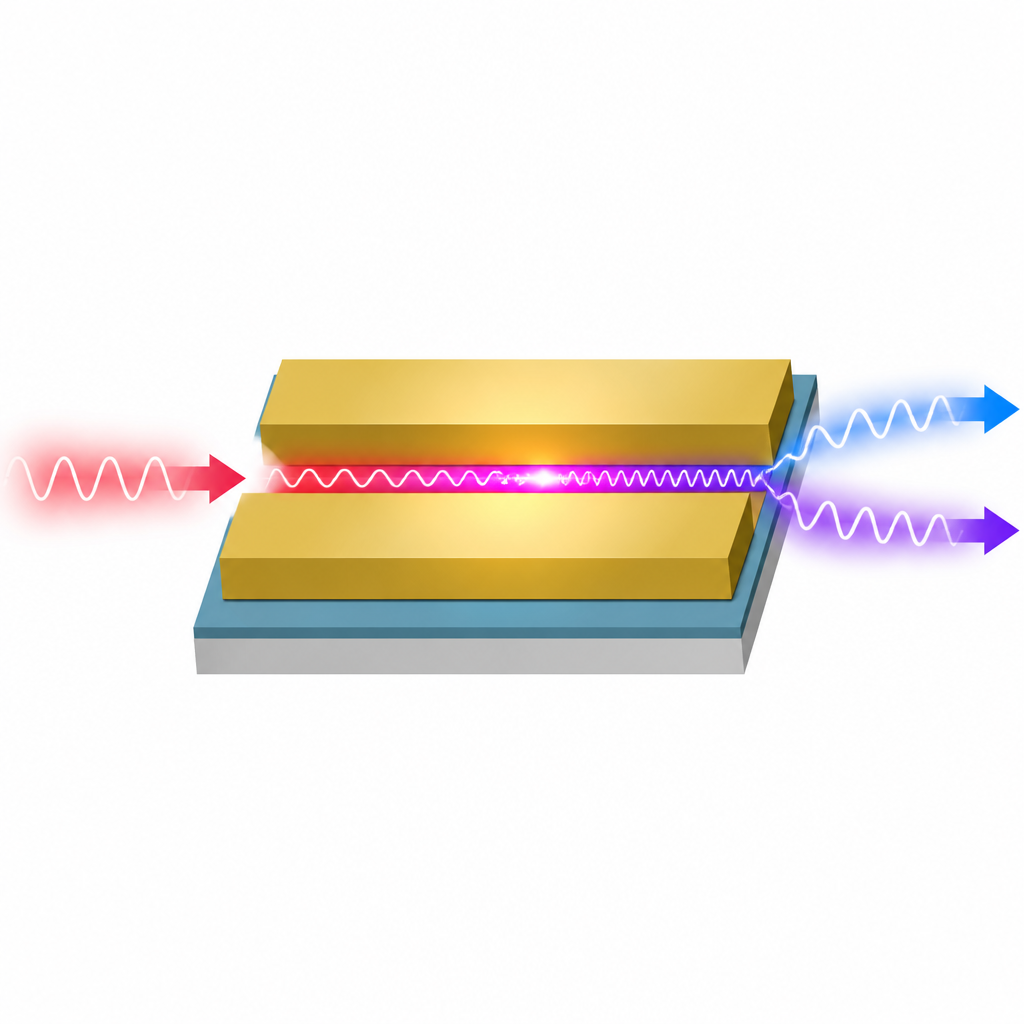
The authors propose a compact metal-based structure, called a plasmonic waveguide, to generate squeezed light much more efficiently. The device consists of two thin gold strips sitting on a glass-like material, with an ultra-narrow gap between the metal layers. This gap is filled and covered with an organic material that responds very strongly to intense light. When light travels in this structure it can excite surface waves, where the light couples to electrons in the metal. These waves trap the optical field in a region far smaller than the wavelength, greatly increasing its intensity inside the organic layer and thereby strengthening the nonlinear interactions that create quantum states.
Using four photons to shape noise
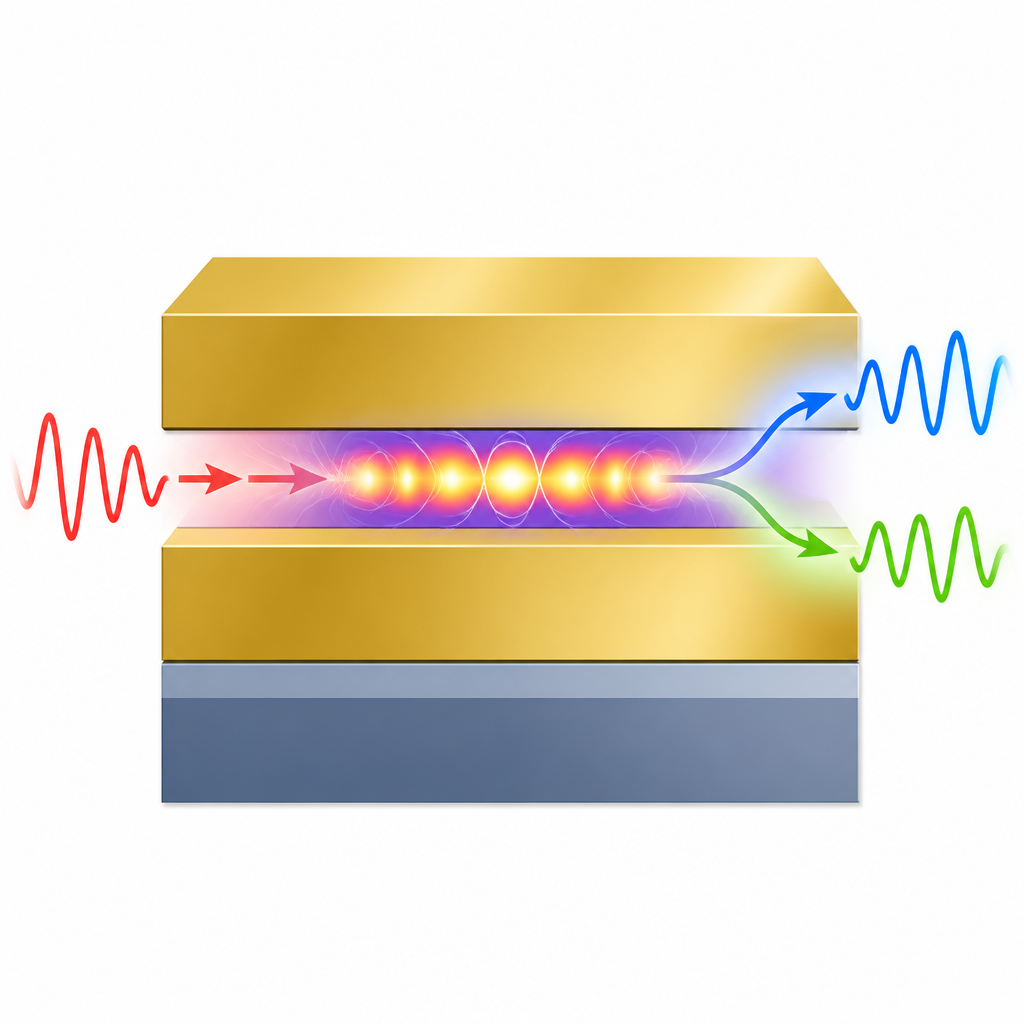
The key process at work is four-wave mixing, in which two photons from a strong input beam are converted into a pair of photons at different colors, known as the signal and idler. The researchers treat this process both as a classical energy exchange and as a fully quantum interaction that affects the fluctuations of the light fields. They derive and numerically solve coupled equations for the average light levels and for the tiny quantum jitters around those averages. By building a mathematical description of how these jitters evolve step-by-step along the waveguide, and by packaging the relevant correlations into covariance matrices, they compute how much squeezing develops in both a single mode (the pump) and in the joint signal–idler pair.
How design and power tune the squeezing
The analysis shows that higher pump power strengthens the four-wave mixing and produces deeper squeezing over even shorter distances, down to interaction lengths below two micrometers. Compared with earlier designs that relied on a different nonlinear process, second-harmonic generation, the proposed structure needs a waveguide that is roughly a thousand times shorter to reach a similar level of noise reduction. The authors also explore practical limits: losses in the metal and surrounding materials act like tiny beam splitters that constantly mix in vacuum noise, weakening the squeezing. They model this effect and show that while loss degrades performance, strong squeezing remains possible within the very short device lengths allowed by the intense field confinement.
Shaping the gap for better performance
The width of the gap between the gold layers turns out to be a crucial design knob. Narrower gaps squeeze the optical field more tightly into the organic material, raising the local field strength and boosting the efficiency of four-wave mixing. As the gap widens, the peak electric field drops, the nonlinear interaction becomes weaker, and both the amount of squeezing and the speed at which it develops are reduced. Simulations indicate that gaps in the 50 to 70 nanometer range give the best trade-off between strong squeezing and realistic fabrication, especially given recent advances in nanofabrication techniques.
A small platform for future quantum chips
In everyday terms, this work shows how to build a very small, very efficient "noise sculptor" for light using a metal slot only tens of nanometers wide. By combining extreme field confinement with a highly responsive organic material, the proposed plasmonic waveguide can generate both single-mode and pairwise squeezed states within a fraction of the length required by more conventional devices. Although optical loss and fabrication challenges remain, the results suggest a clear path toward compact, chip-scale components that supply quiet quantum light for sensing, communication, and information processing.
Citation: Ghasempour Ardakani, A., Bornak, H. Generation of single-mode and two-mode quantum squeezed states of light by degenerate four-wave mixing in a plasmonic waveguide. Sci Rep 16, 16684 (2026). https://doi.org/10.1038/s41598-026-45164-2
Keywords: squeezed light, plasmonic waveguide, four-wave mixing, quantum photonics, nanophotonics