Clear Sky Science · en
A neural network model for managing renewable resources with population growth
Why this study matters for our future
As the global population grows, societies are drawing ever more heavily on forests, fisheries, and other renewable resources. Yet these natural systems have long memories: past use and overuse shape how they recover today. This article explores a new mathematical and artificial intelligence based framework that tries to capture this memory, helping planners identify sustainable harvesting limits before ecosystems tip toward collapse.
Linking people and nature
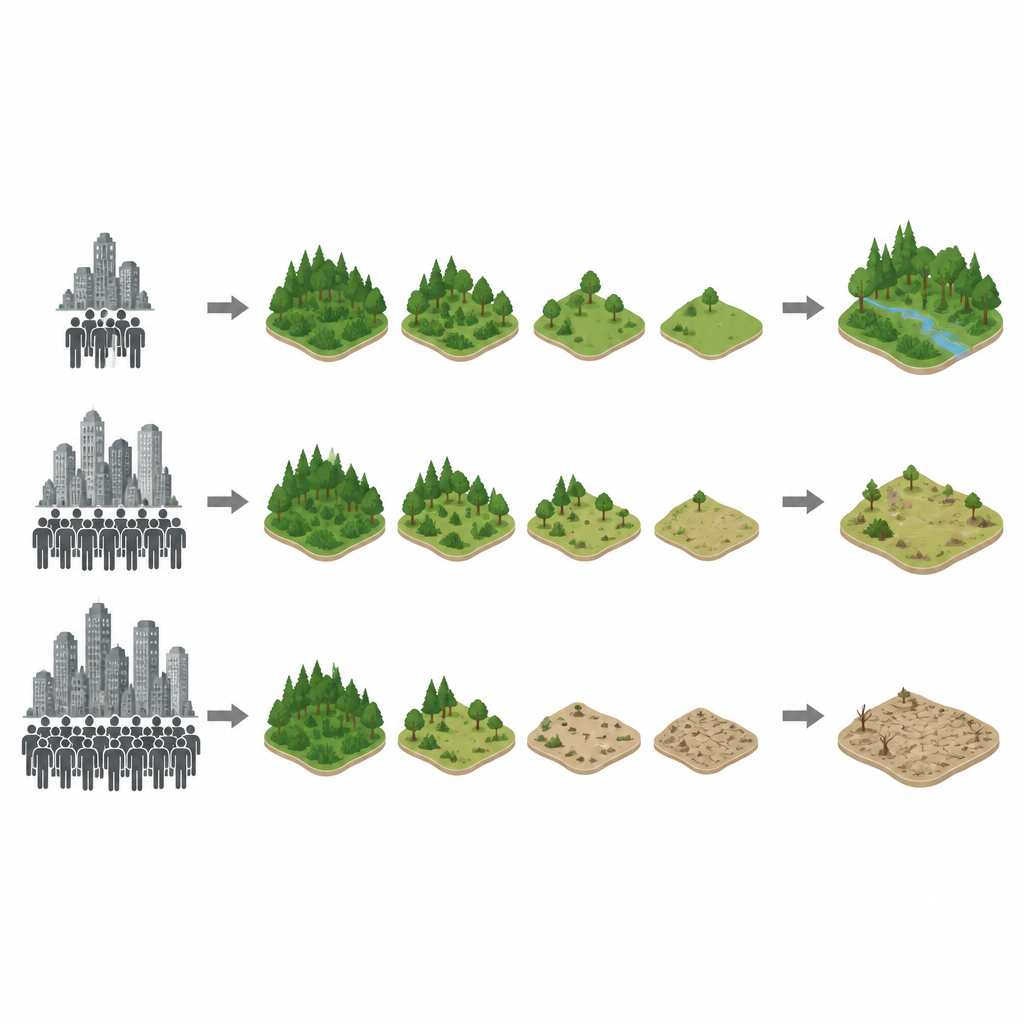
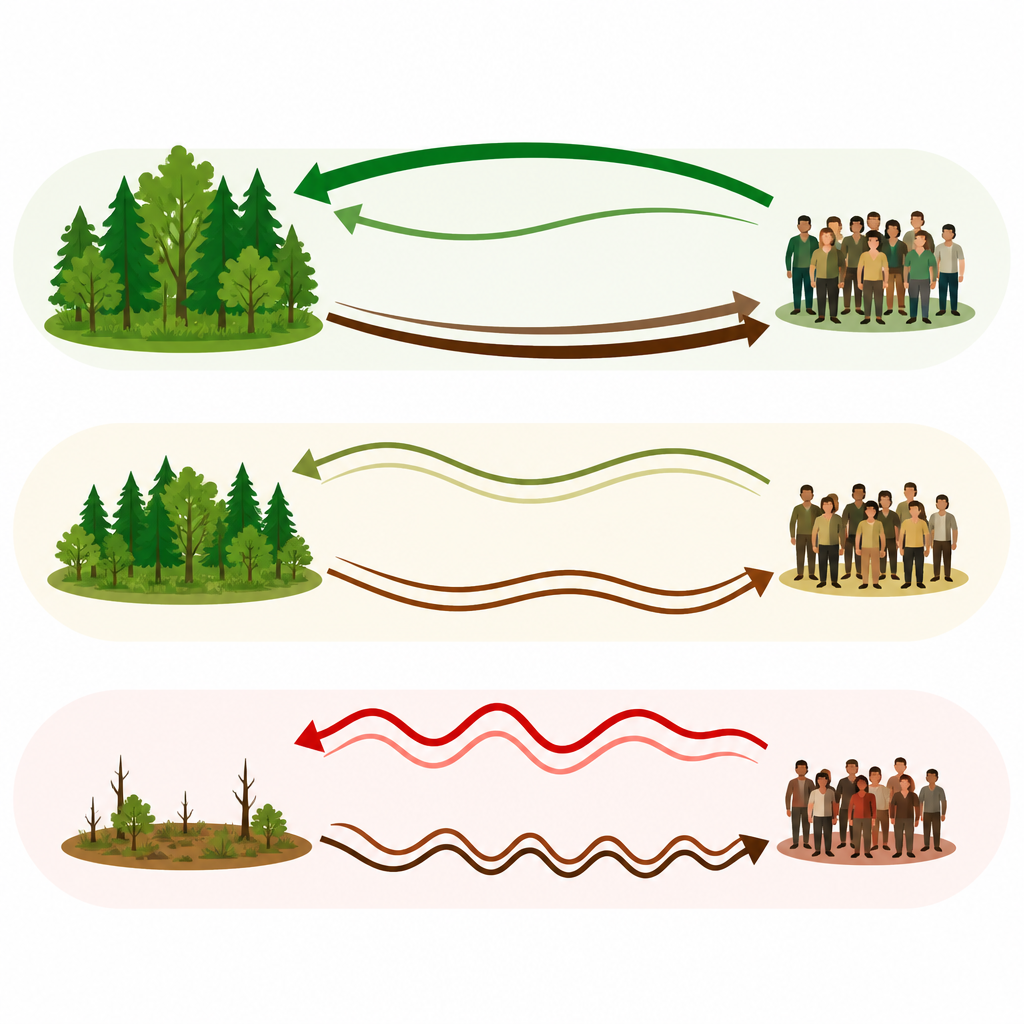
The authors model a simple but powerful relationship: a human population that depends on a renewable resource, such as a fish stock or forest biomass. The population grows when resources are plentiful and slows when they are scarce. In turn, people harvest and consume the resource, which also grows naturally up to a carrying capacity. This feedback loop can lead to stable coexistence, gradual depletion, or rapid collapse, depending on how strongly and how quickly the system reacts to changes.
Adding the memory of the past
Traditional models usually assume that only the current state matters. In reality, ecosystems and societies carry a legacy of past events: soil quality, previous logging, or earlier population booms all influence how fast systems can bounce back. To include this, the study uses a fractional calculus approach, which adds a “memory” component to the equations. Two key parameters control how strongly the past influences the present and how this influence fades over time. When this memory is strong, changes in population and resources become smoother and less abrupt, producing more realistic, gently curved trajectories rather than sharp jumps.
Testing stability and safe harvest levels
Beyond writing down equations, the researchers rigorously test when the system’s behaviour is well defined and stable. They derive conditions under which there is a unique, predictable outcome and show how growth rates, harvesting effort, and carrying capacities shape long term stability. Using a new numerical method tailored to the memory based equations, they simulate many scenarios. A striking result is the identification of a critical harvesting effort: when effort exceeds a value of about 150 (in their chosen units), the resource stock crashes in the classical, memory free setting. With memory included, the crash can be delayed and slightly softened, but the system still crosses into an unsafe region if harvesting is too intense.
Neural networks as a fast prediction tool
To make the model more practical, the team trains neural networks to mimic the numerical solutions of the memory based equations. These networks take time as input and predict both resource biomass and population density. They achieve extremely close agreement with the numerical method, with accuracy scores near one. This makes it possible to quickly explore how the system responds to different policies, such as changing harvest rates, growth rates, or environmental capacities, without rerunning heavy computations each time.
What this means for managing resources
Overall, the study shows that including ecological memory changes how we see the balance between people and nature. Memory tends to slow the population’s response and allows the resource to stay higher for longer, but it does not remove the danger of overuse. The work points to a practical sustainability guideline: keeping harvesting effort below the identified threshold helps maintain a positive resource stock and a thriving population, while exceeding it steers the system toward depletion. By blending advanced mathematics with neural network predictions, the framework offers a flexible tool that can inform future resource management strategies and support more cautious, memory aware policies.
Citation: Ahmad, S., Ahmad, I., Alluhaidan, A.S. et al. A neural network model for managing renewable resources with population growth. Sci Rep 16, 16350 (2026). https://doi.org/10.1038/s41598-026-45163-3
Keywords: renewable resources, population dynamics, fractional calculus, harvesting thresholds, neural network modeling