Clear Sky Science · en
Intelligent power underwater wireless sensor networks for marine environmental monitoring using a hybrid marine predator–Henry gas solubility optimization approach
Watching the oceans with less wasted power
Our oceans are laced with underwater sensors that listen for storms, pollution, and shifting ecosystems, but keeping these silent guardians alive is hard. Their batteries are almost impossible to replace, and underwater communication eats power quickly. This study introduces a smarter way for large fields of underwater sensors to share information so that the whole network lasts longer and delivers data more reliably for marine monitoring.
Why underwater sensors struggle today
Underwater wireless sensor networks are essential for tracking ocean health, detecting leaks, and warning of natural hazards. Yet many existing systems burn through battery power because they send data inefficiently. Sensors may transmit directly to a distant station or follow poorly chosen routes, causing some devices to die early while others still have plenty of energy. This unbalanced drain shortens the useful life of the network and reduces the quality of the information scientists receive just when long-term records are most valuable.
A two-part strategy inspired by nature
To tackle this problem, the authors propose a new control scheme called MPA-HGSO that splits the job into two linked decisions: how sensors are grouped into clusters, and how data moves from those clusters to a base station. For clustering, they use an algorithm modeled on the hunting behavior of marine predators, which helps choose which sensor in each area should act as the local leader. For routing, they borrow ideas from how gas dissolves into liquid, using a separate method to find multi-hop paths that cost the least energy overall. By letting each algorithm focus on a single task, the system can search more effectively for good configurations. 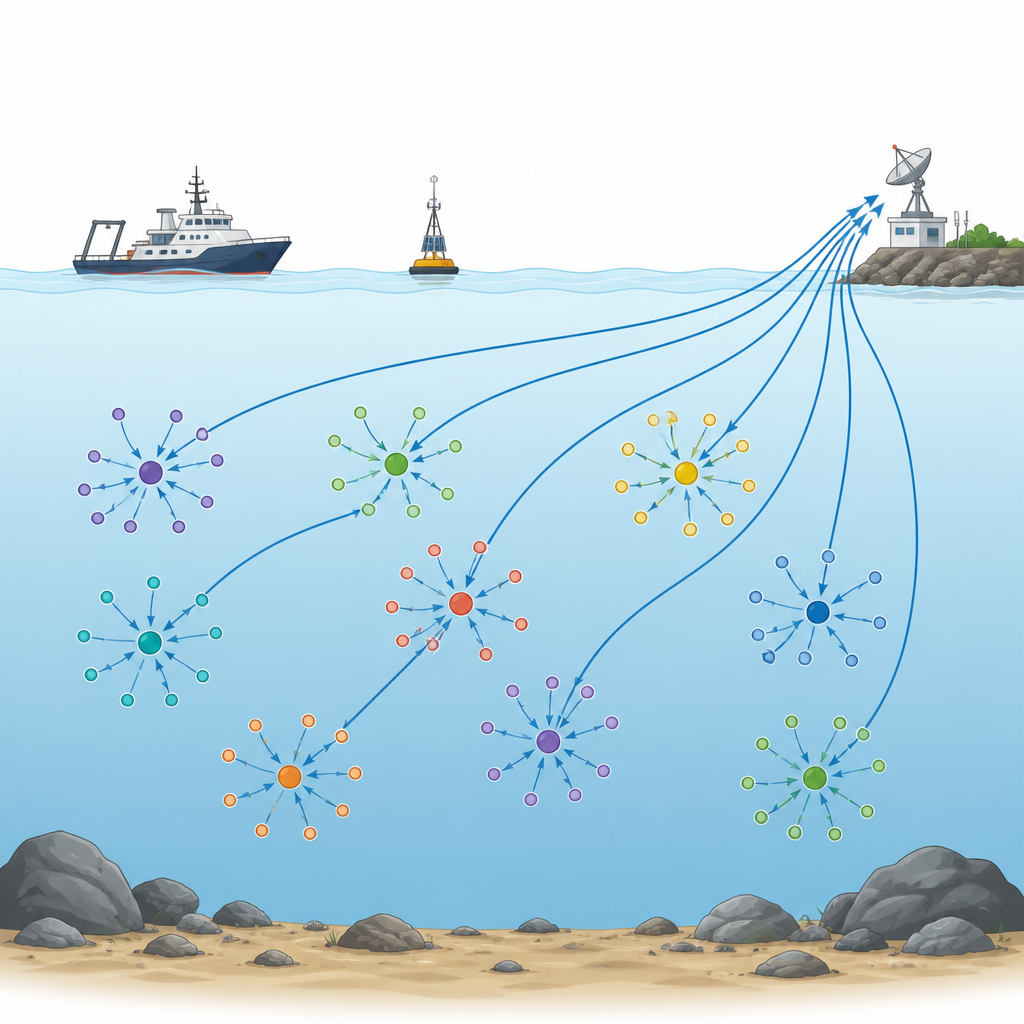
Building a more balanced underwater web
In the proposed network, hundreds of sensors share measurements with a nearby cluster head instead of all shouting directly to the surface. These cluster heads collect and compress readings, then pass them along through a chain of other leaders until the data reaches the base station. The marine-predator-inspired step chooses cluster heads that are both well placed and rich in remaining energy, so no single sensor is overworked. The gas-solubility-inspired step then picks routes that avoid overused relays and long jumps through water, naturally steering traffic toward paths that waste less energy and suffer fewer delays.
Testing different ocean layouts
The team tested their approach in computer simulations of a 300-node network covering a square patch of seafloor. They considered three practical placements of the base station: in the middle of the area, at one corner, and completely outside the monitored zone. They compared MPA-HGSO with several well-known methods that either rotate cluster heads randomly or use a single optimization strategy for both clustering and routing. Using shared assumptions about energy use, data size, and underwater sound speed, they measured how long the network functioned, how much energy it spent, how many data packets reached the base station, and how long each packet took to arrive.
Longer life and faster messages
The results show that the new framework keeps the network operating much longer while also cutting communication delay. In the most favorable case, where the base station sits at the center, the first sensor death was delayed to over 2100 rounds of operation, compared with about half that for a classic baseline method. Even when the base station was placed at the edge or outside the sensing region, the new approach still kept sensors alive for hundreds more rounds than competing schemes. At the same time, the average end-to-end delay for data delivery dropped to around 140–190 milliseconds, up to 44 percent lower than in traditional protocols, meaning fresher information reaches scientists sooner. 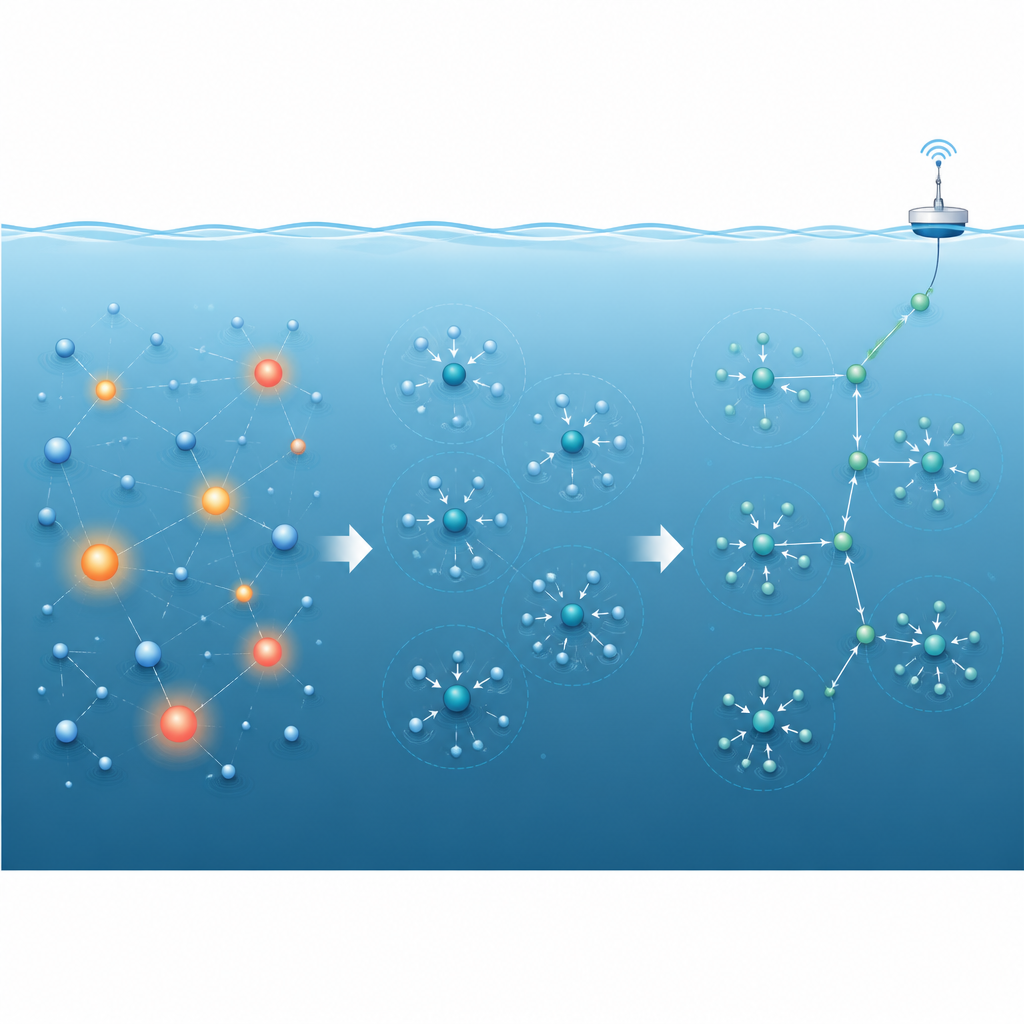
What this means for watching the sea
For non-specialists, the key message is simple: by letting underwater sensors “cooperate smartly” rather than “shout blindly,” this method stretches scarce battery power and keeps ocean monitoring systems useful for longer periods. The nature-inspired twin strategy organizes sensors into fairer work groups and guides their messages along gentle, efficient paths. While real oceans add extra complications like moving nodes and noisy channels, the study suggests a promising blueprint for building durable, large-scale underwater networks that can quietly watch our changing seas for years instead of months.
Citation: Yanhao, W., Alsarhan, A., Aljaidi, M. et al. Intelligent power underwater wireless sensor networks for marine environmental monitoring using a hybrid marine predator–Henry gas solubility optimization approach. Sci Rep 16, 14931 (2026). https://doi.org/10.1038/s41598-026-45139-3
Keywords: underwater sensor networks, energy efficient routing, marine monitoring, wireless clustering, multi hop communication