Clear Sky Science · en
Hipk transduces nutrient signals to control intestinal stem cell proliferation and fate in Drosophila
How the gut listens to food
Our intestines quietly rebuild themselves every day, and this work speeds up or slows down with the food we eat. This study in fruit flies uncovers a key protein that lets gut stem cells sense nutrients and decide when to divide and what kinds of cells to become. Because the same basic signaling systems guide stem cells in many animals, this work offers a window into how diet can reshape the digestive tract over time.
The fly gut as a simple test bed
The researchers focused on the midgut of the fruit fly, a widely used model for studying stem cells. This tissue is built from a small pool of stem cells that sit at the base of the gut wall. These stem cells can either renew themselves or produce short-lived daughter cells that mature into the main absorptive cells of the gut or into hormone-producing cells that help control digestion and metabolism. Earlier work had shown that when flies are well fed, their guts grow and renew rapidly, while fasting causes the organ to shrink. A major nutrient-sensing pathway called insulin–Akt–TOR was known to drive this response, but the link between this pathway and the detailed behavior of stem cells was not fully understood.
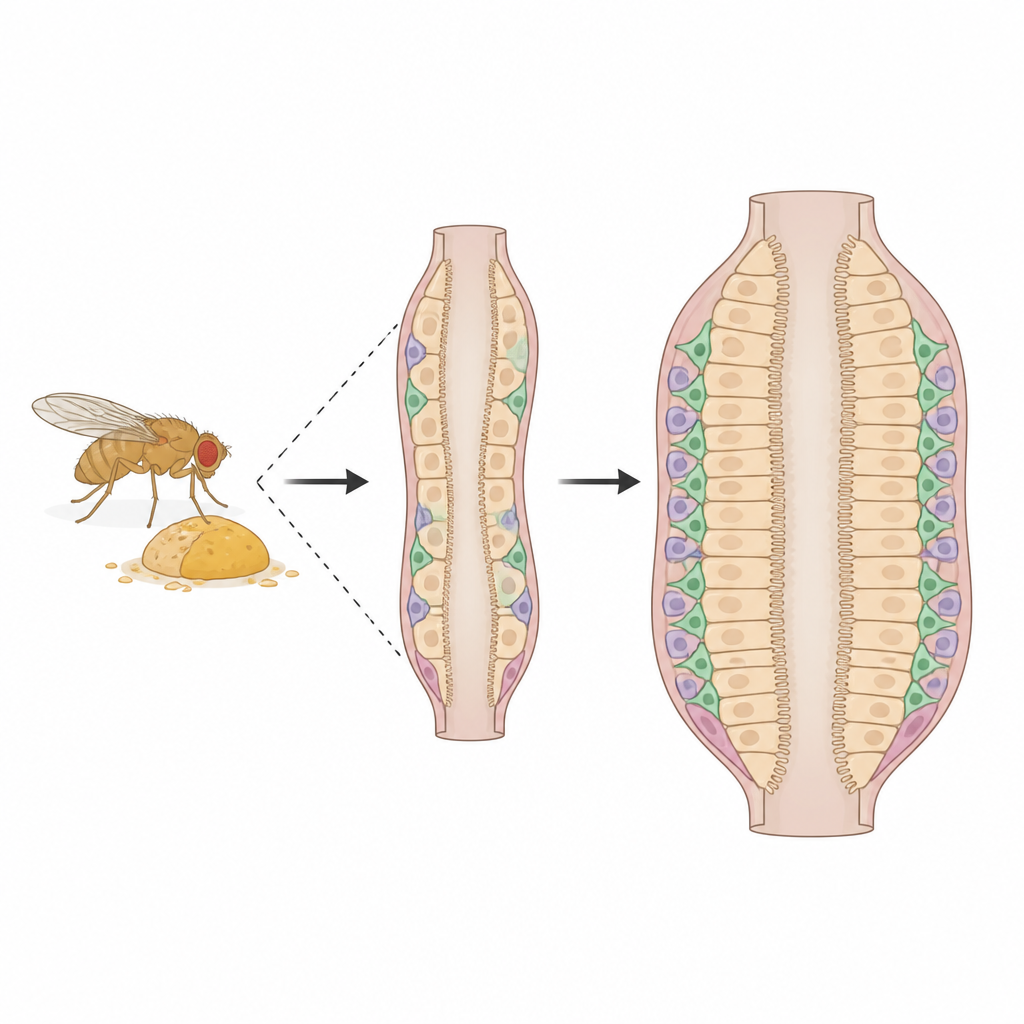
A nutrient switch in gut stem cells
The team discovered that a protein called Hipk is turned on specifically in gut stem cells and their immediate daughters, but not in fully mature gut cells. Using staining methods and genetic reporter tools, they showed that Hipk appears only in these early cells and is absent from the absorptive and hormone-producing cells that line the gut. Importantly, Hipk levels rise when flies are fed and fall sharply during fasting across all regions of the midgut. When fasted flies were given food again, Hipk expression returned, indicating that its production tracks nutritional status in a reversible way.
How nutrients control the Hipk switch
To find out what turns Hipk on, the authors manipulated signaling pathways inside the stem cells. Blocking insulin, Akt, or TOR signals in these cells caused Hipk to drop, even in fed animals. In contrast, forcing these signals to be active kept Hipk high even when flies were starved. Other growth-related pathways did not have this effect. This showed that Hipk sits directly downstream of the insulin–Akt–TOR nutrient-sensing chain and acts as a specific relay that connects information about food availability to the cells that rebuild the gut.
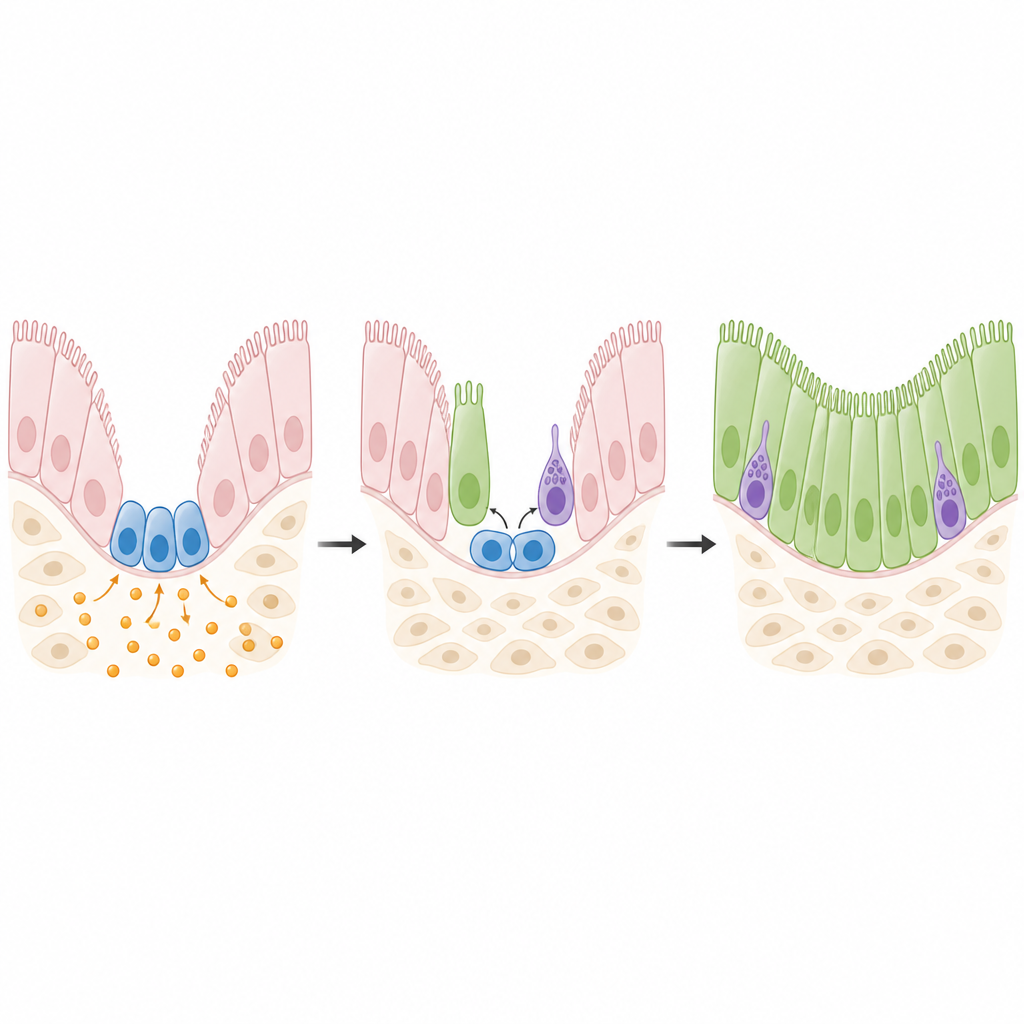
Balancing stem cell growth and cell fates
Once they had placed Hipk in the nutrient pathway, the researchers asked what it does. Boosting Hipk in stem cells and their daughters caused the pool of these progenitor cells to expand, and the cells themselves became larger. Knocking down Hipk had the opposite effect: stem cells divided less, shrank in size, and the overall number of progenitor cells fell, similar to what is seen in a starved gut. Detailed genetic experiments tracking marked cell families over time revealed another role. With normal Hipk, most stem cell daughters followed a default route toward becoming absorptive cells, with only a few choosing the hormone-producing fate. Without Hipk, this balance flipped, and many tiny clones rapidly adopted hormone-producing identities, leaving few cells to build the absorptive layer.
A coordinator of gut renewal and choice
Taken together, the findings show that Hipk acts as a nutrient-sensitive control hub in the fly intestine. When food is plentiful and insulin–Akt–TOR signaling is high, Hipk is produced in stem cells, helping them divide, grow larger, and preferentially generate daughters that mature into absorptive cells. When Hipk is missing or nutrients are low, stem cell division slows and the remaining cells are more likely to become hormone-producing cells instead. For a lay reader, the message is that the gut uses proteins like Hipk to tune both how much it grows and what mix of cell types it makes, allowing the organ to match its structure to the body’s current diet.
Citation: Wu, X., Kim, H., Jang, W. et al. Hipk transduces nutrient signals to control intestinal stem cell proliferation and fate in Drosophila. Sci Rep 16, 14874 (2026). https://doi.org/10.1038/s41598-026-45137-5
Keywords: intestinal stem cells, nutrient signaling, Drosophila midgut, Hipk protein, cell fate decision