Clear Sky Science · en
The river erosion and deposition algorithm with adaptive search dynamics for balancing exploration and exploitation
Why rivers can teach computers to search smarter
Modern computers face countless puzzles, from tuning deep learning models to designing efficient machines. Solving these puzzles means searching through huge numbers of possibilities to find good answers. This paper shows how watching the way real rivers carve and build up their beds can inspire a clever new search method that helps artificial intelligence systems explore widely, yet still zoom in on the best solutions.
How nature balances change and stability
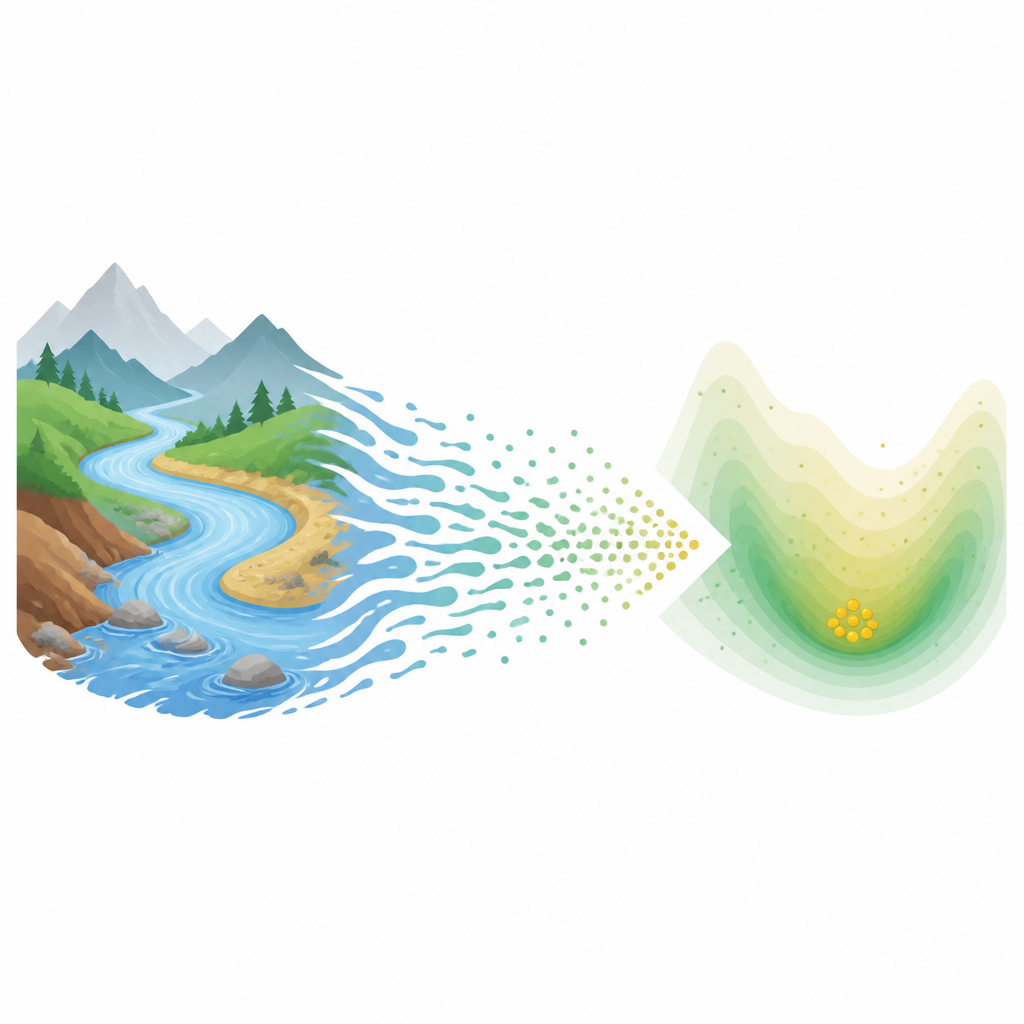
In the natural world, a river is constantly reshaping its surroundings. Fast water erodes soil and rock, carving channels and carrying sediment away. Slow water lets that sediment settle, building sandbars and new banks. Across the seasons, flow speeds rise and fall, and the river naturally alternates between cutting and filling. Over time this push and pull reaches a kind of balance, where the river still changes but does not run wild. The authors of this study borrow this idea to design a computer algorithm that can both roam widely for new options and carefully refine what it has already found.
Turning river seasons into a search strategy
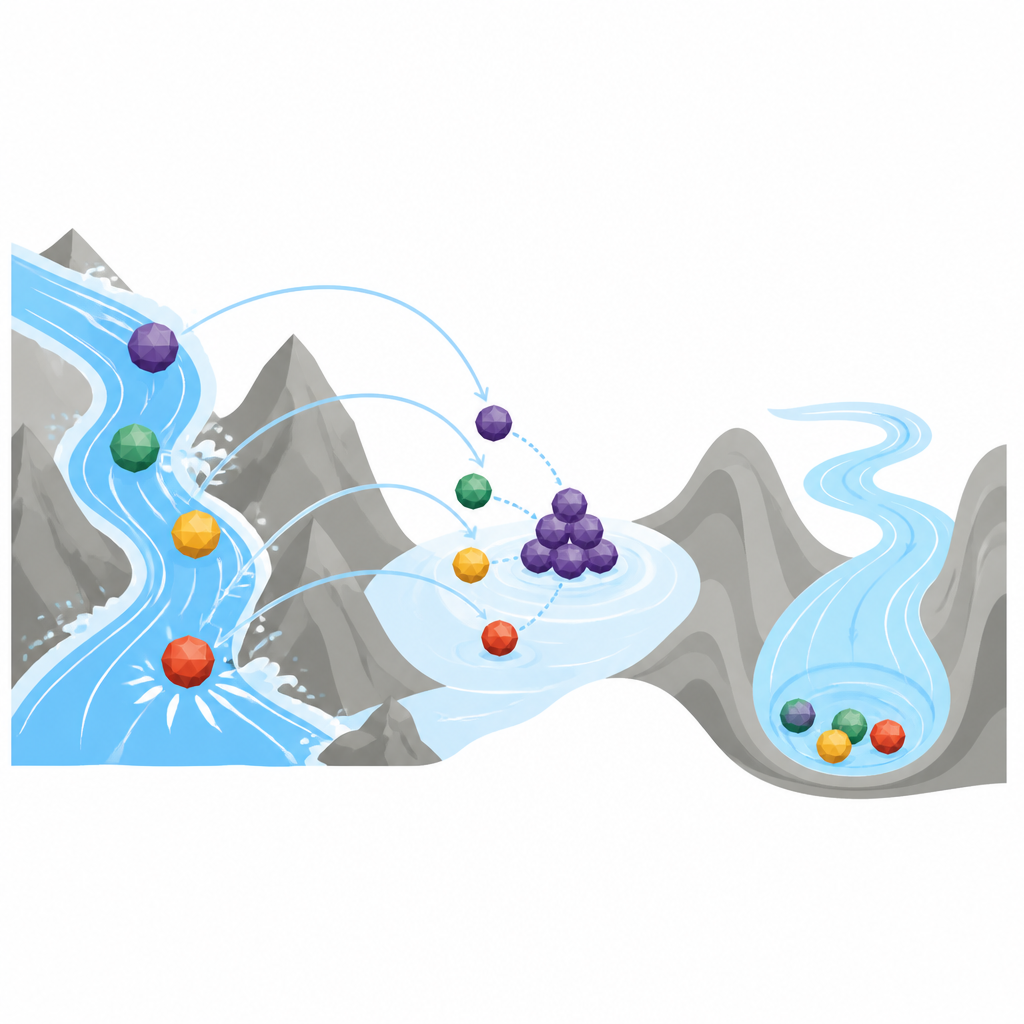
The new method, called the River Erosion and Deposition Algorithm, imagines each possible solution as a particle moving in a river. A key control knob in the algorithm mimics seasonal flow: during a “flood” phase, the virtual river runs fast, and particles are pushed far from their current positions, allowing broad exploration of the search space. During a “low water” phase, flow slows, and particles make only small moves, settling into promising regions. This flow factor changes in a smooth, wave-like cycle rather than decaying once and for all, which means fresh bursts of exploration keep returning and help the search avoid getting stuck too early.
Remembering good spots without getting trapped
Real rivers do not just react to the present; their paths reflect a long history of past floods and dry spells. The algorithm mirrors this by keeping an “elite memory” of particularly good solutions it has discovered. When the search generates new candidates, it does not throw away this history. Instead, it gently mixes current positions with remembered high-quality ones, like sediment stirring through the water. At the same time, a controlled dose of randomness keeps the population varied, so the search does not collapse into a single narrow region. A special pruning step ensures that remembered solutions stay spread out, much like separate deep pools along a river rather than a single overfished spot.
Testing on math puzzles and real machines
To see whether this river-inspired approach truly helps, the researchers tested it on dozens of standard math challenges used to compare optimization tools. These tasks range from smooth, bowl-shaped landscapes to rugged terrains with many peaks and valleys, in spaces of 10, 30, and 50 variables. River Erosion and Deposition often matched or outperformed 13 other advanced algorithms, especially on lower and medium-sized problems and on particularly tangled functions that resemble real engineering situations. The team then tried the method on 19 real design tasks, such as pressure vessels, springs, gear systems, and structural frames, where strict limits and performance targets must all be satisfied at once. In most of these cases, the river-based algorithm reached equal or better designs than its rivals.
Sharper models for solar power systems
The authors also applied their method to fine-tune models of solar panels, which must match measured electrical behavior as closely as possible. Here, the unknowns include several physical parameters inside the panel’s circuit. The river-based search was able to adjust these parameters so that simulated current and power curves nearly overlapped the measured ones, across several increasingly detailed panel models. In practical terms, this means more reliable estimates of how panels behave, which can support better control, monitoring, and planning in solar energy systems.
What this means for everyday technology
From a layperson’s viewpoint, the key message is that inspiration from something as familiar as a river can help computers search more wisely. By cycling between fast “erosion” and gentle “deposition,” and by remembering but not over-trusting past successes, the River Erosion and Deposition Algorithm offers a balanced way to explore possibilities and polish the best ones. The study’s results on standard tests, engineering designs, and solar models suggest that this nature-inspired strategy can become a useful general tool whenever we need to squeeze better performance out of complex systems without exhaustively trying every option.
Citation: Wang, J., Liu, Y., Luo, Z. et al. The river erosion and deposition algorithm with adaptive search dynamics for balancing exploration and exploitation. Sci Rep 16, 15137 (2026). https://doi.org/10.1038/s41598-026-45131-x
Keywords: metaheuristic optimization, swarm intelligence, river erosion algorithm, engineering design, solar photovoltaic modeling