Clear Sky Science · en
Protamine labeling with Reactive Black-5 and its molecularly designed derivatives visualize vacuoles in human sperm head
Why tiny hollow spots in sperm matter
When couples struggle to conceive, doctors often examine the size and shape of sperm. Under high-powered microscopes, many sperm heads show tiny hollow-looking spots called vacuoles, which may be linked to damaged DNA. This study set out to find a simple blue dye that makes these hidden pockets stand out clearly, so scientists and clinicians can measure them more accurately and learn what they really mean for male fertility.

Looking for clearer views inside sperm heads
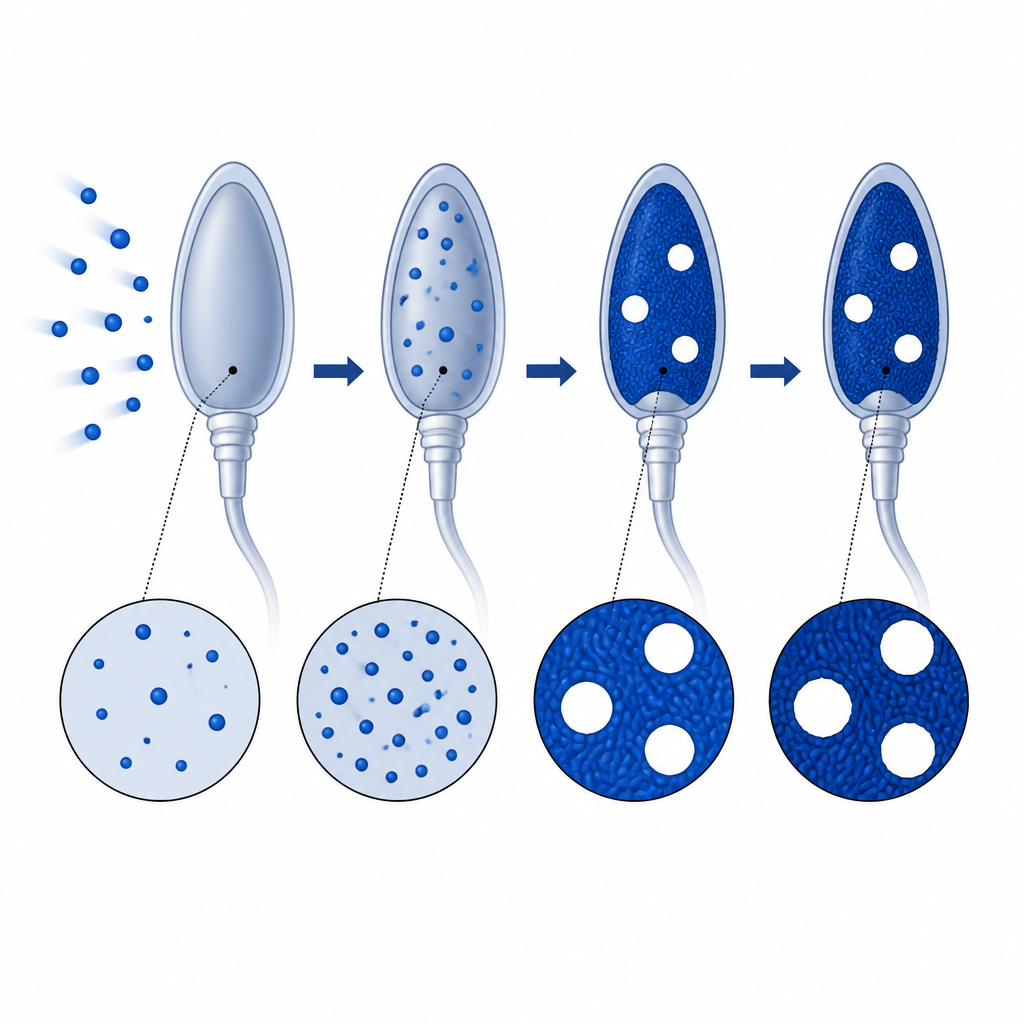
Traditional lab stains color sperm strongly, helping doctors see overall shape but washing out fine detail inside the head. Earlier work showed that a dye known as Reactive Blue 2 could gently tint the sperm head and reveal vacuoles as pale spots, but the contrast was too weak for computers to analyze reliably. The researchers reasoned that the right dye, at a carefully tuned low strength, could color the dense nuclear material while leaving vacuoles almost untouched, turning them into sharply defined, unstained islands in a blue sea.
Testing everyday textile dyes in the fertility lab
The team gathered 12 industrial dyes commonly used to color fabrics, focusing on those that carry negatively charged groups able to latch onto positively charged proteins called protamines. These proteins wrap DNA tightly inside sperm heads. They tested how well each dye stained sperm and how clearly it revealed vacuoles. One candidate, Reactive Black 5, produced a deep but translucent blue that sharply outlined even very small scattered vacuoles, all while being used at an extremely low concentration. This made it not only useful for visual inspection under the microscope but also ideal for digital image processing.
Designing new blue molecules for sharper staining
To understand what made Reactive Black 5 so effective, chemists created 30 new molecules by tweaking parts of its structure. By gradually adding or changing simple building blocks, they mapped how the length of connected chemical rings and the number and spacing of charged groups affected color and binding. A key derivative, called 2221 in the study, reached the minimum arrangement needed to produce a strong blue shade and bound tightly enough to protamines to stain sperm heads at a tenth of the concentration required for Reactive Black 5. Both the original dye and this designer cousin highlighted not only large vacuoles but also tiny ones that are less than a micrometer across.
From blurry shades to precise digital measurements
The researchers also explored how to turn these stained images into reliable numbers. After staining sperm with Reactive Black 5, they converted the color photographs into simple black-and-white images, where the head became dark and vacuoles appeared as clear holes. This strong contrast allowed computer software to measure head shape and vacuole area in nearly 6000 sperm from multiple men. They found that more than 90 percent of sperm contained at least one vacuole and that both the number and size of vacuoles varied widely between and within individuals. The team showed that very high camera resolution is essential, because the smallest vacuoles are near the limit of what standard microscopes and sensors can capture.
What this means for understanding male fertility
Many clinicians suspect that sperm vacuoles reflect weak spots in DNA packaging, which might affect embryo development, but past studies have been inconsistent. By establishing gentle blue staining with Reactive Black 5 and a well-characterized designer dye, along with clear technical guidelines for imaging, this work lays the groundwork for precise, large-scale measurements of vacuoles. The study does not claim that these hollow-looking spots directly cause DNA breaks or infertility, but it provides tools to investigate that link much more rigorously, bringing us closer to understanding which sperm features truly matter for successful pregnancy.
Citation: Kaneko, S., Kuroda, Y., Saito, A.N. et al. Protamine labeling with Reactive Black-5 and its molecularly designed derivatives visualize vacuoles in human sperm head. Sci Rep 16, 15165 (2026). https://doi.org/10.1038/s41598-026-45124-w
Keywords: human sperm, sperm vacuoles, protamine staining, Reactive Black 5, male fertility