Clear Sky Science · en
Machine learning classification of early-stage Parkinson’s disease using sit-to-walk biomechanical features
Why getting up from a chair matters
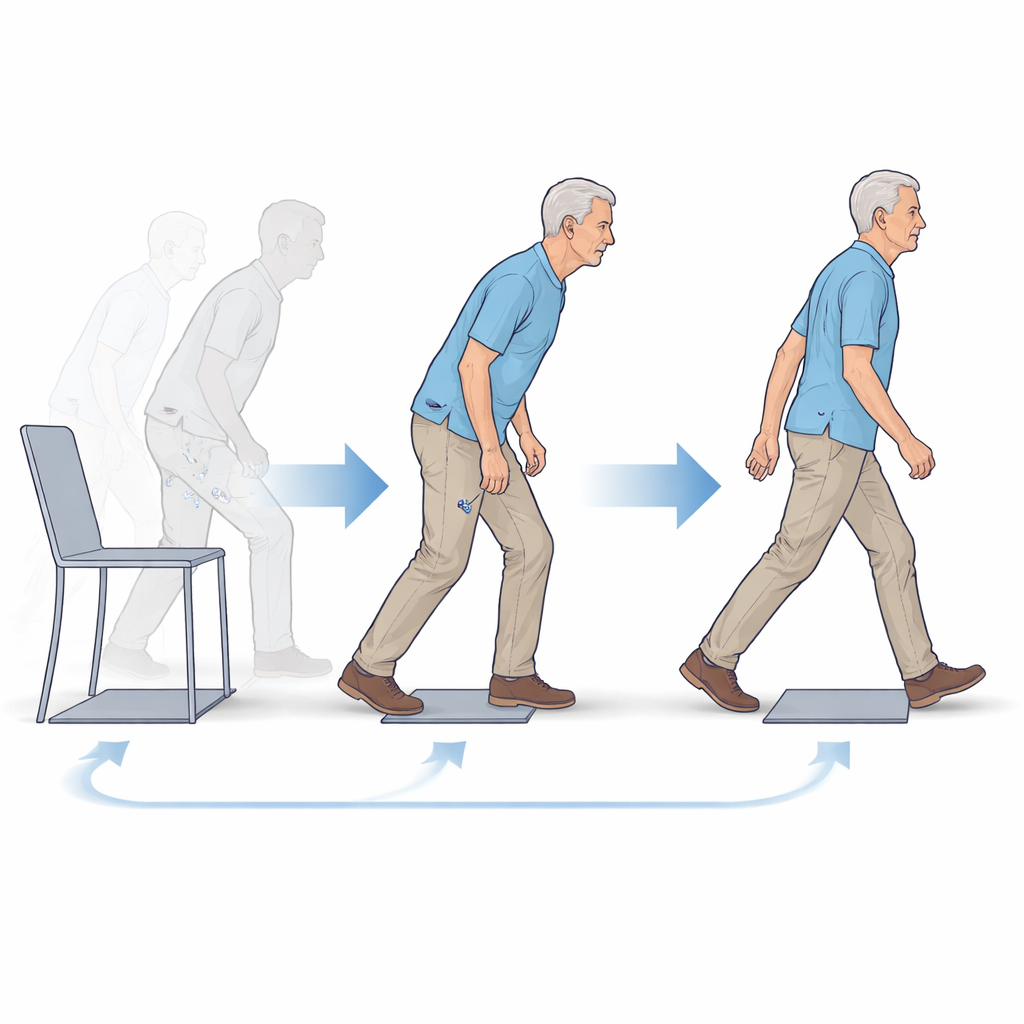
For many older adults, simply standing up from a chair and taking the first few steps feels a bit unsteady. For people in the very early stages of Parkinson’s disease, this everyday move can quietly reveal problems in balance and movement control long before symptoms become obvious. This study explores whether a short “sit-to-walk” task, combined with motion sensors and machine learning, can help spot Parkinson’s disease earlier and more objectively than standard clinical observation alone.
A closer look at an everyday movement
The researchers focused on the sit-to-walk task, which blends two challenging actions: rising from a chair and launching into walking. This transition taxes balance because the body’s weight shifts rapidly forward and onto one leg. In the study, 63 people with early-stage Parkinson’s disease and 43 similar-aged adults without the disease performed this task at a comfortable speed. While they moved, an array of cameras, force plates in the floor, and small sensors on their leg muscles captured how their bodies and muscles behaved from the instant they leaned forward to the completion of the first two steps.
From hundreds of measurements to a few key signals
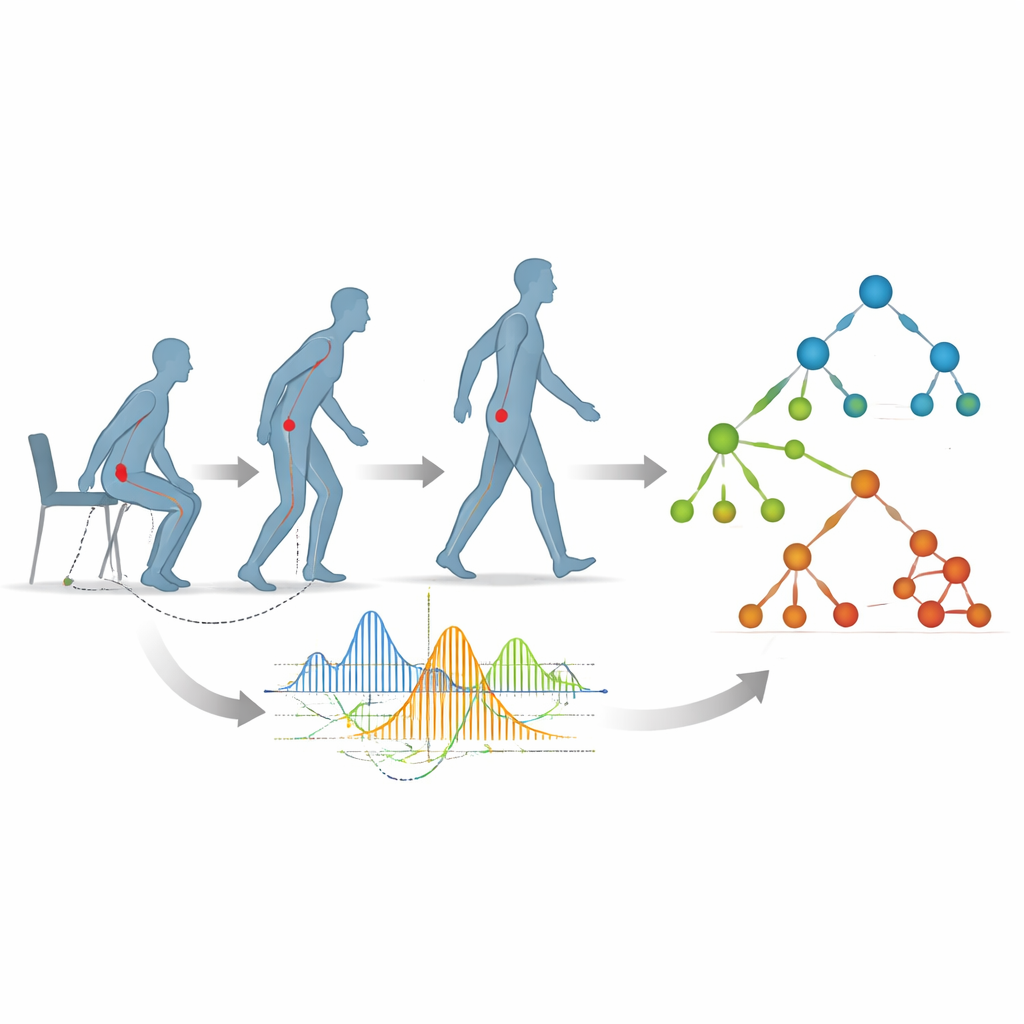
Each sit-to-walk trial was broken into phases, from the first trunk lean to the second footfall, and more than 200 measures were extracted. These included how quickly the body’s overall center of mass moved, how far it shifted relative to the pressure beneath the feet, and how the trunk and legs rotated. Advanced computer algorithms sifted through this large dataset. Using random forest and gradient-boosting methods, the team first narrowed the measurements to 26 that best separated people with early Parkinson’s from healthy volunteers. A further statistical analysis then trimmed this list to just three biomechanical markers that, together, carried most of the useful information.
What early Parkinson’s looks like in motion
The three crucial markers captured how people controlled their body mass and trunk while rising and taking the first steps. Compared with healthy peers, those with early Parkinson’s disease moved their center of mass more slowly across the whole task, shifted it a shorter distance forward relative to the pressure under their feet during the first stepping phase, and bent their upper back forward through a smaller range. These patterns suggest a careful, shortened weight shift and a stiffer trunk—changes that may be compensations to keep balance when the brain’s movement-planning circuits are already subtly impaired. The study also found greater left–right differences in lower leg muscle activity in the Parkinson’s group, echoing the disease’s tendency to start on one side of the body.
Teaching computers to recognize the pattern
Armed with these markers, the team trained several machine learning models to tell who did and did not have Parkinson’s disease. When fed all 200 original measurements, the best model, a random forest classifier, correctly classified participants about 87% of the time. Using the 26 most important features improved this slightly to about 92%. Remarkably, when the model relied only on the final three sit-to-walk markers, its accuracy remained strong at about 85%. This shows that even a very compact set of movement signals, drawn from a simple daily task, can provide robust information about early-stage disease.
What this could mean for everyday care
The authors conclude that subtle changes in how people stand up and take their first steps can serve as sensitive early warning signs of Parkinson’s disease. Because the three key markers reflect small shifts in whole-body speed, forward weight transfer, and trunk motion, they could potentially be measured with simpler tools such as wearable sensors or clinic-based motion platforms. If confirmed in larger and more diverse groups, this approach could give doctors a fast, non-invasive way to screen older adults for early Parkinson’s disease and to identify those at higher risk of falls—well before more obvious symptoms emerge.
Citation: Kim, M., Youm, C., Park, H. et al. Machine learning classification of early-stage Parkinson’s disease using sit-to-walk biomechanical features. Sci Rep 16, 10559 (2026). https://doi.org/10.1038/s41598-026-45122-y
Keywords: Parkinson’s disease, gait and balance, machine learning, biomechanics, early diagnosis