Clear Sky Science · en
A looming belowground threat: assessment of climate-driven global expansion risk of Meloidogyne spp. in tobacco-growing regions
Hidden trouble beneath a global cash crop
Tobacco may be a controversial crop, but it supports millions of farmers and workers worldwide. Much of its fate is decided out of sight, in the thin layer of soil that surrounds its roots. This study looks at a little-known but costly enemy of tobacco—microscopic root‑knot worms—and asks how a warming climate will change where both the crop and its pest can thrive. The answers matter not only for growers and rural economies, but also for anyone interested in how climate change reshapes the balance between crops and the organisms that feed on them. 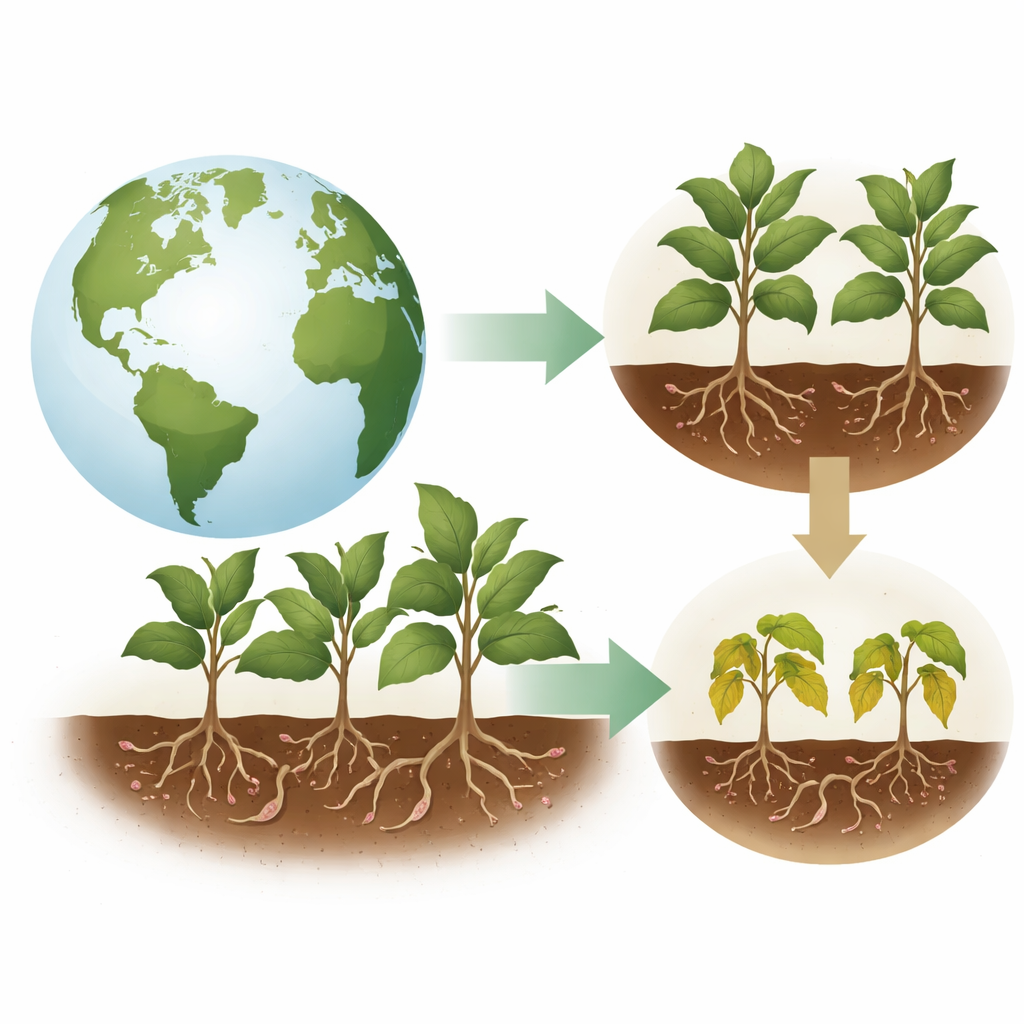
A global crop and a costly underground pest
Tobacco is grown on millions of hectares, especially in China, India, Brazil, parts of Africa, and Southeast Asia. These plants depend on the right mix of temperature, rainfall, and soil properties such as texture, acidity, and organic matter. The same soils, however, can also host root‑knot nematodes—tiny roundworms in the genus Meloidogyne that invade roots, create swelling "knots," and drain plants of water and nutrients. Across all crops, these pests are estimated to cause well over a hundred billion dollars in yield losses each year. For tobacco farmers, infestations can mean weaker plants, lower leaf quality, and greater vulnerability to other diseases that enter through nematode-created wounds.
Mapping where crops and pests can live today and tomorrow
To understand present and future risks, the authors used a computer modelling technique that predicts where a species can live based on known records and environmental conditions. They gathered thousands of geographic records for tobacco and for four of the most harmful root‑knot species, then combined these with global maps of climate, elevation, and key soil traits—soil acidity, organic carbon, and texture. The model was run for recent historical conditions (1970–2000) and for three future climate pathways that range from low to very high greenhouse‑gas emissions, looking at mid‑century and late‑century periods. By comparing the predicted ranges of tobacco and the nematodes, the team identified zones where the crop and pest are likely to overlap, and graded these zones from low to high risk. 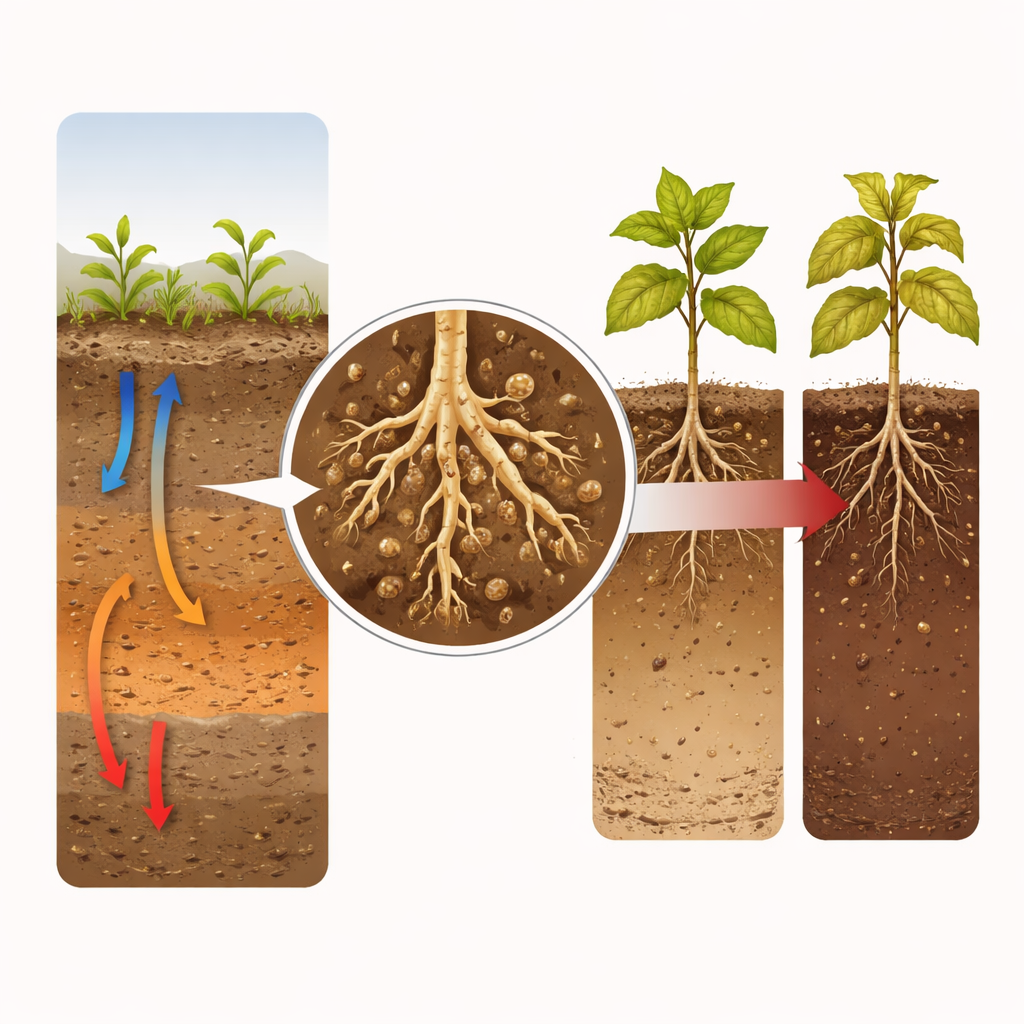
Soil rules the worms, climate steers the crop
The study shows that the crop and its pest respond differently to their environment. Tobacco’s global spread is shaped most strongly by temperature and the way it varies over the year, with rainfall patterns playing a smaller but still important role. In contrast, the nematodes are more tightly bound to the soil beneath them. Slightly acidic to neutral soils with moderate organic carbon and low elevation are especially favorable for the worms. Climate sets the broad regions where they could survive, but local soil conditions decide where they actually flourish. Under recent conditions, only a small fraction of the world’s land area sees strong overlap between suitable tobacco habitat and high nematode suitability, concentrated in intensively farmed lowlands of South and Southeast Asia, tropical Africa, and parts of the Americas.
Climate change shifts and intensifies risk zones
Looking ahead, the models suggest that suitable areas for tobacco shrink, fragment, and move under all climate pathways, with the strongest losses under the highest emissions. The story for nematodes is more complex: some regions become less suitable as temperatures overshoot their comfort range, but others become more favorable, especially under intermediate and high‑emission futures. When the two sets of maps are overlaid, the total land area where tobacco and nematodes can both thrive grows in every future scenario, and the share classified as "high risk" increases sharply. Under modest warming, this increase eventually levels off; under stronger warming, medium‑risk zones are gradually converted into high‑risk hotspots, particularly in low‑lying agricultural belts of Asia, Africa, and South America.
What this means for farmers and planners
For a lay person, the main message is that climate change is unlikely to make underground pests quietly disappear. Instead, in many key tobacco regions, fewer suitable fields will face more intense nematode pressure. The authors stress that soil factors—acidity, organic matter, and elevation—can either amplify or soften this risk. Managing soils carefully, diversifying crops, and improving biological control of nematodes may be as important as cutting emissions in protecting future harvests. Rather than offering exact predictions for each farm, the study provides a global risk map that can guide where to focus monitoring, research, and adaptation efforts as the climate warms.
Citation: Roy, S.D., Sen, D., Mandal, G. et al. A looming belowground threat: assessment of climate-driven global expansion risk of Meloidogyne spp. in tobacco-growing regions. Sci Rep 16, 10838 (2026). https://doi.org/10.1038/s41598-026-45118-8
Keywords: tobacco, root-knot nematodes, climate change, crop pests, soil health