Clear Sky Science · en
Multi-center chameleon hashing based Blockchain integrated digital copyright transaction scheme for data redacting in Blockchain based IoT systems
Why flexible digital ownership matters
Music, photos, videos, and industrial data now flow constantly between creators, companies, and connected devices. Protecting who owns what is vital, yet today’s digital copyright systems still rely on central agencies and long, opaque procedures. This paper presents a new way to manage copyright on a blockchain so that ownership can change cleanly, errors can be fixed, and sensitive details stay private—features that are especially important in the rapidly growing Internet of Things (IoT) and industrial IoT.

Problems with today’s copyright systems
Current digital copyright protection usually runs through trusted middlemen that register works, store contracts, and mediate sales. That centralization makes the process slow and often opaque. Owners must repeatedly re‑register or confirm rights as works are sold or licensed, and transaction data are kept in isolated databases that can be altered without leaving a clear trail. As digital copying and remixing become easier, disputes about who owns what, who got paid, and whether a file was quietly changed are becoming more frequent. Existing tools like digital watermarks and standard encryption help, but they do not solve issues like efficient resale, clear history of ownership, or fixing honest mistakes on supposedly “immutable” ledgers.
Making blockchain edits safe and accountable
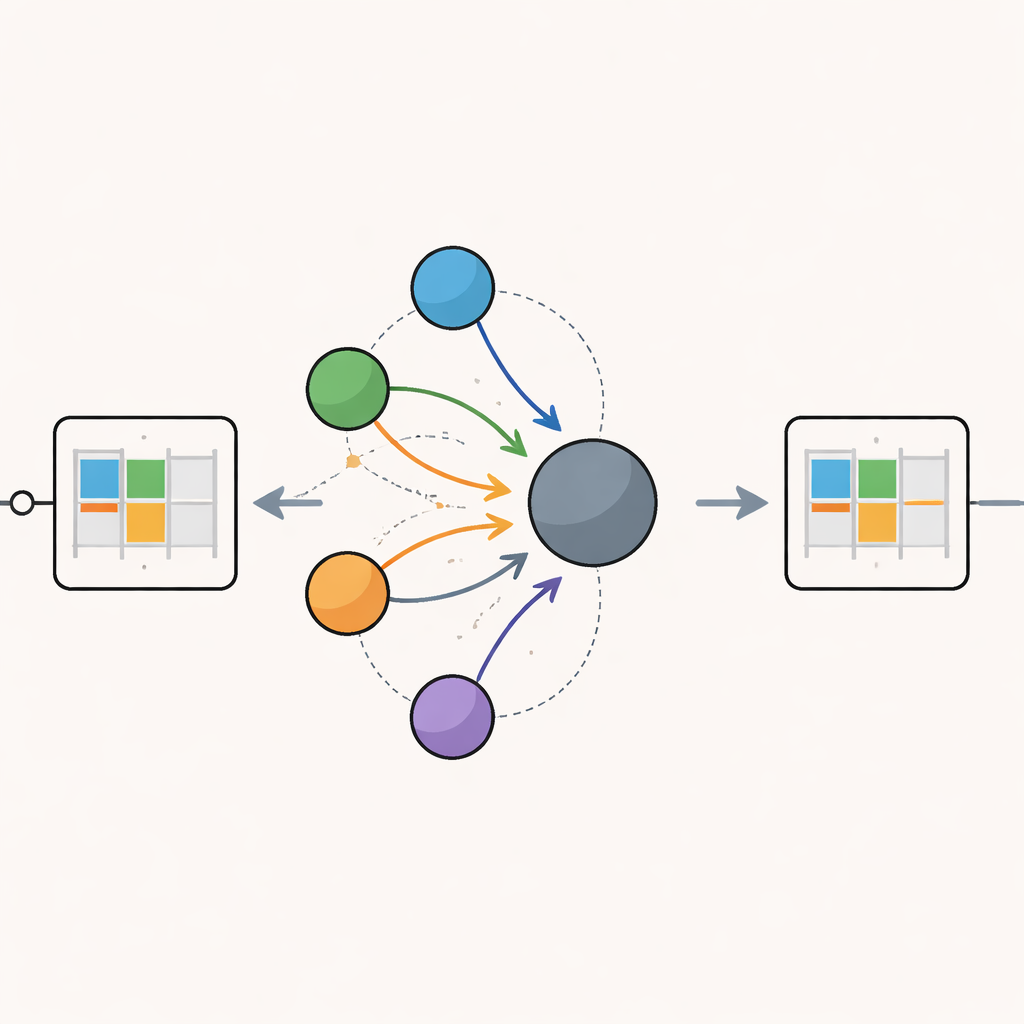
Blockchains promise transparent, tamper‑evident records, but that strength turns into a weakness when a copyright entry needs to be corrected—for example, when a song’s rights are sold or a registration contains a typo. Simply overwriting data breaks the chain’s integrity. The authors address this by using a special cryptographic tool called a chameleon hash, which allows specific entries to be updated while keeping the block’s overall fingerprint unchanged. Instead of giving that power to a single trusted party, the scheme splits the secret key across multiple “permission nodes.” Only when enough of these nodes cooperate can a temporary edit key be reconstructed, used once to update the record, and then effectively discarded. This multi‑center design preserves decentralization: no single node can secretly rewrite history.
How the new transaction model works
The proposed system organizes copyright dealings into four phases: registration, node selection, transaction, and redaction. Creators and buyers first register with dedicated authorities that issue digital identities and attribute‑based keys. A subset of blockchain nodes are chosen as permission nodes based on their attributes, performance, and a security deposit that can be forfeited if they misbehave. When a copyright sale occurs, the work’s information and price are recorded on a consortium blockchain through a smart contract, and the buyer pays automatically. To reflect the change of ownership, a permission node proposes a data update; other permission nodes vote. If enough agree, a temporary redacting node combines sub‑keys from the group, computes a chameleon hash collision, and changes the owner field in the relevant transaction without disturbing the overall block structure. The buyer then receives an updated on‑chain record that now lists them as the owner.
Keeping keys and nodes under control
A major risk is that one of the permission nodes, or even an attribute authority, could leak its share of the secret key. To counter this, the authors design a specialized encryption scheme that lets an exiting node broadcast its sub‑key securely to the remaining ones, protected by an access policy tied to node attributes. Keys evolve over time through controlled updates, so an old leak does not endanger future edits. The construction also embeds enough information to trace which node or authority leaked a key if it ever appears in the wild. Combined with deposits and rewards, this creates both economic and cryptographic pressure against misbehavior. Simulations show that, in networks with many permission nodes, the time needed for nodes to exit and hand over their key shares grows slowly and eventually levels off, whereas older approaches become increasingly sluggish.
Performance in connected device networks
The authors test the scheme under conditions similar to large IoT or industrial IoT systems, where many devices and services may participate in copyright‑like data exchanges. They measure how long a full transaction takes—including encryption, signatures, consensus, and verification—as the number of permission nodes grows. The delay rises only modestly, staying well below a second even for dozens of nodes, and it increases more slowly than in earlier redactable blockchain designs. They also study storage demands when the same record is updated many times. Traditional methods often keep all previous versions or create new blocks for every edit, causing storage to balloon. Here, thanks to in‑place updates with chameleon hashing, the total data size changes very little even after many redactions, an important advantage for devices and gateways with limited memory.
What this means for future digital rights
Overall, the work shows that it is possible to combine two goals that usually clash: keeping a blockchain history trustworthy while still allowing controlled corrections and ownership transfers. By spreading editing power across multiple nodes, tying it to economic incentives, and guarding the underlying keys with accountable encryption, the proposed framework aims to make copyright trading more transparent, efficient, and suitable for IoT and industrial settings. While a full economic analysis and further optimization for tiny devices are left for future study, this approach points toward digital rights systems where creators, buyers, and machines can interact directly on a shared ledger without giving up either flexibility or security.
Citation: Chen, L., Bhattacharjya, A., Sun, Y. et al. Multi-center chameleon hashing based Blockchain integrated digital copyright transaction scheme for data redacting in Blockchain based IoT systems. Sci Rep 16, 14290 (2026). https://doi.org/10.1038/s41598-026-45111-1
Keywords: blockchain copyright, redactable ledger, IoT security, chameleon hash, attribute-based encryption