Clear Sky Science · en
A two-stage multi-objective optimization framework for coordinated EV charging scheduling and reactive power dispatch
Why smarter charging for electric cars matters
Electric vehicles promise cleaner air and lower greenhouse gas emissions, but if millions of drivers plug in whenever they like, the local power grid can struggle. Transformers may be overloaded, power losses increase, and voltages drift outside safe limits. This paper presents a practical way to manage home charging for hundreds of EVs at once, cutting waste and costs while keeping the lights on and the grid healthy.
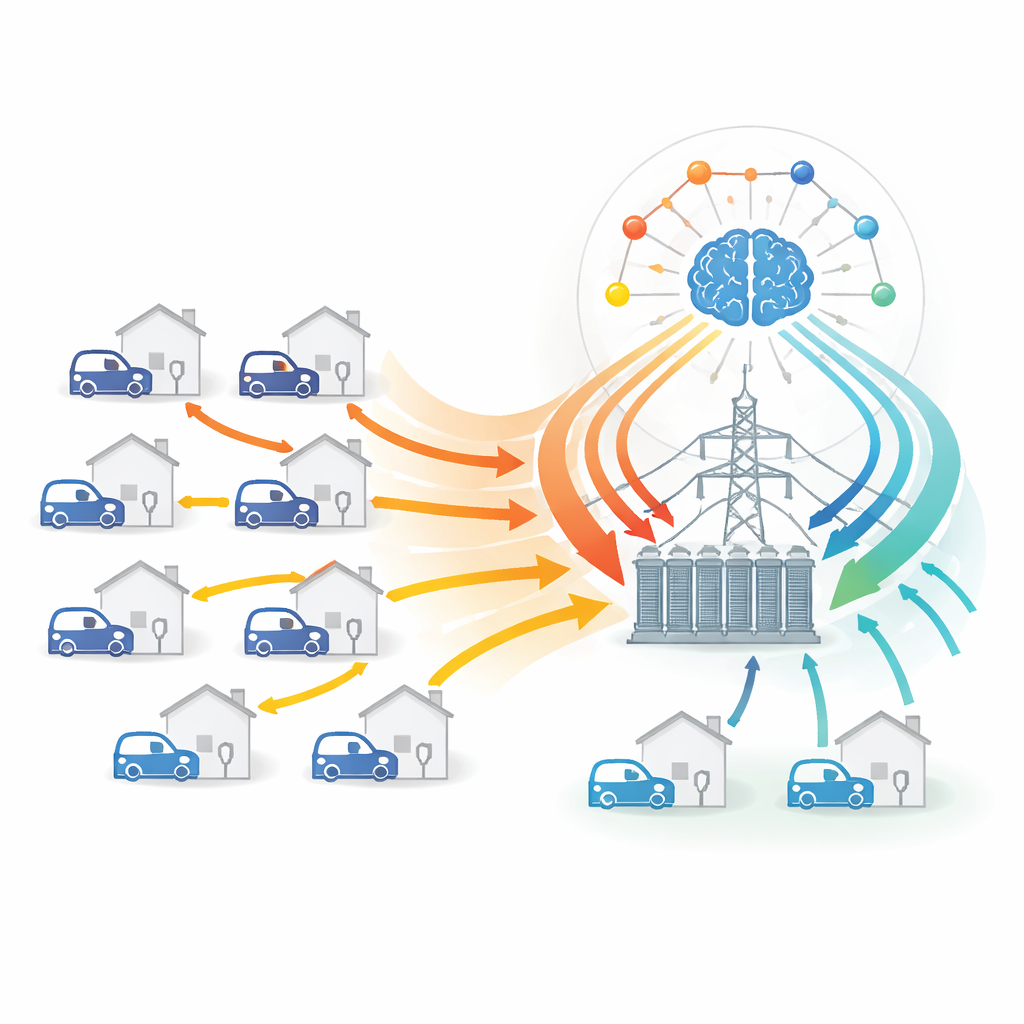
Balancing cars and cables
The authors focus on a typical urban distribution network: a 33-bus radial feeder serving homes where 984 electric cars charge mainly at night. Instead of letting drivers charge immediately on arrival, a central computer called an aggregator coordinates when each car actually draws power. The aim is to spread charging over the night, avoiding spikes in demand, while still meeting every driver’s requirement to leave with a nearly full battery. This matters because today’s grids were not built for large clusters of EVs on the same streets, and unmanaged charging can double power losses and push equipment beyond its rated capacity.
Two ways to plan ahead
The framework has two planning styles. In “day-ahead” mode, the aggregator plans the next 24 hours in advance using forecasts of electricity prices, base household demand, and expected EV arrival and departure times. It runs detailed power-flow calculations, checking transformer loading, line losses, and voltages at every bus. In “real-time” mode, the system updates decisions every five minutes only for newly arrived cars, using simpler formulas instead of full network calculations to stay fast enough for online control. Day-ahead planning has the advantage of seeing the whole picture and can find a close-to-global optimum; real-time planning reacts better to surprises, such as drivers arriving later than expected or wanting more energy than usual.
Using parked cars to support the grid
A key innovation is that the authors do not just schedule when cars charge; they also use the electronics inside chargers to shape the flow of non-fueling power called reactive power. Unlike discharging the battery back to the grid, providing reactive power does not shorten battery life. When local voltages sag or rise, the charger’s inverter can inject or absorb this kind of power to nudge voltages back toward the ideal level. To keep the problem manageable, the method does not tune each individual car; instead, it decides how much reactive power should be provided at each node of the network, based on how many EVs are connected there and how hard they are charging.
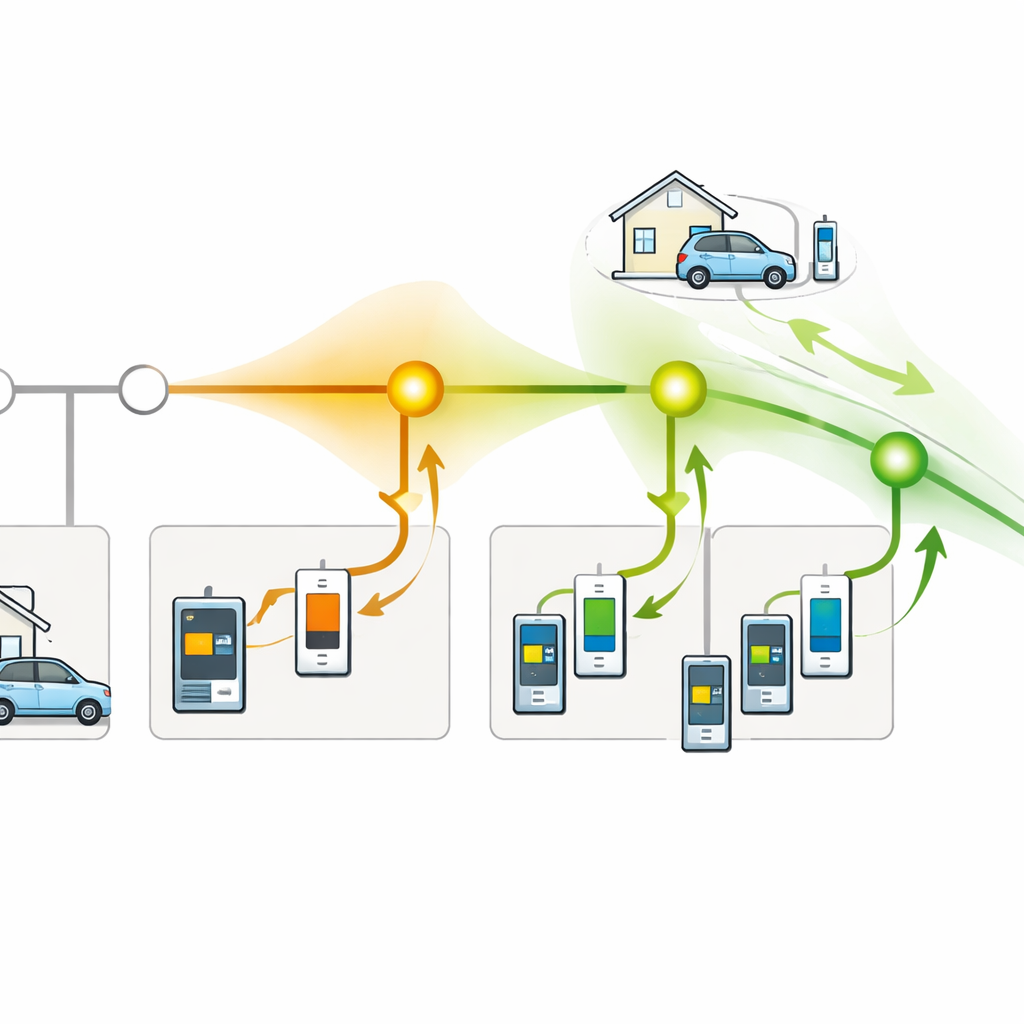
Smarter algorithms behind the scenes
Because the system must juggle several goals at once—minimizing power losses, flattening the load curve, keeping voltages within ±5% of nominal, and reducing charging costs—the authors cast the task as a multi-objective optimization problem. They test several modern “metaheuristic” search methods inspired by nature, including particle swarms and patterns of animal movement. Among them, a relatively new method called the Slime Mould Algorithm performs best, consistently finding solutions that reduce both grid stress and customer bills. The study also explores trade-offs between objectives using Pareto fronts, allowing operators to choose, for example, whether to prioritize lower losses or cheaper charging.
What the numbers show
Simulations reveal sizable benefits. Under unmanaged charging, the daily energy lost as heat in the network is about 4.04 megawatt-hours. With coordinated charging alone, this falls by roughly 19% in the day-ahead case and 16% in the real-time case. When reactive power control from EV chargers is added, losses drop even further—to 2.55 and 2.77 megawatt-hours for day-ahead and real-time strategies—cutting losses by 36.8% and 31.4%. The worst-case substation loading is brought back within its 5 MVA rating, and voltages along the most distant feeder stay above 0.95 per unit. On the customer side, total charging costs shrink by about 29% for day-ahead scheduling and 34% for real-time scheduling, mainly by shifting charging into low-tariff hours while meeting each driver’s desired state of charge.
What this means for everyday drivers
For EV owners, the proposed approach is largely invisible: you still plug in at home and specify when you need to leave and how full you want the battery. Behind the scenes, the grid operator’s software staggers charging times and quietly adjusts the way chargers interact with the grid, so that neighborhoods can host many more electric cars without costly upgrades. The study shows that coordinated EV charging and smart use of charger electronics can substantially cut energy waste, keep voltages within safe limits, and lower bills, paving the way for cleaner transport that fits smoothly into existing power systems.
Citation: Badr, M.S., Sharaf, H.M. & Zobaa, A.M. A two-stage multi-objective optimization framework for coordinated EV charging scheduling and reactive power dispatch. Sci Rep 16, 12470 (2026). https://doi.org/10.1038/s41598-026-45109-9
Keywords: electric vehicle charging, smart grid, reactive power control, distribution networks, multi-objective optimization