Clear Sky Science · en
Essential oil nanoemulsions enhance protection of stored tobacco against Lasioderma serricorne
Why kitchen spices matter for stored tobacco
Spices like cinnamon, clove, and peppermint do more than flavor food—they also produce fragrant oils that can kill insects. This study asks whether those plant oils, packaged into ultra-fine droplets called nanoemulsions, can protect stored tobacco from the tiny beetle that ruins leaves in warehouses around the world. For growers, manufacturers, and even regulators who want to cut back on harsh synthetic pesticides, the work points to a future where common plants help keep tobacco stocks safe with far smaller doses of chemicals.

The hidden pest in tobacco warehouses
The cigarette beetle, Lasioderma serricorne, is a small insect whose larvae tunnel through dried tobacco leaves, leaving holes, dust, and financial losses. Globally, infestations in storage can cost the industry up to a few percent of total production—significant when the market is worth hundreds of billions of dollars. For decades, the main line of defense has been synthetic insecticides and fumigant gases such as phosphine. These chemicals can linger in the environment, harm beneficial organisms, and, over time, drive pests to evolve resistance. Finding an effective but gentler alternative has become a priority for stored-tobacco protection.
Turning plant scents into tiny droplets
Essential oils from cinnamon bark, clove flower buds, and peppermint leaves are already known to repel or kill several grain and tobacco pests. However, in their raw form they are volatile and unstable: they evaporate quickly, break down in light and air, and do not mix well with water-based treatments. The researchers tackled this by transforming each oil into a nanoemulsion—an oil-in-water mixture where the oil is broken into extremely small, spherical droplets tens of nanometers across, stabilized by food-grade surfactants. Microscopy and light-scattering measurements confirmed that these droplets were uniform, remained separate rather than clumping together, and stayed stable across temperature swings and storage tests.
Putting nanoemulsions up against the beetle
The team then tested both the raw oils and their nanoemulsions against cigarette beetle adults and larvae in several ways. In contact tests on glass surfaces and on treated tobacco leaves, insects were exposed to thin films containing different doses. In fumigation trials, the vapors from the oils and nanoemulsions filled small sealed jars holding the beetles. Across all experiments, the nanoemulsions were dramatically more potent: to kill half of the test insects, the concentrations needed for nanoemulsions were roughly 10 to over 160 times lower than for the corresponding pure oils in contact tests, and about 17 to more than 140 times lower in fumigation tests. Clove nanoemulsion was especially strong, requiring only a few dozen parts per million to severely affect larvae, while cinnamon and peppermint nanoemulsions also performed very well.
How tiny droplets change the battle
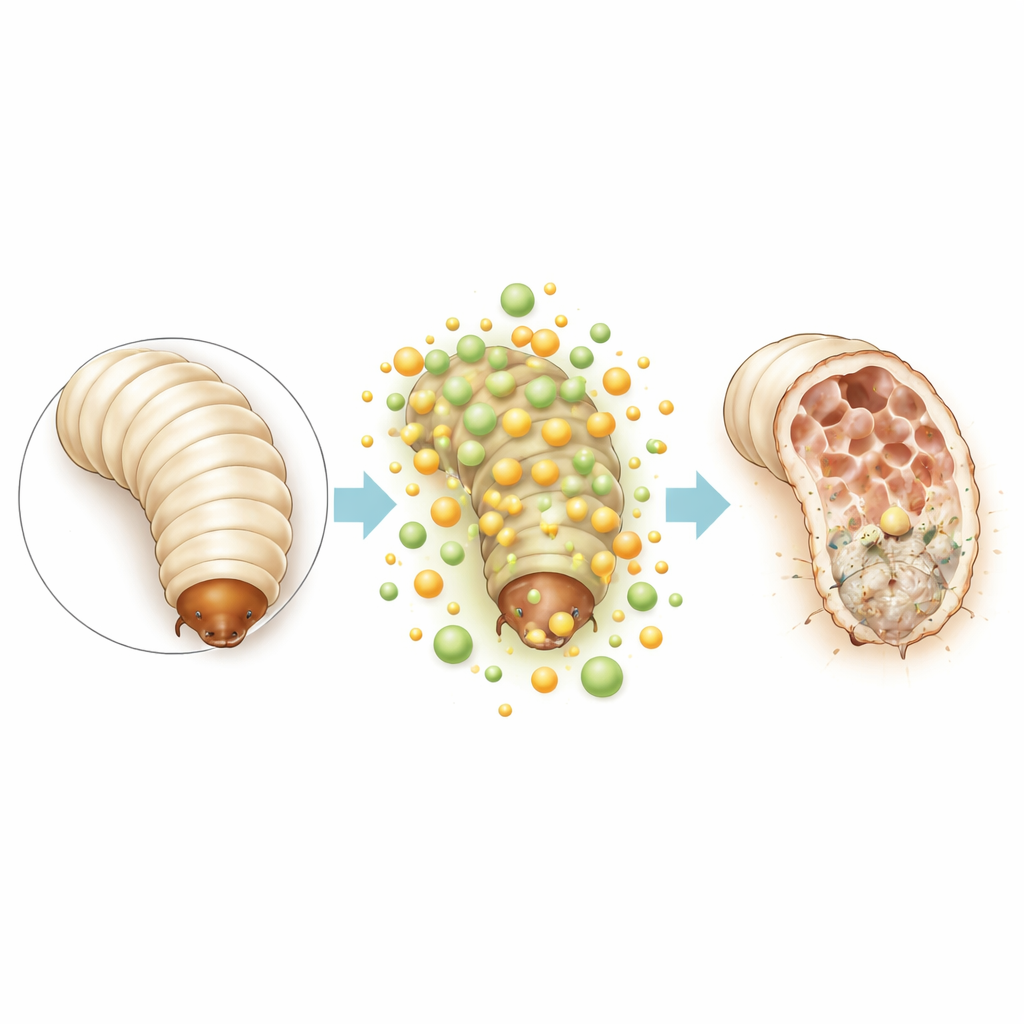
The results reveal not just that nanoemulsions work, but also why they matter. Smaller droplets present a much larger surface area to the insect, spreading more evenly over the cuticle and likely seeping through its waxy layers more efficiently than bulk oil. The nano-scale packaging also slows evaporation and keeps active ingredients available longer. In the tests on real tobacco leaves, nanoemulsions applied at only 40 parts per million produced 70–90% beetle mortality within three days—matching the performance of pure oils used at 1,000 parts per million. Statistical analyses showed that the main drivers of success were how much material was applied and how long insects were exposed, with the type of oil shaping the fine details: clove tended to excel against larvae, while adults were particularly sensitive to nanoemulsion vapors.
What this means for safer pest control
For a lay reader, the takeaway is clear: by shrinking droplets of familiar plant oils down to the nanoscale, scientists can turn everyday spices into powerful yet potentially safer tools against a major storage pest. In this study, nanoemulsions of clove, cinnamon, and peppermint oils guarded tobacco as effectively as heavy doses of the raw oils, while using 10–25 times less material. That could reduce residues, slow resistance, and offer an eco-friendlier option for warehouses that currently rely on synthetic fumigants. The work is still at the laboratory stage and does not yet account for real-world storage conditions or impacts on non-target organisms, but it strongly suggests that the future of “green” pest control will depend not only on what natural substances we use, but how cleverly we formulate and deliver them.
Citation: Massoud, M.A., Saad, A.S.A., Mesbah, H.A. et al. Essential oil nanoemulsions enhance protection of stored tobacco against Lasioderma serricorne. Sci Rep 16, 12057 (2026). https://doi.org/10.1038/s41598-026-45107-x
Keywords: essential oil nanoemulsion, stored tobacco pests, cigarette beetle control, botanical insecticide, postharvest protection