Clear Sky Science · en
Forecasting deep shale gas production using a ROA-optimized Transformer–Mamba hybrid network
Why predicting gas from rocks matters
Natural gas from shale rock has become a key part of cleaner energy plans around the world. Yet once a shale well starts flowing, its output can rise and fall in complex ways that are hard to foresee. This paper explores how modern artificial intelligence can read the subtle patterns in real field data from deep shale gas wells and deliver more reliable day‑to‑day forecasts, which can help operators plan investments, manage infrastructure, and reduce waste.
The challenge of taming unruly wells
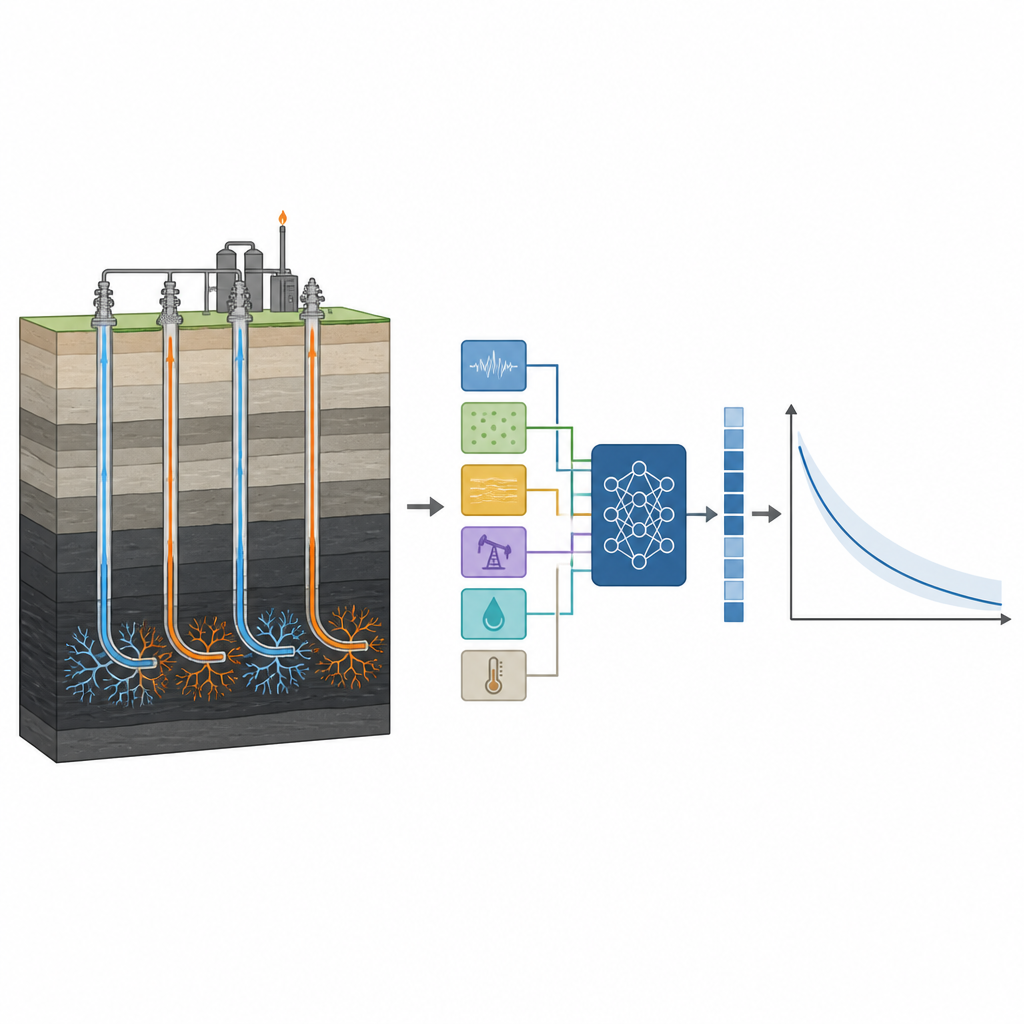
Deep shale gas reservoirs are very different from the more familiar, gentle gas fields that fueled the past century. These rocks lie at great depths, are heavily fractured during development, and often produce gas and water together. As a result, their flow rates swing up and down as pressures change, fractures clean up, and operating controls are adjusted. Traditional tools for forecasting, which rely on smooth decline curves and simple assumptions about how fluids move underground, often miss these twists and turns. That can lead to over‑ or under‑estimating how much gas a field will deliver and when.
Letting data tell the story
To capture this more complicated behavior, the authors assembled a large set of daily production records from 112 deep shale gas wells, covering about 160,000 production days. From this wealth of data they chose three key signals as inputs: the pressure measured in the well casing, the amount of water produced each day, and the fraction of injected fracturing fluid that has flowed back. Together, these quantities reflect the strength of the reservoir, how open the fractures are, and how gas and water share the same pathways. After cleaning the records and organizing them into overlapping time windows, the team framed the problem as teaching a model to predict tomorrow’s gas rate from recent trends in these three signals.
A new blend of smart algorithms
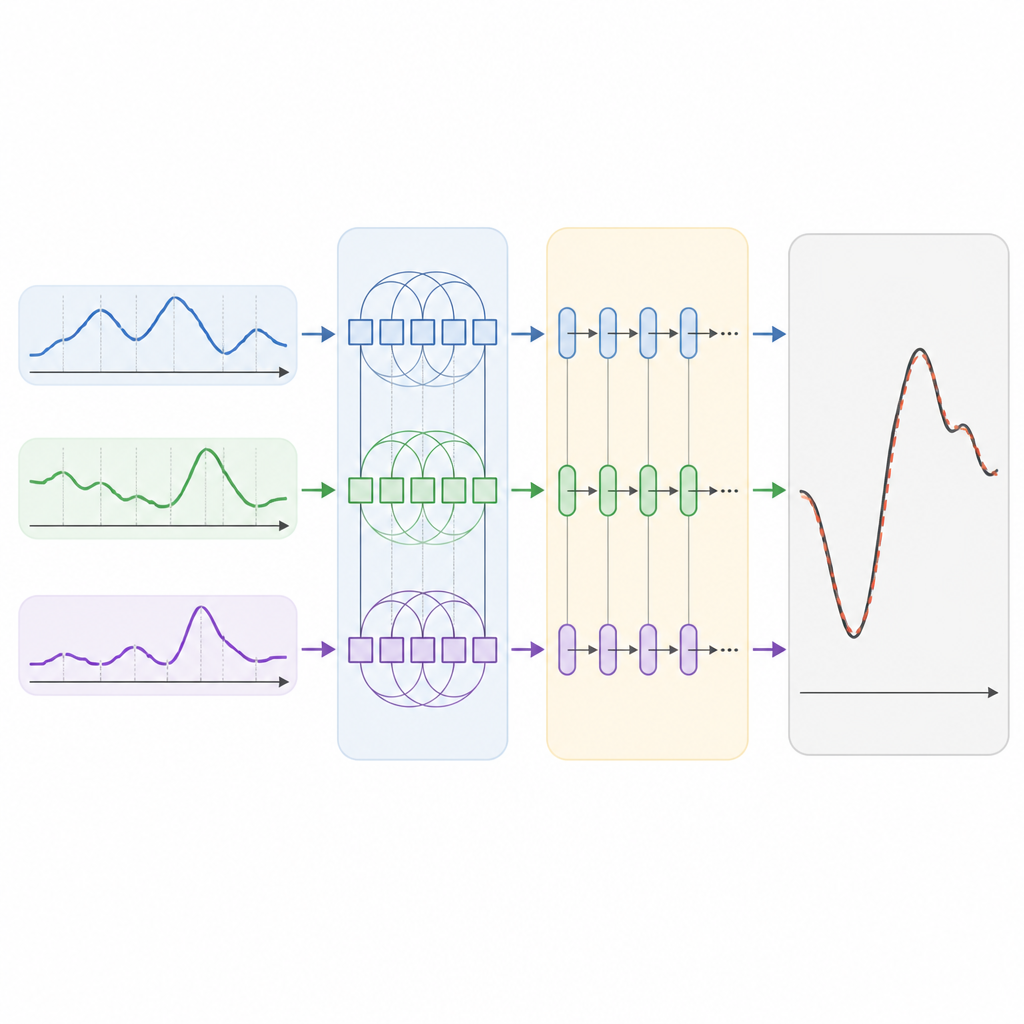
The core of the study is a hybrid neural network that combines two modern sequence‑handling ideas. One part, inspired by the Transformer models used in language translation, is good at spotting long‑range connections across many days of data. The other part, called a state‑space module in the Mamba family, is designed to carry information efficiently through long sequences without becoming bogged down. A simple convolution step at the front of the network highlights short‑term ripples, and a final layer converts the learned patterns into a single forecast of daily gas production. To avoid trial‑and‑error tweaking of settings like learning rate and layer sizes, the authors turn to a nature‑inspired search method, the Rabbit Optimization Algorithm, which systematically hunts for the combination that gives the most accurate validation results.
Putting the hybrid model to the test
The researchers compare their new framework with two alternatives: a model built only from the Mamba‑style module and another that pairs a Transformer with a more traditional recurrent unit called LSTM. All three models see the same inputs and are tuned using the same optimization strategy. Using five‑fold cross‑validation and separate test wells, the authors find that the hybrid Transformer–Mamba model consistently tracks both the overall decline and the short‑lived bumps in production more closely than its rivals. In statistical terms, it cuts average and root‑mean‑square errors by around one‑fifth to one‑third relative to the pure Mamba model, and achieves a higher coefficient of determination, meaning the forecasts line up better with actual measurements across many wells.
From black box to physical insight
Although this is a data‑driven approach, the model’s behavior echoes known physics. When well pressure falls steadily, the predicted gas rate drops faster, mirroring loss of reservoir energy. Periods with high or choppy water output lead the model to lower or delay gas forecasts, reflecting how water can clog or compete for flow paths. As the flowback ratio grows, which signals cleaner fractures, the model often predicts a slowing of the decline or a mild recovery in gas, matching field intuition. This suggests that the network is not just fitting curves but is also internalizing the underlying controls on flow from the rock.
What this means for future gas planning
In practical terms, the study shows that a carefully designed hybrid neural network, tuned automatically and fed with a few well‑chosen signals, can provide reliable short‑ to mid‑term forecasts for deep shale gas wells, even under shifting operating conditions. It offers operators a fast stand‑in for detailed physical simulations when those are unavailable or too costly, while still respecting the main physical drivers of production. The authors note that performance may weaken under extreme events such as long shut‑ins or abrupt choke changes, and suggest adding more operating indicators and uncertainty analysis in future work. Still, their results point to data‑centric forecasting as a valuable aid for managing shale gas fields more efficiently and with greater confidence.
Citation: He, W., Li, X., Wan, Y. et al. Forecasting deep shale gas production using a ROA-optimized Transformer–Mamba hybrid network. Sci Rep 16, 15954 (2026). https://doi.org/10.1038/s41598-026-45105-z
Keywords: shale gas, production forecasting, deep learning, time series, energy modeling