Clear Sky Science · en
Effects of AI-assisted review presentation formats on consumer decision-making efficiency from a cognitive load perspective
Why choosing a movie online feels so hard
Scrolling through pages of movie reviews can feel less like fun and more like homework. Many streaming and ticketing apps bombard us with long, chatty comments that are supposed to help us decide what to watch, but often just make us feel stuck. This study asks a simple question with big consequences for everyday digital life: can artificial intelligence (AI) reshape online reviews in a way that lightens our mental load and helps us choose faster and with less frustration?
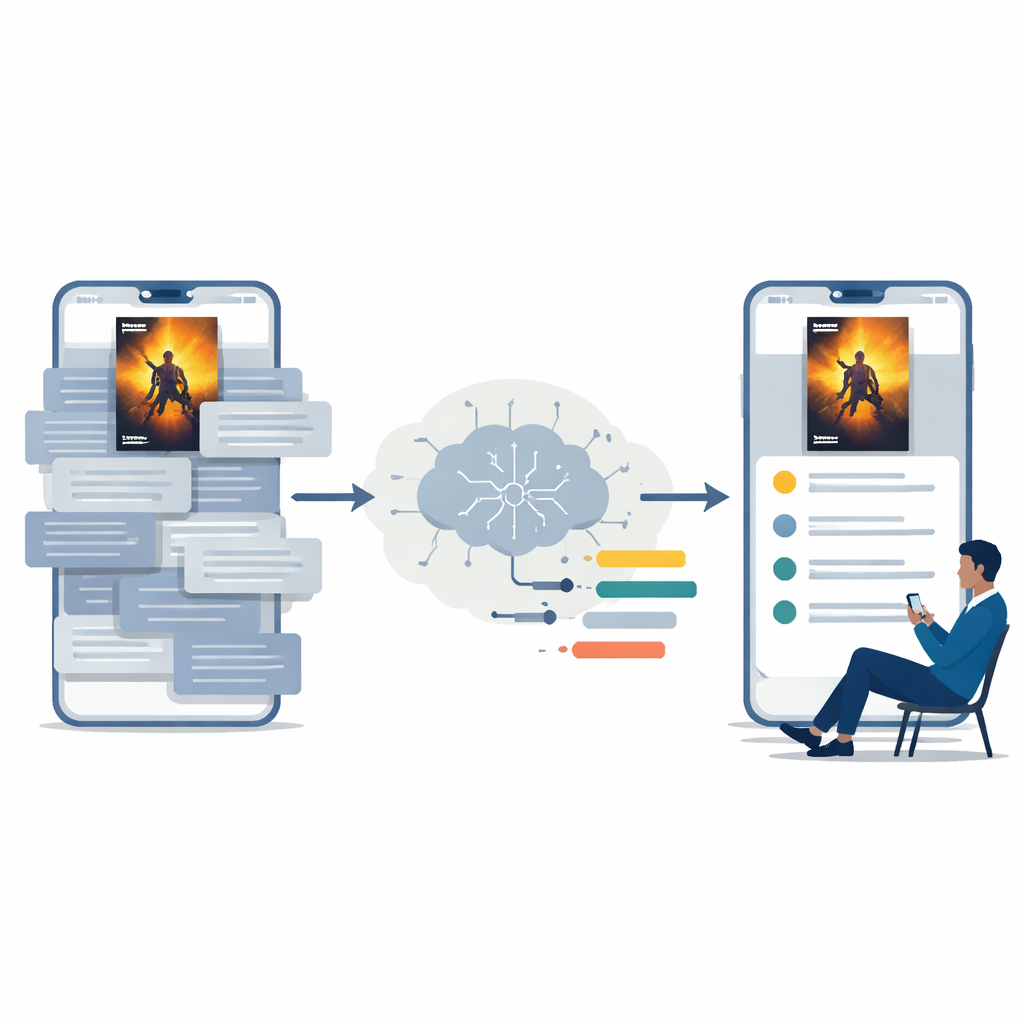
From messy opinions to clearer clues
The researchers focus on movies, a type of product whose quality you only truly know after watching. That uncertainty pushes people to rely heavily on other viewers’ comments. But the explosion of online reviews means we are often dealing with far more information than our short-term memory can comfortably handle. Drawing on ideas from cognitive load theory, the authors argue that the problem is not just how much information we see, but how it is organized on the screen. Long, unstructured paragraphs force us to sift, connect, and compare many points at once, using up mental energy and making decisions feel difficult.
Turning paragraphs into easy-to-scan points
To test a possible fix, the team used AI tools to restructure real long-form movie reviews. Instead of leaving them as dense blocks of text, they had the AI break each review into short bullet-style chunks grouped around familiar themes such as plot, characters, feelings, and production quality. Importantly, the wording stayed the same; only the layout changed. They then compared these bullet-style reviews with traditional paragraphs in a controlled experiment. Two types of films were used: one with a complex, information-heavy story (high cognitive demand) and one with a simple, straightforward plot (low cognitive demand). College students who had not seen the films were randomly shown one of four combinations: simple vs. complex movie, each with either bullet-style or paragraph-style reviews.

How mental effort shapes our choices
After reading the reviews on their phones, participants reported how mentally demanding the task felt and how hard it was to decide whether to watch the movie. The results reveal a clear pattern. For the complex film, bullet-style reviews noticeably reduced mental effort: participants’ cognitive load was about 11.8% lower than when the same information appeared in paragraphs. Lower mental effort, in turn, was strongly linked to lower decision difficulty. In other words, when the layout made it easier to pick out key points, people felt more certain and less stuck. For the simple film, however, switching to bullets did not make much difference; the task was already easy enough that extra structure provided little benefit.
Matching the screen to the task
These findings support the idea of “cognitive fit”: people think and decide more efficiently when the way information is presented matches the complexity of the task. When a movie demands more thinking – because of a twisty storyline or dense details – a structured, bullet-like layout helps viewers organize what they read and reduces unnecessary mental strain. But when the movie is simple, forcing everything into stricter structure adds no real advantage and could even disrupt the natural flow of a short, casual review. The study shows that cognitive load acts as a bridge between review layout and decision experience: presentation format changes how hard our brain has to work, and that effort level then shapes how difficult the choice feels.
What this means for everyday users
For ordinary movie fans, the takeaway is intuitive: smart design matters as much as star ratings. AI can act as a quiet assistant behind the scenes, reorganizing crowdsourced opinions into clearer, chunked information that makes tough choices feel lighter, especially for complex films that are harder to judge at a glance. The authors argue that platforms should not rely on one fixed review layout. Instead, they recommend dynamically adapting the interface: use AI-generated, structured bullet-style summaries for cognitively demanding content, and keep more relaxed paragraph reviews for simpler titles. Extending this approach to books, games, and travel services could help turn information overload into a more manageable, user-friendly experience.
Citation: Wang, Q., Wang, Y., Wei, T. et al. Effects of AI-assisted review presentation formats on consumer decision-making efficiency from a cognitive load perspective. Sci Rep 16, 14166 (2026). https://doi.org/10.1038/s41598-026-45101-3
Keywords: online movie reviews, cognitive load, AI-assisted interfaces, decision difficulty, information overload