Clear Sky Science · en
Multi-scale performance, life-cycle and economic assessment of blended concrete using recycled coarse aggregates
Building With Yesterday’s Concrete
As cities expand, they leave behind mountains of broken concrete and burn huge amounts of fuel to make new cement. This study asks a simple but powerful question: can we turn yesterday’s rubble into tomorrow’s strong, long‑lasting and cheaper buildings—without sacrificing safety? By carefully blending recycled chunks from old concrete with industrial by‑products from steelmaking, the researchers show how to cut climate impact and costs while still meeting modern construction needs.
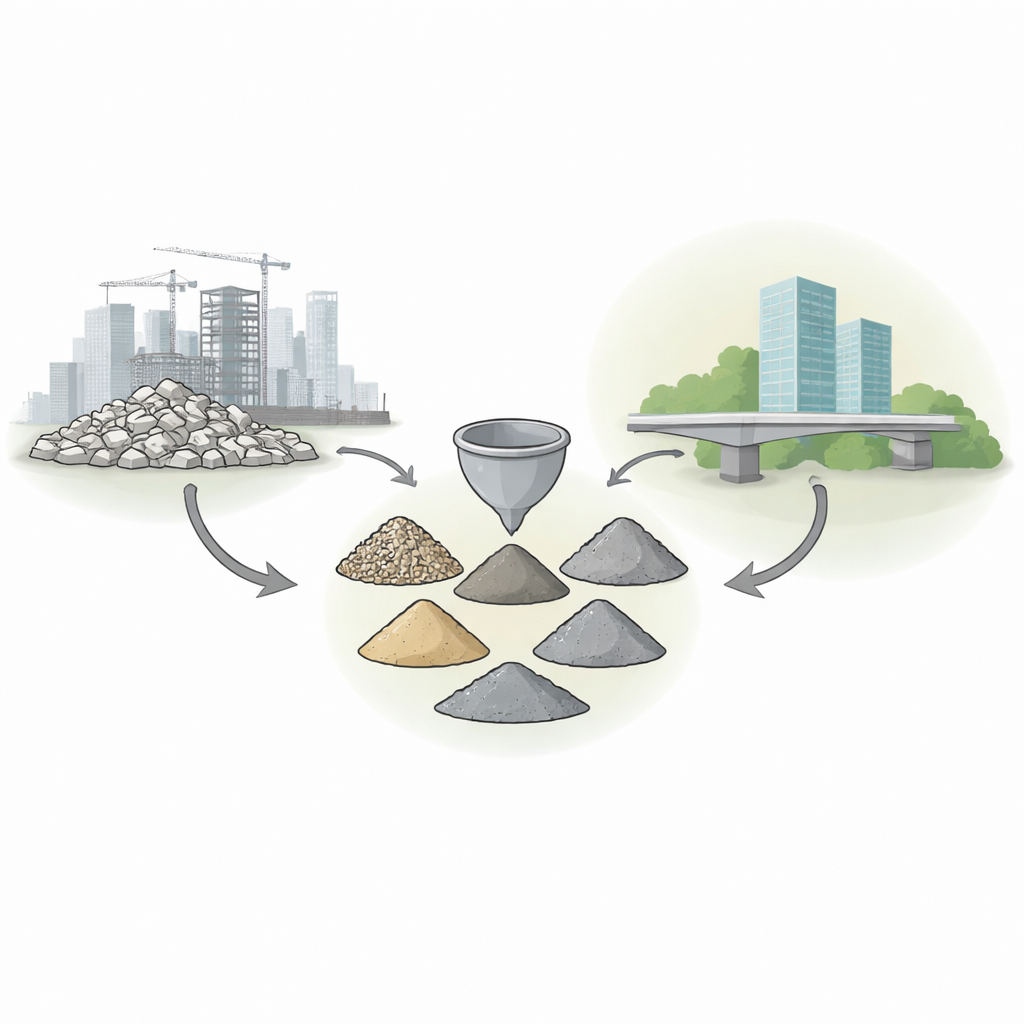
Turning Waste Into a New Resource
The team focused on two key waste streams. The first is recycled coarse aggregate, produced by crushing old concrete from demolition sites into stone‑sized pieces. The second is ground granulated blast furnace slag, a powdery material left over from making steel that can partially stand in for cement. Using standard mixing equipment, they prepared a series of concrete recipes where natural stone was replaced with different amounts of recycled aggregate (0, 12.5, 25, 50 and 65 percent), and where part of the cement was replaced with slag (20 or 25 percent) in the most promising mix.
Finding the Sweet Spot for Strength
To see how well these mixes would perform in real structures, the researchers tested how much squeezing, pulling and bending each concrete could withstand over time. Surprisingly, a small dose of recycled aggregate—just 12.5 percent—actually made the concrete slightly stronger than the all‑new version, reaching about 13 percent higher compressive strength after 28 days. But as the recycled share climbed beyond that level, strength dropped steadily, with the highest replacement (65 percent) losing nearly half its compressive strength. Microscopic images backed this up: at low recycled levels, the contact zone between old stone and new cement looked dense and well bonded, while higher levels introduced more tiny cracks and voids that acted as weak links.
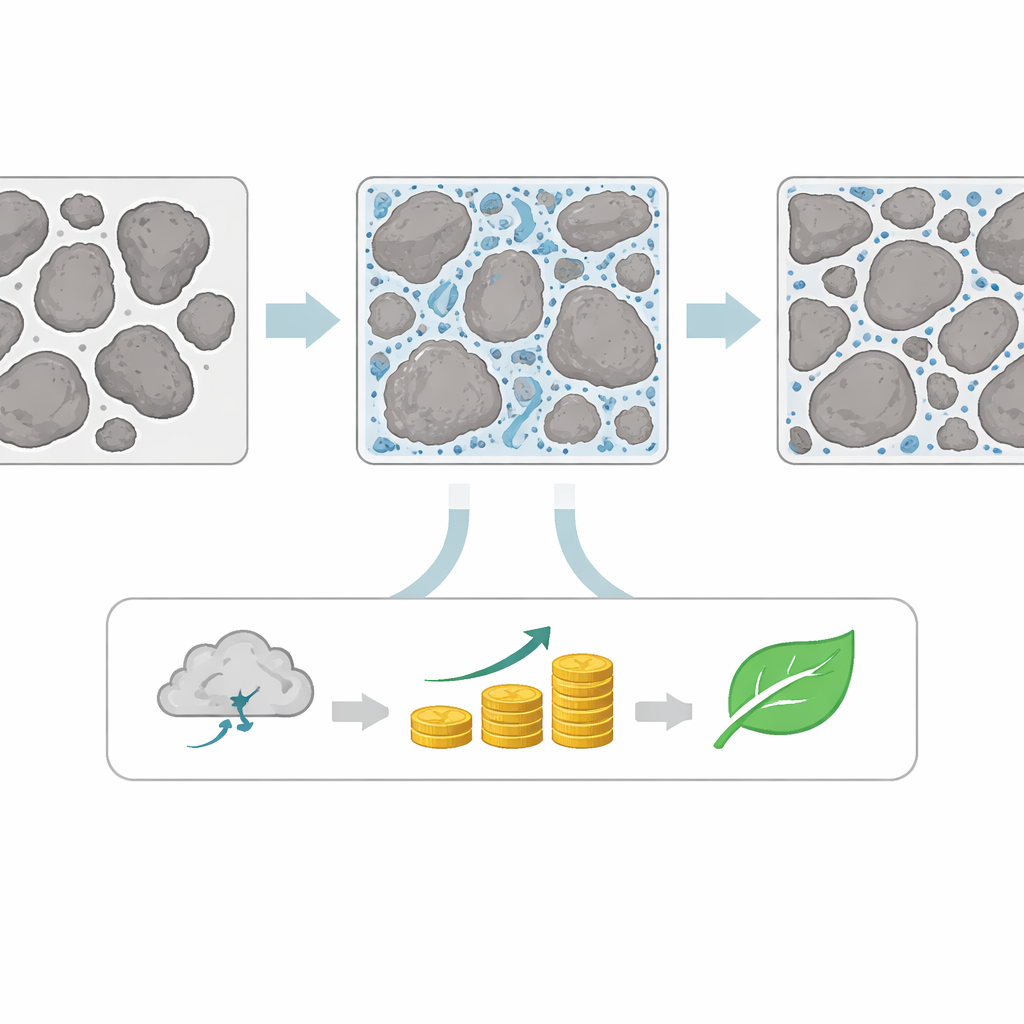
Cleaner Concrete From Cradle to Grave
Strength alone is not enough; the team also traced environmental impacts from raw materials through construction, 50 years of use and final demolition. They calculated climate‑warming emissions, resource use and several types of air and water pollution for each mix, using region‑specific data from southern India. Here again, the best performer was not the most heavily recycled option but the carefully balanced one: concrete with 12.5 percent recycled aggregate plus 25 percent slag produced 27 percent less carbon dioxide per cubic meter than the conventional mix. It also used fewer virgin stones and less energy overall. Pushing recycled content to 65 percent diverted more material from quarries, but the extra energy needed to clean and crush the old concrete ate into those gains.
Saving Money Over a Building’s Lifetime
The researchers then followed the money over five decades, adding up not just initial material and construction costs but also maintenance, repairs and end‑of‑life handling. Upfront savings from using recycled aggregate were modest because processing old concrete adds labor, energy and quality control expenses. Over time, however, the stronger, lower‑carbon mix—again, 12.5 percent recycled aggregate with 25 percent slag—stood out. It cut total life‑cycle costs by roughly 27 percent compared with standard concrete, paid back its small extra processing costs in just over two years, and delivered the highest return on investment. By contrast, the most heavily recycled mix saved little money overall because its weaker performance led to more frequent and costly repairs.
What This Means For Future Cities
For non‑specialist readers, the key takeaway is that “more recycling” is not always better. This work shows that a carefully tuned recipe using a modest share of recycled concrete and steelmaking by‑product can give builders a win on three fronts at once: strong structures, lower climate impact and long‑term cost savings. Rather than chasing the highest possible recycled content, engineers may need to look for such sweet spots—levels where performance, the environment and economics all align—to design the next generation of truly sustainable concrete.
Citation: Chaitanya, B.K., Madhavi, Y., Venkatesh, C. et al. Multi-scale performance, life-cycle and economic assessment of blended concrete using recycled coarse aggregates. Sci Rep 16, 13391 (2026). https://doi.org/10.1038/s41598-026-45095-y
Keywords: recycled concrete, sustainable construction, low-carbon materials, life cycle assessment, economic analysis