Clear Sky Science · en
Benthic foraminiferal colonisation of phytodetritus during spring bloom within the marginal sea ice zone off Northern Svalbard continental margin
Life Beneath the Arctic Bloom
Each spring, as sunlight returns to the high Arctic, vast blooms of microscopic algae erupt beneath and around the sea ice. When these blooms fade, their remains sink to the deep, forming a thin, short‑lived carpet of organic debris on the seafloor. This study explores how tiny seafloor organisms called foraminifera respond to that sudden pulse of food, revealing how invisible life in the mud helps drive the ocean’s natural carbon storage system in a rapidly changing Arctic.
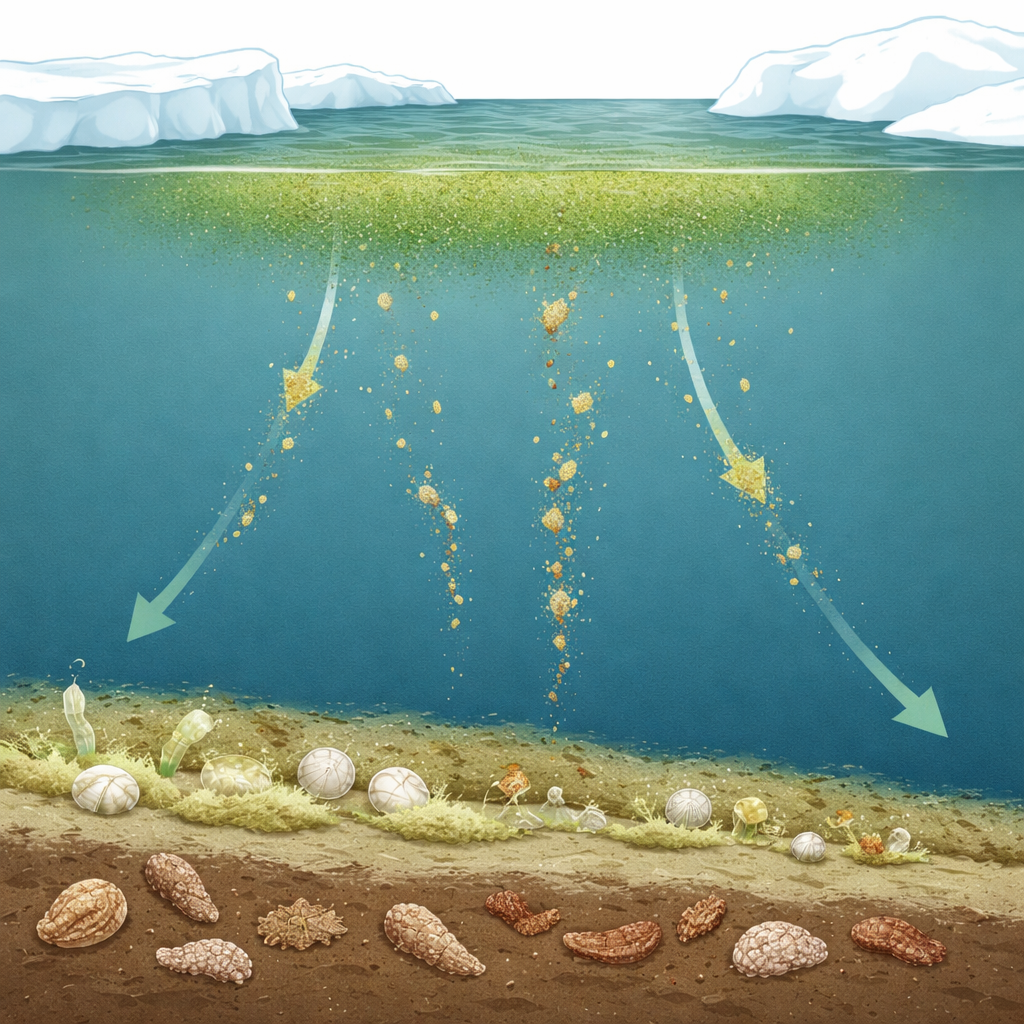
A Snowfall of Food to the Deep
The authors focus on phytodetritus—flecks and clumps of dead phytoplankton and other organic particles that drift down like marine snow. This material is a key part of the “biological carbon pump,” the process that transfers carbon from surface waters to the deep ocean where it can be stored for long periods. Around northern Svalbard, warmer Atlantic water is pushing farther into the Arctic, reshaping sea‑ice cover and triggering earlier and longer algal blooms. As sea ice retreats and under‑ice blooms intensify, more phytodetritus can rain down to the seafloor, but scientists still know little about how seafloor communities respond in this remote and ice‑covered region.
Tiny Shell Builders on the Ocean Floor
Benthic foraminifera are single‑celled protists that build tiny shells, or tests, from calcium carbonate or glued‑together sediment grains. Though microscopic, they occur in huge numbers and act as major consumers of fresh organic matter on the seafloor. Their shells preserve in sediments, making them important recorders of past ocean conditions. In this work, researchers examined living foraminifera both within the freshly fallen phytodetritus layer and in the underlying surface sediment at three Arctic sites: a highly productive slope of the Barents Sea, the moderately productive Yermak Plateau, and the Sophia Basin, where blooms of the colony‑forming alga Phaeocystis were prominent.
Sampling Springtime Life Under the Ice
During a late‑spring expedition in 2015, an icebreaking research vessel used video‑equipped coring devices to collect undisturbed slices of the seafloor from depths between about 200 and 2,200 meters. Cameras documented fluffy green and ball‑like accumulations of phytodetritus on the seabed, often ballasted by gypsum crystals released from melting sea ice. Scientists gently pipetted off precise volumes of the phytodetritus and also collected the top centimeter of sediment beneath it. They stained the organisms to distinguish living individuals, sieved the samples, and identified and counted hundreds of foraminifera per sample, calculating how many individuals occurred per unit volume and what fraction each species contributed to the local community.
Different Neighborhoods in a Thin Green Carpet
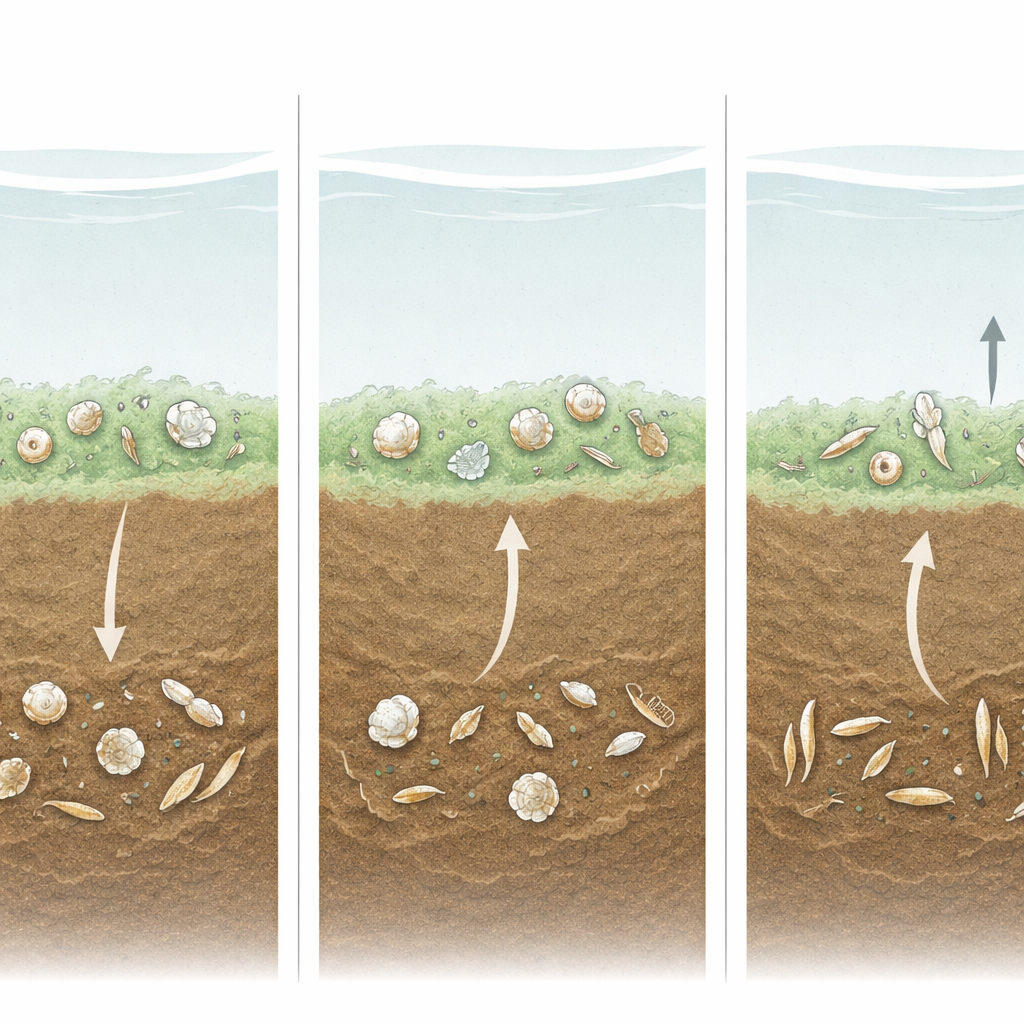
The analyses showed that the phytodetritus layer hosted far denser foraminiferal populations—on average nearly 20 times more individuals per unit volume than the underlying sediment. Yet the community composition differed strikingly between layers and among sites. On the productive Barents Sea slope, several opportunistic species crowded into the freshly deposited phytodetritus, while another species dominated deeper in the sediment. On the Yermak Plateau, some species were abundant in both layers, but one poorly known form strongly favored the phytodetritus. In the Sophia Basin, species linked to under‑ice Phaeocystis blooms and fresh food pulses thrived in the fluffy surface layer, while deep‑water and sediment‑dwelling species were more common below. These patterns reflected local differences in water temperature, salinity, ice cover, bloom stage, and the type and freshness of organic matter delivered from above.
What These Tiny Creatures Tell Us
By documenting which foraminifera move into or remain within the phytodetritus layer, the study shows that many species are more flexible and mobile than previously thought, able to track brief surges of food at the seafloor. The authors conclude that food availability from spring blooms is the main driver of how these communities are structured, with depth and water properties playing secondary roles. Because foraminifera help process and bury carbon, and their shells preserve a detailed record in sediments, understanding their behavior in relation to shifting blooms and sea ice is crucial. These findings provide a new, high‑resolution window into how the Arctic seafloor’s living filters may respond as climate change continues to transform the timing and nature of life at the ocean surface.
Citation: Faizieva, K., Wollenburg, J.E., Nagy, M. et al. Benthic foraminiferal colonisation of phytodetritus during spring bloom within the marginal sea ice zone off Northern Svalbard continental margin. Sci Rep 16, 10889 (2026). https://doi.org/10.1038/s41598-026-45090-3
Keywords: Arctic seafloor, phytoplankton blooms, carbon pump, foraminifera, sea ice change