Clear Sky Science · en
Designing a novel multiepitope vaccine candidate against Treponema pallidum via adhesins using reverse vaccinology
Why a new vaccine idea matters for an old disease
Syphilis is an age-old sexually transmitted infection that is once again on the rise worldwide. While antibiotics like penicillin can cure an infection, they cannot stop people from getting infected again. There is still no vaccine to prevent syphilis, partly because the germ that causes it, Treponema pallidum, is hard to grow in the lab and hides cleverly from the immune system. This study uses computer-guided design to build and test, in silico and in bacteria, a new kind of experimental vaccine that targets several weak spots on the microbe at once.

Picking the germ’s grip points as targets
T. pallidum infects people by latching onto human tissues and slipping past natural defenses. It does this using surface molecules called adhesins that act like tiny hooks, helping the bacteria cling to host cells, move through tissues, and dodge immune attack. The researchers reasoned that these exposed hooks are attractive vaccine targets, because antibodies might block them and keep the germ from settling in. From the genome of a well-studied strain, they selected seven adhesin proteins that are present on the surface, show favorable chemical traits, and are not similar to human or mouse proteins, reducing the risk of cross-reaction.
Building a many-piece vaccine by computer
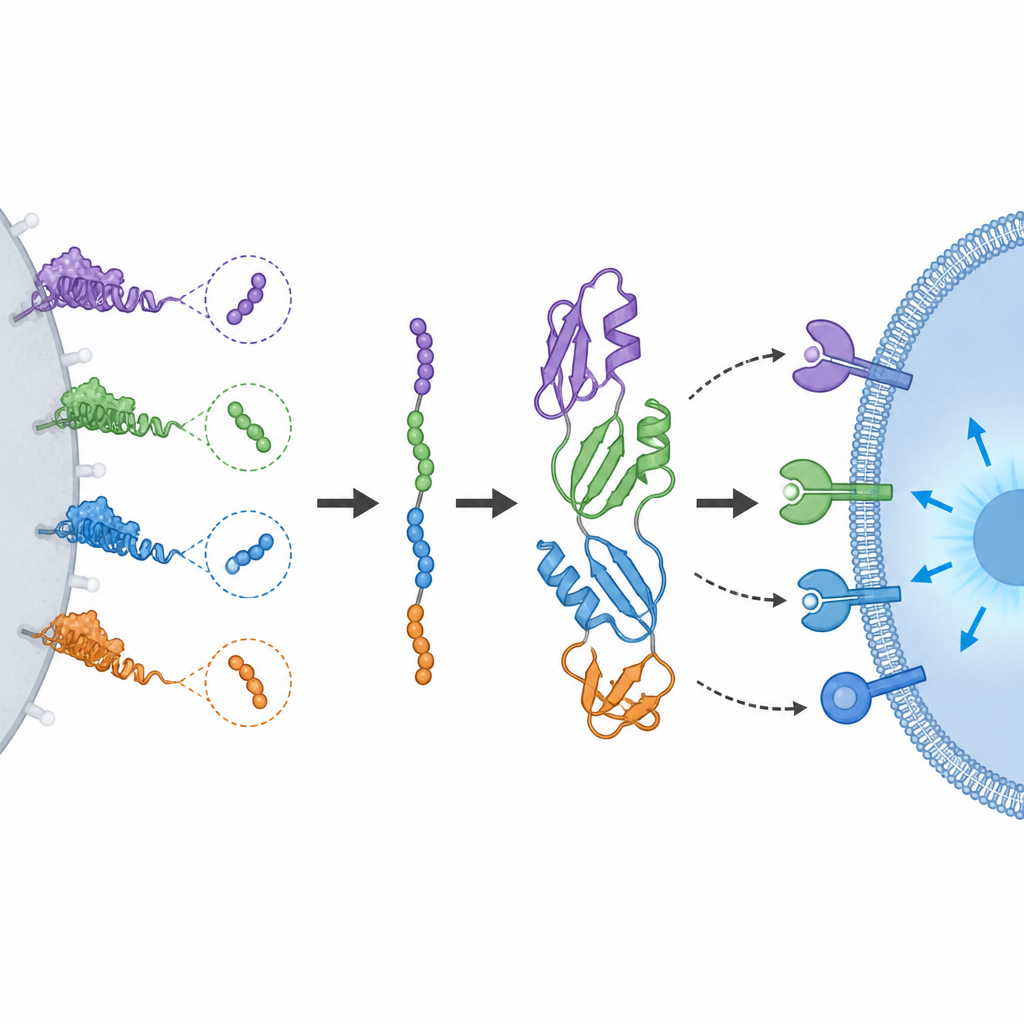
Rather than using whole proteins, the team focused on short stretches called epitopes, which are the specific bits that immune cells recognize. Using several online prediction tools, they scanned the adhesins for regions likely to be seen by B cells, which make antibodies, and by two kinds of T cells that help coordinate and carry out attacks. They chose fifteen T-cell epitopes and seven B-cell epitopes that were predicted to be strongly antigenic, non-toxic, and non-allergenic, and that covered many genetic backgrounds in the global population. These pieces were then strung together with short linker segments and paired with a built-in immune booster peptide to create a single multi-epitope vaccine protein, named MEVTP.
Testing structure and behavior in the virtual world
Next, the authors asked whether this designed protein would fold into a stable shape and interact well with key immune sensors. Using tools such as AlphaFold and refinement servers, they predicted the three-dimensional structure of the vaccine and checked that most of its building blocks sat in energetically favorable positions. They then simulated how MEVTP would bind to two innate immune receptors, TLR2 and TLR4, which help kick off inflammatory responses when microbes are detected. Computer docking and long molecular dynamics simulations suggested that the vaccine can form tight, stable complexes with these receptors, especially TLR4, maintaining many contact points and a compact overall structure.
From digital design to lab-made protein
To move beyond pure theory, the researchers adapted the gene sequence of MEVTP for efficient production in common laboratory bacteria. They inserted the optimized gene into an expression plasmid, introduced it into Escherichia coli, and induced the cells to make the fusion protein. The resulting product, carrying a small purification tag, was isolated using nickel affinity columns and confirmed by gel analysis and western blotting at roughly the expected size. In parallel, the team designed an mRNA version of the vaccine using elements known to improve stability and translation, and checked that the predicted RNA structure had low overall energy, another sign of robustness.
Simulated immune responses and what comes next
Finally, the group used an immune system simulator to explore how the body might respond to repeated doses of the vaccine. The virtual model predicted strong waves of antibodies, including different IgG subclasses, together with a rise in cytokines such as interferon-gamma and interleukin-2 that signal vigorous T-cell activity. Numbers of helper and killer T cells, B cells, and other defensive cells increased and formed memory populations, suggesting the potential for long-lasting protection in this simulated setting. Taken together, the work proposes a carefully engineered multi-epitope adhesin vaccine that appears stable, non-allergenic, and immunogenic in silico, and that can be produced as a purified protein. However, its true ability to prevent syphilis will only be known after thorough testing in animals and, eventually, in people.
Citation: Tang, H., Chen, Z., Yan, H. et al. Designing a novel multiepitope vaccine candidate against Treponema pallidum via adhesins using reverse vaccinology. Sci Rep 16, 15305 (2026). https://doi.org/10.1038/s41598-026-45084-1
Keywords: syphilis vaccine, Treponema pallidum, multi-epitope, reverse vaccinology, adhesin proteins