Clear Sky Science · en
Nitrogen-doped carbon dot-based dual-emission ratiometric probe for smartphone-assisted ultrasensitive detection of moxifloxacin
Why tracking a common antibiotic matters
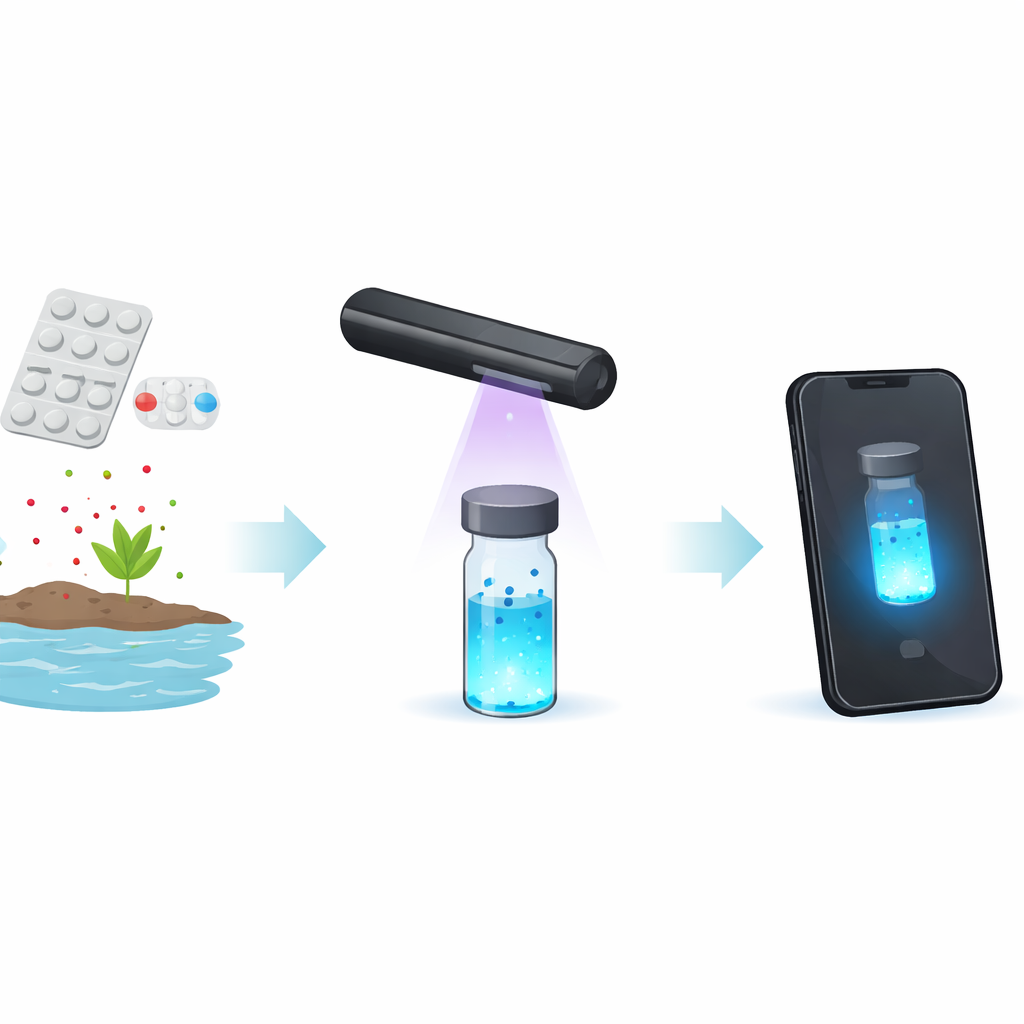
Moxifloxacin is a powerful antibiotic used to treat serious infections in both humans and animals. But when it is overused or improperly discarded, it can leak into rivers, soil, and food, helping fuel the global crisis of antibiotic-resistant bacteria. Monitoring tiny traces of this drug outside the clinic is therefore crucial, yet most current testing methods are expensive, slow, and tied to well-equipped laboratories. This study introduces a simple, portable way to spot moxifloxacin using glowing nanomaterials and an ordinary smartphone, making high-quality testing far more accessible.
Tiny glowing dots with a big job
At the heart of the new method are “carbon dots” — nanometer-sized specks of carbon that naturally emit light when excited by ultraviolet illumination. The researchers made their carbon dots from two common organic chemicals, one rich in carbon and the other rich in nitrogen, using a straightforward high-temperature water treatment. Detailed tests confirmed that the resulting particles were roughly 5 nanometers across (about 20,000 times smaller than a grain of sand), well-dispersed in water, and decorated with many chemical groups that keep them stable and bright. By carefully introducing nitrogen into the dot structure, the team boosted their light output and made their behavior especially suitable for sensing.
Turning color shifts into a measuring tool
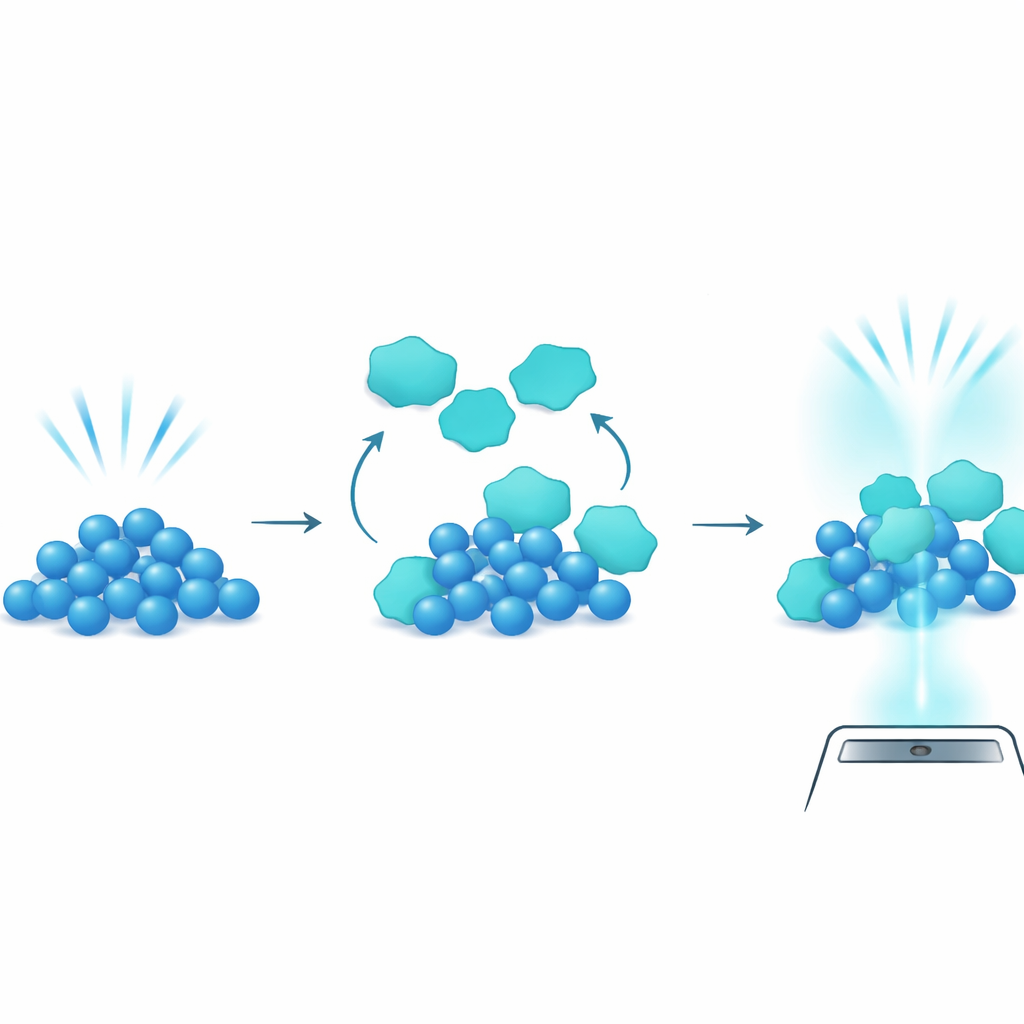
The key idea of the sensor is to compare two colors of light at once rather than relying on a single glow. On their own, the carbon dots shine blue when illuminated, providing a steady, built-in reference signal. Moxifloxacin, in contrast, naturally glows a cyan color under the same conditions. When the drug is mixed with the carbon dots and exposed to ultraviolet light, the blue emission from the dots remains almost constant, while the cyan emission from moxifloxacin grows in intensity as more drug is present. By taking the ratio of cyan to blue light, the method largely cancels out common sources of error such as changes in lamp brightness, probe concentration, or small temperature shifts, delivering a more reliable measure of how much antibiotic is in the sample.
From laboratory instruments to smartphone readout
Using a standard laboratory fluorometer, the team showed that this dual-color approach could detect extremely low levels of moxifloxacin in water, down to tens of billionths of a mole per liter, across a useful working range. They then translated the same principle into a field-ready setup: solutions were placed in clear vials inside a simple dark box, illuminated with a handheld ultraviolet source, and photographed with a smartphone camera. A freely available color-analysis app extracted the blue portion of each image, which changed predictably with the drug concentration. While this phone-based version is less sensitive than the laboratory instrument, it remains more than adequate for checking pharmaceutical products and offers clear advantages in speed, cost, and portability.
Testing real pills and avoiding false alarms
To prove that the approach works outside ideal conditions, the researchers tested commercial moxifloxacin tablets from different manufacturers. After dissolving and diluting the tablets, they used their fluorescent probe to determine how much active drug was actually present. The measured values closely matched the expected ones, with recovery rates mostly between 93% and 112%, indicating good accuracy and robustness. The team also challenged the sensor with a panel of other common antibiotics and drugs. None of these produced the same strong change in the color ratio, demonstrating that the probe responds selectively to moxifloxacin rather than lighting up for any medicine in the mixture.
Greener chemistry for real-world monitoring
Beyond performance, the authors evaluated how environmentally friendly their method is. Their process uses water-based solutions, avoids highly toxic reagents, consumes modest energy, and generates little waste. Using two established “green analytics” evaluation tools, the method earned high scores that compare favorably with many existing techniques, which often rely on large volumes of organic solvents and complex equipment. In practical terms, this means the same sensor that helps track an antibiotic linked to resistance can itself be produced and used with a lighter environmental footprint.
What this work means going forward
By combining bright, nitrogen-doped carbon dots with the natural glow of moxifloxacin and the ubiquitous smartphone camera, this study delivers a sensitive, selective, and eco-conscious way to track a widely used antibiotic. In everyday terms, it offers a simple color-change test — readable by eye or phone — that can verify the quality of drug tablets, support routine checks in pharmacies, and eventually help monitor contamination in water or food. The approach also serves as a blueprint for building similar portable tests for other medicines, supporting better antibiotic stewardship and more responsive public-health surveillance.
Citation: Mohammed, S.J., Alshatteri, A.H. & Abubakr, S.A. Nitrogen-doped carbon dot-based dual-emission ratiometric probe for smartphone-assisted ultrasensitive detection of moxifloxacin. Sci Rep 16, 14354 (2026). https://doi.org/10.1038/s41598-026-45081-4
Keywords: moxifloxacin sensing, carbon dots, ratiometric fluorescence, smartphone diagnostics, green analytical chemistry