Clear Sky Science · en
Ostrich egg shell as an accurate retrospective dosimeter using electron paramagnetic resonance technique
Eggshells as Silent Radiation Diaries
Imagine if a simple fragment of eggshell could quietly record how much radiation it has seen, long after the event took place. This study shows that the thick shells of ostrich eggs can do exactly that. By reading tiny changes in the shell with a sensitive magnetic technique, scientists can reconstruct past radiation exposure, even when no regular monitoring devices were present. Such a natural, durable "radiation diary" could help in accident investigations, medical follow-up, and environmental monitoring.
Why Reading Past Radiation Matters
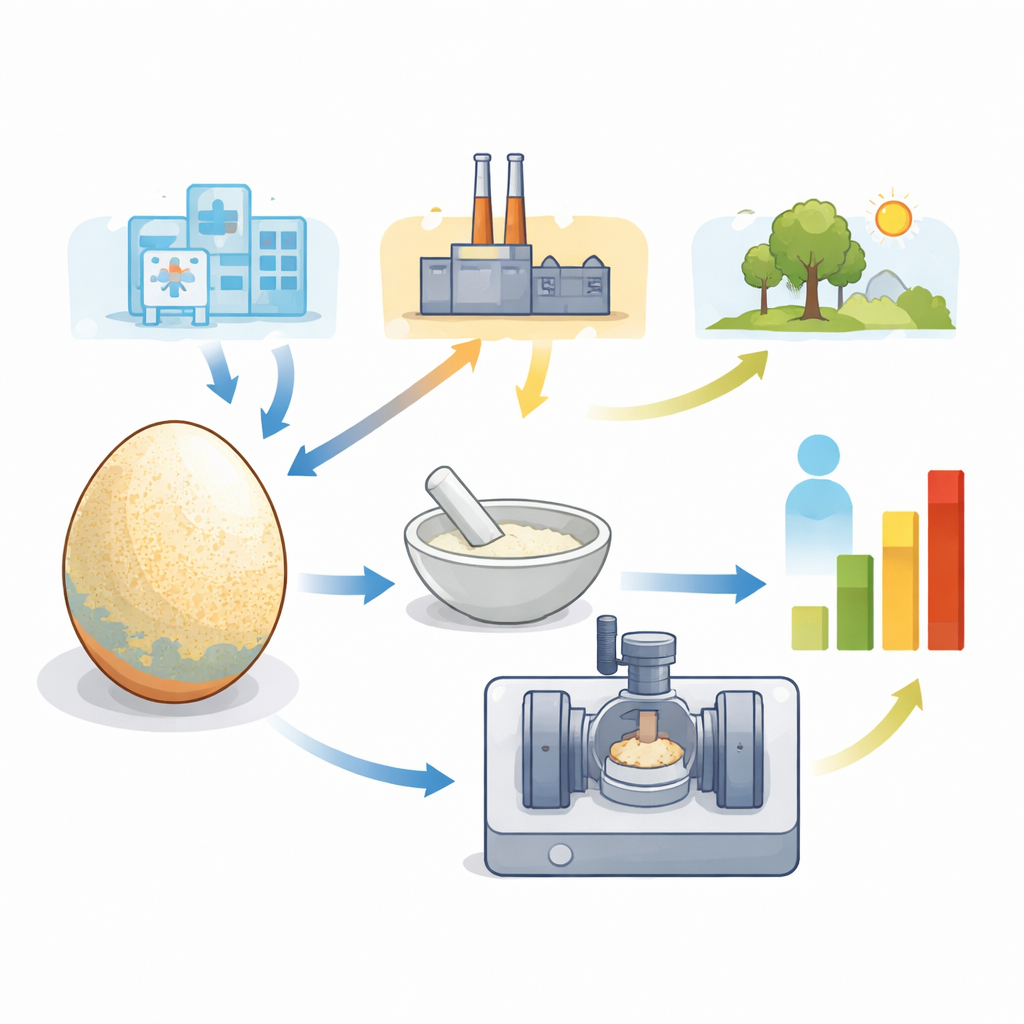
Radiation is used widely in medicine, industry, and research, and accidents or unexpected exposures, though rare, can have serious consequences. Often, when something goes wrong, there is no personal dosimeter on every person, or existing devices may be damaged. Retrospective dosimetry aims to solve this problem by using materials that were present at the time—such as teeth, glass, or building materials—to estimate the dose after the fact. Bird eggshells are attractive candidates: they are common, stable, easy to handle, and their mineral content is known to react in predictable ways when exposed to radiation.
Ostrich Eggshells Under the Microscope
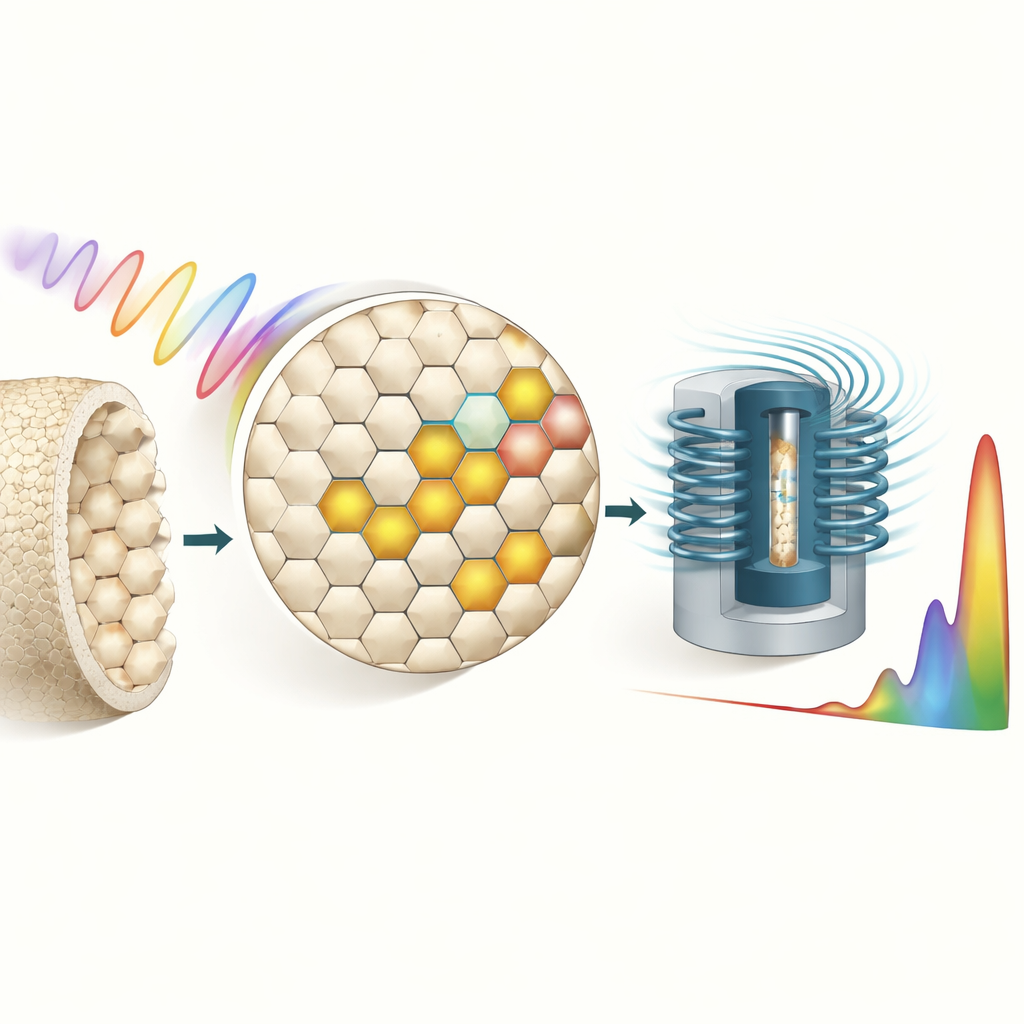
Ostrich eggshells are particularly interesting because they are unusually thick and mechanically robust, built mostly from calcium carbonate arranged in a well-ordered crystalline structure. The researchers crushed commercial ostrich eggshells into powders of controlled grain size and exposed them to known amounts of gamma radiation from different sources. They then used electron paramagnetic resonance (EPR), a technique that detects unpaired electrons, to measure radiation-induced changes in the mineral. Irradiated shells produced a set of clear signals tied to carbonate radicals—tiny charged fragments created when radiation knocks electrons loose and traps them in the crystal. These signals were strong, repeatable, and directly related to how much radiation the sample had absorbed.
How Well the Eggshells Store the Signal
A good retrospective dosimeter must not only respond sensitively to radiation, it also needs to "remember" that dose reliably. The team tracked the shells’ signals for six months after exposure. They observed a modest initial drop, about 15–18 percent in the first week, as less stable radicals faded. After roughly seven days, however, the remaining signal became very stable. Most of the long-lived response came from highly durable carbonate radicals known from other natural minerals. Because one part of the combined signal changed in a smooth, predictable way over time, the researchers could also use the ratio between two key peaks as a rough clock: by comparing those peak heights, they could estimate how long ago the irradiation occurred within the studied period.
Following the Dose from Very Low to Very High
The ostrich eggshells responded linearly to radiation over an impressively wide range, from about 0.3 gray up to 1,000 gray, before gradually leveling off at ultra-high doses up to 50,000 gray. Importantly for real-world use, the smallest reliably detectable dose was around 0.21 gray, substantially better than values reported for chicken eggshells. Across the low and intermediate ranges that matter most in medicine and accidents, the relationship between dose and signal stayed almost perfectly straight, simplifying calibration. The response also behaved predictably for different types of gamma sources: shells irradiated with cesium-137 and cobalt-60 showed nearly identical efficiency at energies above 100 keV, confirming that the material does not introduce large energy-dependent errors in this regime.
Sunlight and Other Practical Concerns
Because real objects are often exposed to sunlight, the team tested whether ultraviolet (UV) light could spoil the radiation record. They subjected both unirradiated and irradiated shells to strong UVA and UVC lamps for two hours and then re-measured their EPR signals. Under these conditions, neither UVA nor UVC erased or distorted the gamma-induced signal in any meaningful way. UVC alone produced a faint extra response in unirradiated shells, but it was tiny compared with the signal produced by a moderate gamma dose and would only matter at extremely low radiation levels. Taken together with the fading and dose-response tests, these results suggest that ostrich eggshell is robust under ordinary storage and environmental illumination.
A Natural Tool for Reconstructing Radiation Events
In plain terms, this work shows that ostrich eggshell behaves like a sensitive, stable, and repeatable natural dosimeter. Its signal grows in a predictable way with dose, survives for months with only a small early loss, is largely unaffected by common UV light, and works similarly for the main gamma energies used in medical and industrial practice. The ability to use both the signal strength and its time-dependent changes means that, in principle, a piece of ostrich eggshell could tell investigators not only how much radiation it received, but also roughly when. This combination of simplicity, availability, and performance makes ostrich eggshell a promising material for reconstructing radiation exposure and for broader radiation monitoring applications.
Citation: Aboelezz, E., Sharaf, M.A. Ostrich egg shell as an accurate retrospective dosimeter using electron paramagnetic resonance technique. Sci Rep 16, 12148 (2026). https://doi.org/10.1038/s41598-026-45071-6
Keywords: radiation dosimetry, ostrich eggshell, electron paramagnetic resonance, retrospective dose assessment, gamma radiation