Clear Sky Science · en
Quantum free-electron laser oscillator
Sharper X‑ray light from free electrons
Modern X‑ray lasers let us watch molecules move and probe materials at the atomic scale, but today’s machines fire pulses whose brightness jitters from shot to shot. This paper explores a new way to build an X‑ray laser that tames those fluctuations by using quantum mechanics itself. The proposed "quantum free‑electron laser oscillator" is designed not only to shine brighter, but also to shine more steadily, opening the door to clearer images and more sensitive precision measurements.
From classical machines to quantum jumps
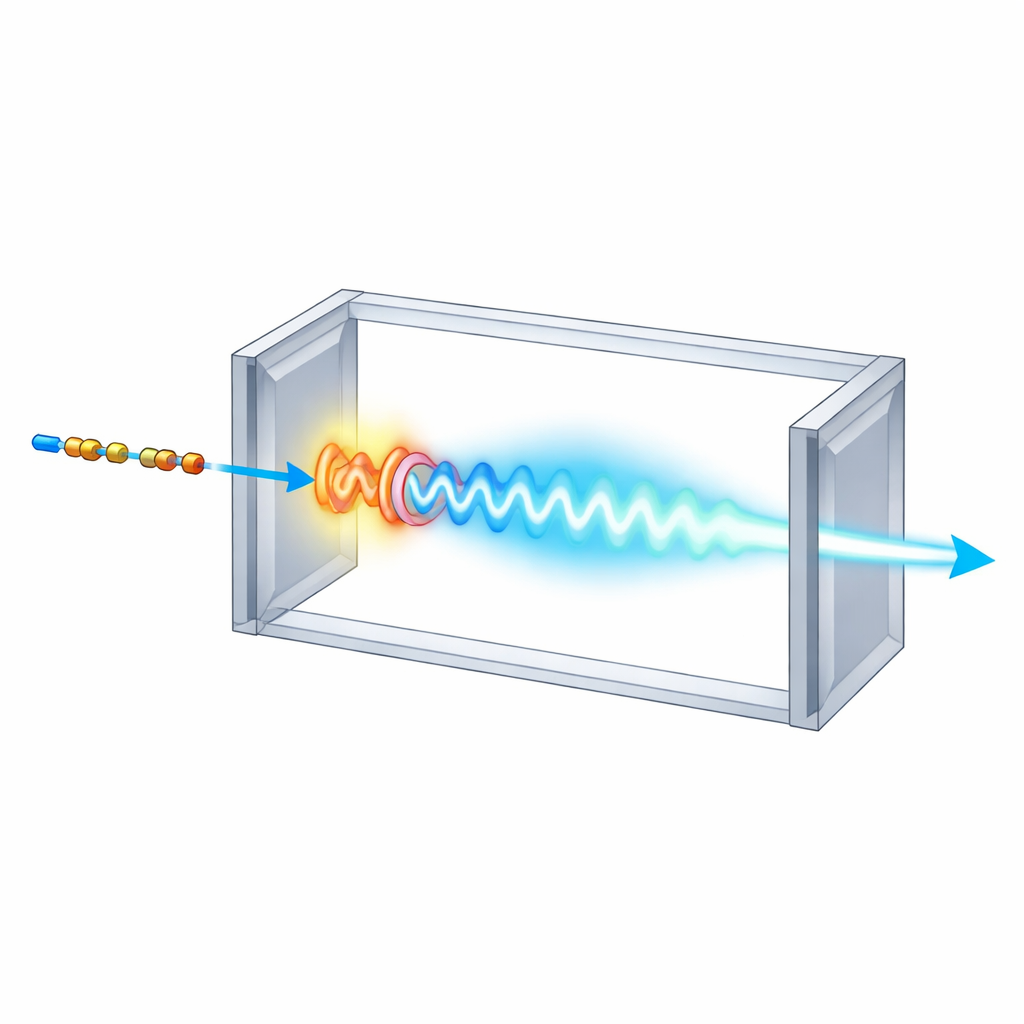
Conventional free‑electron lasers (FELs) use bunches of fast electrons that wiggle through a magnetic structure called an undulator, shedding light along the way. In these devices, each electron can emit or absorb many light quanta, so its motion looks almost continuous and the laser behaves in a largely classical way. In the quantum regime studied here, the situation is very different: the recoil from emitting a single photon is so strong that an electron is essentially restricted to two distinct momenta, before and after emission. Instead of sliding smoothly, the electron performs sharp quantum jumps between these two states, each jump adding or removing exactly one photon from the light field.
Recycling light in a resonant cavity
Previous proposals for quantum FELs focused on a single long pass of electrons through an undulator, which demands impractically long interaction regions. The authors instead suggest an oscillator layout, where many short electron bunches repeatedly feed energy into a light field trapped between highly reflective X‑ray mirrors. As each new bunch traverses the short undulator, it undergoes Rabi‑like oscillations between its two momentum states, exchanging single photons with the stored light. The cavity both amplifies and damps the radiation, so the system naturally settles into a steady state in which photon gain from the electrons is balanced by the small leakage of light through the mirrors.
Quieter photons: narrowing the randomness
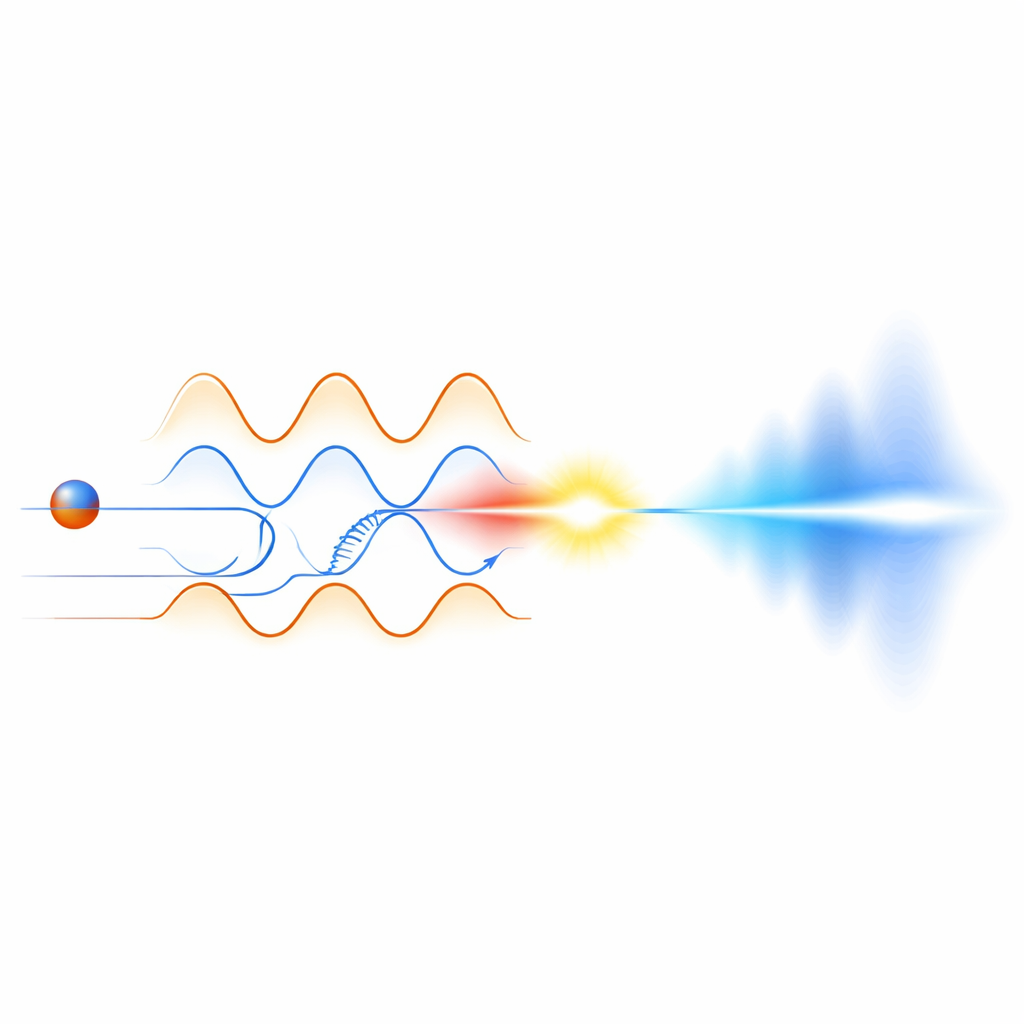
Using tools from laser and micromaser theory, the authors calculate the full distribution of photon numbers in this steady state. They compare the proposed quantum oscillator with a classical FEL operating under similar conditions. In the quantum case, the strong recoil and tight momentum selection mean that only electrons very close to resonance contribute efficiently, and each interaction step is sharply defined. This leads to a photon distribution that is significantly narrower than in a classical FEL, where many momentum states contribute and multiphoton effects smear out the dynamics. Depending on how strongly the beam is pumped, the quantum device can produce light whose fluctuations are not only smaller than those of a classical FEL but even smaller than those of an ideal "shot‑noise" beam, a hallmark of sub‑Poissonian, genuinely quantum light.
Engineering an extreme light source
Turning this concept into a working X‑ray source poses formidable challenges. To reach the quantum regime, the undulator wavelength must be very short and the electron beam must be extraordinarily well controlled, with minuscule spread in energy and direction. The authors outline a concrete design that uses an optical undulator—created by an intense laser field—instead of a bulky magnetic structure, combined with state‑of‑the‑art X‑ray cavities based on Bragg reflection from crystals. They show that operating in a low‑gain oscillator mode shortens the undulator to about a millimeter, easing some constraints on space charge and unwanted spontaneous emission. However, the scheme still demands micron‑scale electron beams with exceptionally low emittance, extremely stable high‑power laser pulses, and repetition rates up to tens of millions of shots per second.
What success would mean
If such a quantum free‑electron laser oscillator can be realized, it would generate X‑ray light whose intensity varies far less from pulse to pulse than in present facilities. For imaging, this means cleaner data at the same radiation dose, improving delicate measurements of biomolecules or advanced materials. For interferometry and other precision techniques, reduced photon noise translates directly into better sensitivity. While the technical hurdles remain substantial, the work shows that, in principle, carefully engineered quantum effects in free electrons could transform our brightest light sources into some of our most precise.
Citation: Kling, P., Giese, E. Quantum free-electron laser oscillator. Sci Rep 16, 10521 (2026). https://doi.org/10.1038/s41598-026-45068-1
Keywords: quantum free-electron laser, x-ray cavity, photon statistics, optical undulator, coherent x-ray source