Clear Sky Science · en
Performance evaluation of cellulose triacetate and cellulose diacetate hybrid membranes with carbon nanotube (CNT) for sustainable slaughterhouse wastewater treatment via forward osmosis
Why this matters for water and food
Every day, slaughterhouses produce huge volumes of dirty water loaded with blood, fat, and leftover nutrients like nitrogen and phosphorus. Getting this water clean is tough and expensive, and most methods simply throw those nutrients away. This study explores a gentler, low‑energy filtration method that can both clean the water and capture its nutrients to grow useful microalgae, linking waste treatment to future food, feed, and bio‑product production.
Turning gentle osmosis into a treatment tool
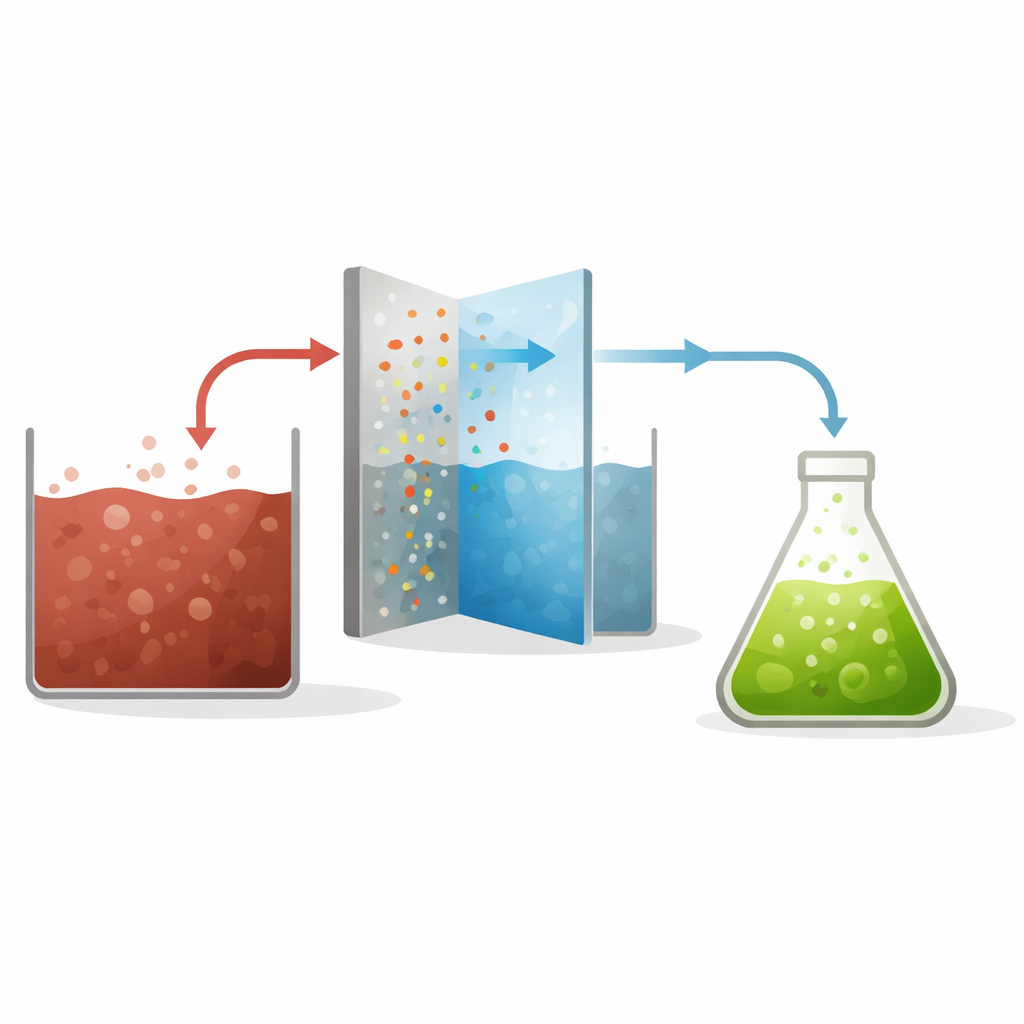
Instead of forcing water through a filter with high pressure, the researchers use forward osmosis, which relies on natural differences in salt concentration. Dirty slaughterhouse wastewater sits on one side of a thin membrane, while a salty “draw solution” sits on the other. Water naturally moves through the membrane toward the saltier side, leaving much of the pollution behind. By choosing the right membrane material and the right salt, the team aims to quietly pull clean water out of a very difficult waste stream while concentrating the nutrients for later use.
Four custom filters put to the test
The team compared four cellulose‑based membranes. One was a standard cellulose triacetate film (M1). A second (M2) was the same material reinforced with tiny carbon nanotubes intended to strengthen it. A third (M3) blended two related plastics, cellulose triacetate and cellulose diacetate, to form a “hybrid” structure. The fourth (M4) combined this hybrid blend with carbon nanotubes. Using a suite of imaging and mechanical tests, they showed that nanotubes could change surface roughness, pore structure, and strength. But when these membranes were actually used to treat slaughterhouse wastewater, the blended CTA/CDA membrane without nanotubes (M3) consistently removed more water and handled the salts best, especially when paired with a magnesium chloride draw solution.
When nano‑additives backfire
Nanotubes are often promoted as wonder additives that make filters stronger, slicker, and more resistant to clogging. Here, they told a more nuanced story. In the simple CTA membrane (M1), adding nanotubes tightened the structure and smoothed some defects, but also made the surface more water‑repelling and reduced the effective pathways for flow. In the more sophisticated CTA/CDA blend (M3), adding nanotubes to form M4 slightly improved hydrophilicity but again reduced the number and connectivity of water channels. The result was lower water flux and weaker resistance to build‑up of salts inside the membrane. In other words, for this particular recipe, the nano‑reinforcement made the membrane look better on paper but work worse in practice.

From waste nutrients to living green factories
A key goal was not just clean water, but also useful recovery of the nutrients left behind. The concentrated solution produced by the best‑performing membrane, M3, turned out to be an excellent growth medium for the salt‑loving microalga Dunaliella salina. Its growth in this recovered solution closely matched that in a standard laboratory medium, and the resulting biomass had comparable levels of protein, carbohydrates, and lipids. By contrast, water from the nanotube‑reinforced membrane M4 had too low a salt level to support healthy algal growth, highlighting how small shifts in membrane behavior can strongly affect downstream biological use.
A simple blend that outperforms high‑tech add‑ons
For readers, the main takeaway is that more advanced materials are not always better. In this work, the plain blended cellulose membrane (M3) outperformed nanotube‑reinforced versions in removing water from slaughterhouse effluent and in producing a nutrient‑rich stream suitable for microalgae cultivation. When coupled with recyclable salts such as ammonium bicarbonate or magnesium chloride as draw solutions, this low‑energy process can both clean a challenging waste and turn it into a resource. The study suggests that carefully tuned, affordable polymers may offer a more sustainable route to closing water and nutrient loops than costly nano‑enhanced filters, especially in food and agricultural industries.
Citation: Moustafa, H.M.A., Meschack, M.M., Shalaby, M.S. et al. Performance evaluation of cellulose triacetate and cellulose diacetate hybrid membranes with carbon nanotube (CNT) for sustainable slaughterhouse wastewater treatment via forward osmosis. Sci Rep 16, 12017 (2026). https://doi.org/10.1038/s41598-026-45066-3
Keywords: forward osmosis, slaughterhouse wastewater, cellulose membranes, nutrient recovery, microalgae cultivation