Clear Sky Science · en
Chaotic and dynamic vibration analysis of a time-delayed nonlinear mathieu oscillator via non-perturbative approach
Why shaking systems can behave in surprising ways
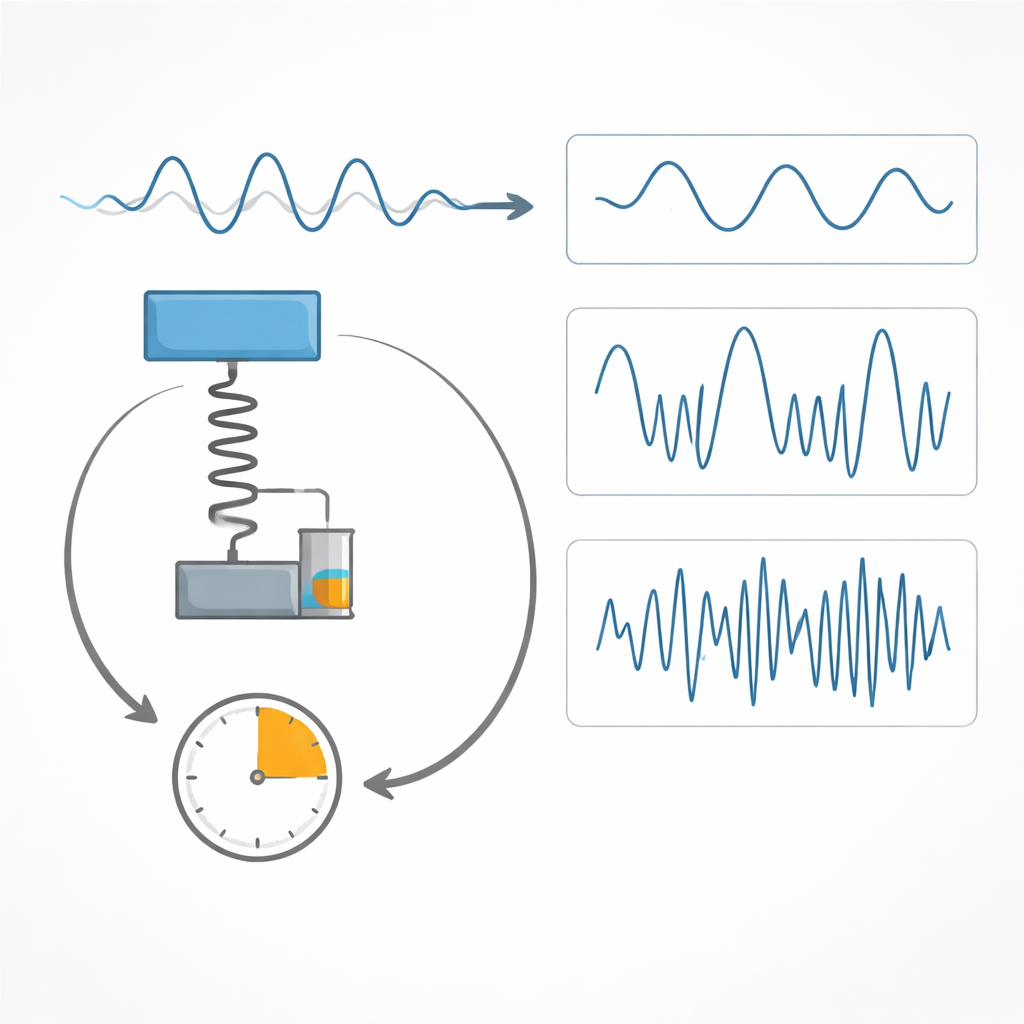
From bridges and aircraft wings to tiny sensors in smartphones, many technologies rely on parts that vibrate. Usually, engineers try to keep these vibrations under control. But when delays and nonlinear effects enter the picture, the motion can suddenly jump from calm to wild and chaotic. This paper explores how such complex behavior arises in a simple yet powerful vibration model, and introduces an analytical method that can predict when a system will stay quiet, resonate dangerously, or descend into chaos.
A simple model with many real-world faces
The authors focus on a classic mathematical model called the Mathieu oscillator, which describes systems whose stiffness is periodically shaken in time. Though abstract, it underpins problems as diverse as vibrating beams, suspension bridges, rotating machinery, semiconductor devices, and even certain biological rhythms. In this work, the oscillator is enriched with three realistic ingredients: a nonlinear damping mechanism that can both add and remove energy, an external periodic force, and a feedback term that depends on the system’s past state after a fixed time delay. This last ingredient mimics control loops and signal lags common in mechanical and electronic devices.
Two ways for friction to feed or tame motion
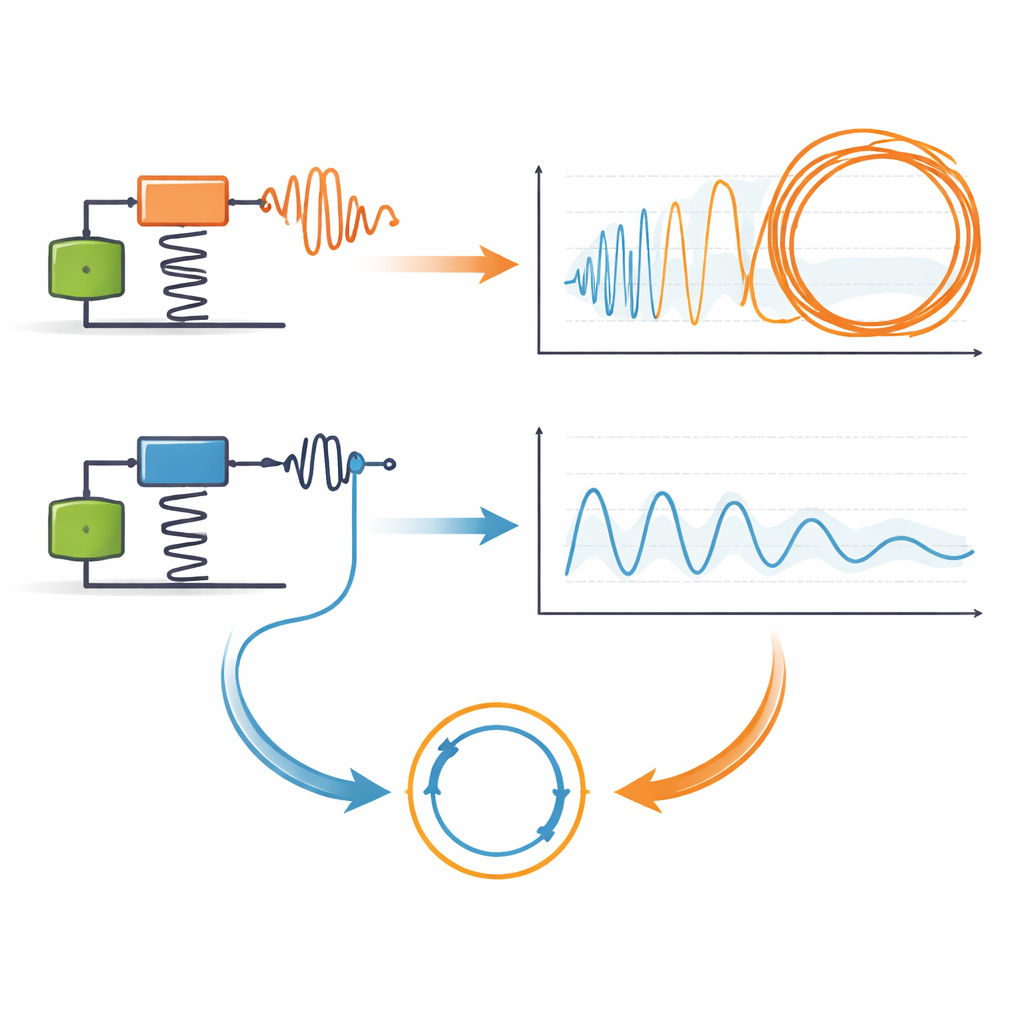
The study compares two famous forms of nonlinear damping: the van der Pol and Rayleigh oscillators. In the van der Pol case, the damping depends mainly on how far the system is displaced. At small amplitudes it acts like “negative friction,” feeding energy in, while at larger amplitudes it removes energy and limits growth, producing self-sustained oscillations. In the Rayleigh case, the damping depends on velocity, leading to smoother self-regulation. By embedding each damping law into the same time-delayed Mathieu framework, the authors can see how these different energy-exchange rules interact with periodic shaking and delayed feedback to shape the overall motion.
A non-perturbative lens on strong nonlinearity
Most traditional analytical tools for such systems assume that nonlinear effects and parametric forcing are weak and that operation stays near resonance. These approximations often fail when the behavior becomes strongly nonlinear, exactly where design decisions are most critical. The authors adopt a non-perturbative approach that sidesteps the need for small parameters. Through carefully chosen trial motions, they systematically recast the original nonlinear, time-delayed equation into an equivalent linear Mathieu-type problem with effective frequencies and damping. This transformation captures both small and large vibration amplitudes and yields explicit conditions that separate stable from unstable regimes over a wide range of parameters.
From formulas to motion: testing with simulations
To check that the new method is not just mathematically elegant but also accurate, the team compares its predictions with direct numerical simulations of the full nonlinear equations. They analyze time traces of motion, phase portraits that show how position and velocity evolve together, and more advanced tools such as Poincaré maps and Lyapunov exponents, which diagnose chaos. The analytical solutions closely track the numerical ones, with only tiny errors over long time spans. The results show that increasing natural frequency or excitation frequency generally pushes the system toward instability, while stronger damping and, in some cases, larger forcing amplitudes can surprisingly stabilize the motion. Time delay emerges as a double-edged sword, either shrinking or enlarging the safe operating region depending on how it couples with the damping type.
Opposite trends and hidden routes to chaos
A key finding is that the van der Pol and Rayleigh versions of the system respond in opposite ways to certain parameter changes. For the van der Pol case, raising the natural frequency tends to enhance stability, while stronger nonlinear damping can actually destabilize the motion by boosting self-excitation. For the Rayleigh case, the cubic nonlinear damping strongly stabilizes large oscillations, but higher natural frequency erodes the stable domain. Bifurcation diagrams and Lyapunov analyses reveal rich routes from regular periodic motion to quasi-periodic behavior and full-blown chaos, as system parameters such as forcing strength, nonlinearity, and delay are varied. Importantly, the non-perturbative framework exposes delay-induced instability zones that previous perturbation-based studies could not capture.
What this means for real machines
In plain terms, this work provides a more reliable way to predict when delayed, self-excited vibrating systems will behave themselves and when they might suddenly start shaking uncontrollably. By mapping out how nonlinear friction, forcing, natural frequency, and time delay interact, the study offers practical guidelines for designing and tuning delay-controlled oscillators in mechanical structures, precision machinery, aerospace components, and micro- and nano-electromechanical devices. Engineers can use these insights to choose parameter ranges that avoid dangerous resonances and chaotic bursts, or, where useful, to deliberately harness rich oscillatory behavior for sensing and energy harvesting.
Citation: Moatimid, G.M., Amer, T.S. & Mohamed, Y.M. Chaotic and dynamic vibration analysis of a time-delayed nonlinear mathieu oscillator via non-perturbative approach. Sci Rep 16, 12219 (2026). https://doi.org/10.1038/s41598-026-45062-7
Keywords: nonlinear oscillators, time-delay feedback, dynamic stability, parametric resonance, chaos in vibrations