Clear Sky Science · en
AdjLeafGNN: a hybrid deep learning and graph neural network framework for probabilistic modeling of adjacent leaf disease spread in precision agriculture
Why watching sick leaves matters
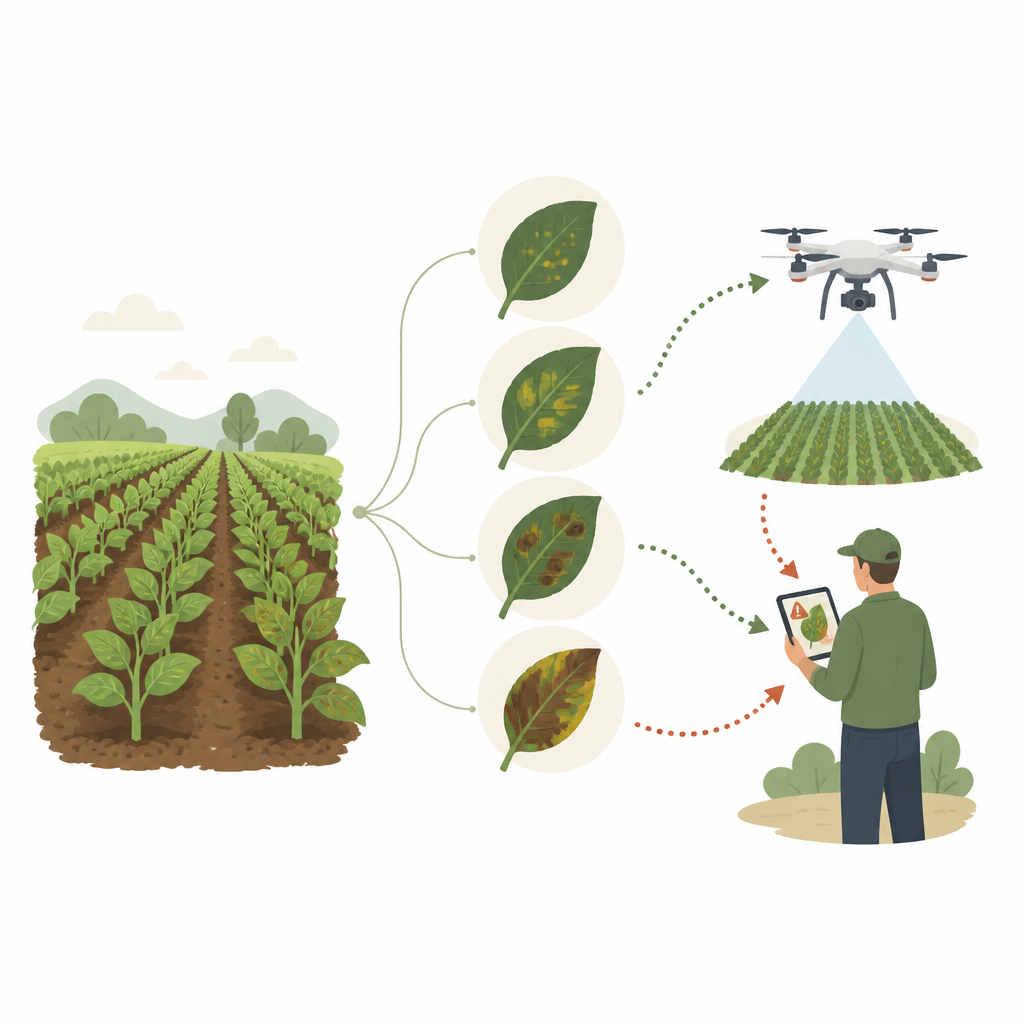
Plant diseases that start as small spots on a few leaves can quietly cut harvests and threaten food supplies. Farmers increasingly use cameras and artificial intelligence to spot sick plants, but most tools still look at each leaf in isolation. This paper introduces AdjLeafGNN, a new system that not only recognizes which disease is on a leaf, but also estimates how likely that disease is to spread to nearby leaves, helping growers act earlier and more precisely.
Looking beyond a single leaf
Most current computer vision systems for crops rely on powerful image models that classify diseases from photos of individual leaves. They work well in controlled tests, yet they ignore how real diseases behave in fields, where infections often move from leaf to leaf by touch, insects, or wind. The authors argue that to understand plant health properly, a model must capture both the appearance of each leaf and its relationship to other leaves around it.
A two part brain for plant health
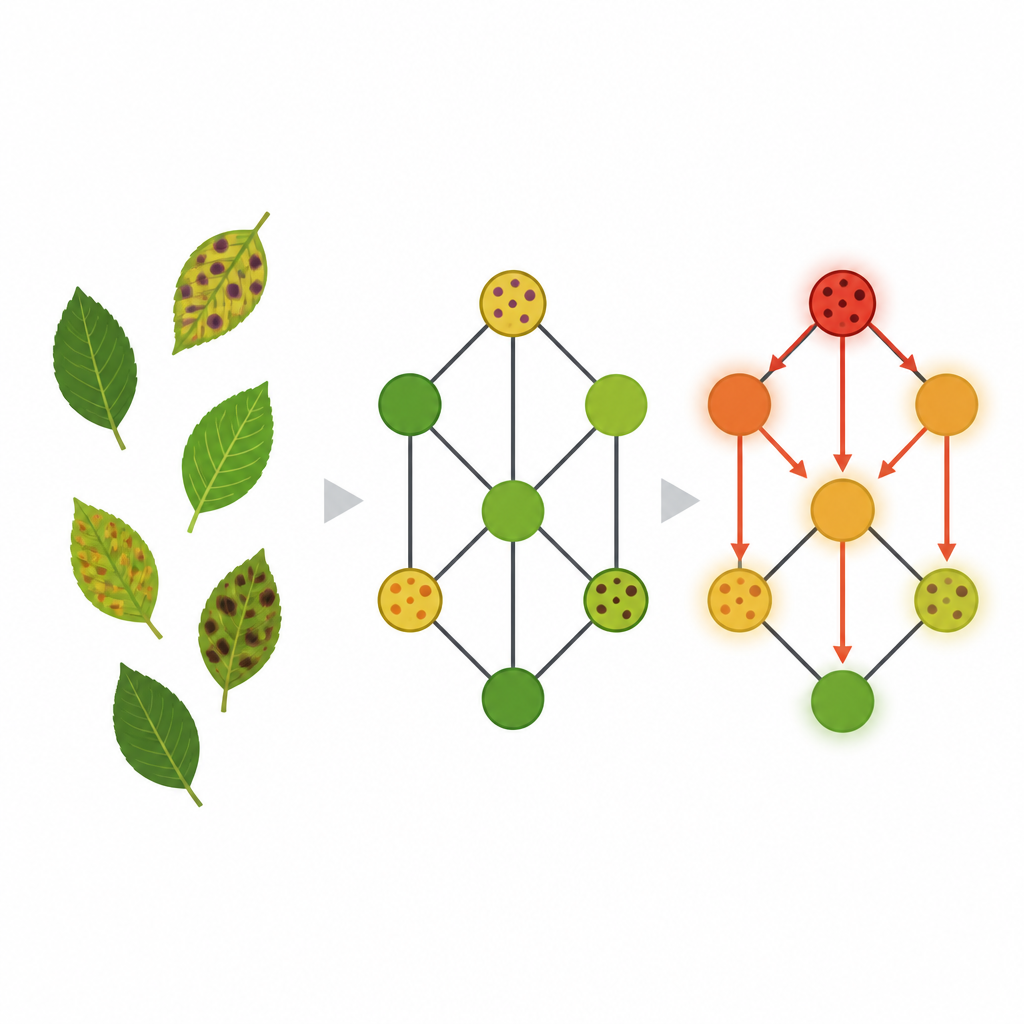
AdjLeafGNN combines two kinds of artificial intelligence. First, a deep image module called LDDNet scans each leaf photo to learn what different diseases look like at multiple sizes and shapes, while an attention mechanism helps it focus on the spots and blotches that matter most. This produces a compact fingerprint for every leaf that captures its health status. These fingerprints are not the final answer; instead, they become building blocks for a larger picture of how disease might move across many leaves.
Turning leaves into a network
In the second stage, the system treats each leaf fingerprint as a point in a network. Leaves that look similar are linked, forming a graph that reflects which ones might realistically pass infection to each other. A graph neural network then passes information along these connections, allowing each leaf to “consult” its neighbors before the final decision is made. From this enriched view, the model produces two outputs at once: the most likely disease type on each leaf and the probability that disease will spread from or to its nearby leaves.
Putting the approach to the test
The researchers trained and evaluated AdjLeafGNN on PlantVillage, a well known collection of tens of thousands of images of healthy and diseased leaves from crops such as tomato, potato, apple, and grape. Using a carefully controlled training setup, their hybrid model outperformed several strong deep learning baselines, including popular image networks like ResNet and EfficientNet. It reached about 99 percent accuracy and F1 score for disease classification and also predicted likely disease spread between leaves with high reliability, as shown by strong scores on standard medical style risk metrics.
What this means for smart farming
To a non specialist, the key result is that AdjLeafGNN can both name a leaf disease and estimate where it might go next, in a single pass. This dual insight could help farmers or agricultural robots not just flag sick plants, but also identify nearby leaves at high risk and treat them before symptoms fully develop. While the system was tested mainly on controlled images rather than messy field scenes, it offers a path toward real time, spatially aware crop monitoring that could support more precise pesticide use and better protection of yields.
Citation: Surekha, B., Subha Mastan Rao, T. AdjLeafGNN: a hybrid deep learning and graph neural network framework for probabilistic modeling of adjacent leaf disease spread in precision agriculture. Sci Rep 16, 15629 (2026). https://doi.org/10.1038/s41598-026-45061-8
Keywords: plant disease detection, leaf image analysis, graph neural network, precision agriculture, disease spread prediction