Clear Sky Science · en
Digital restoration of cultural relics based on 3D modeling and machine vision
Bringing broken treasures back to life
Museum objects such as ancient pots and bronze vessels often reach us cracked, incomplete, or worn away. Restoring them by hand takes expert skill and many hours, and every touch risks further harm. This study shows how computers can now help caretakers of heritage rebuild both the shape and the surface decoration of damaged artifacts in digital form, creating detailed 3D models that can be studied, shared, and displayed without putting the originals at risk.
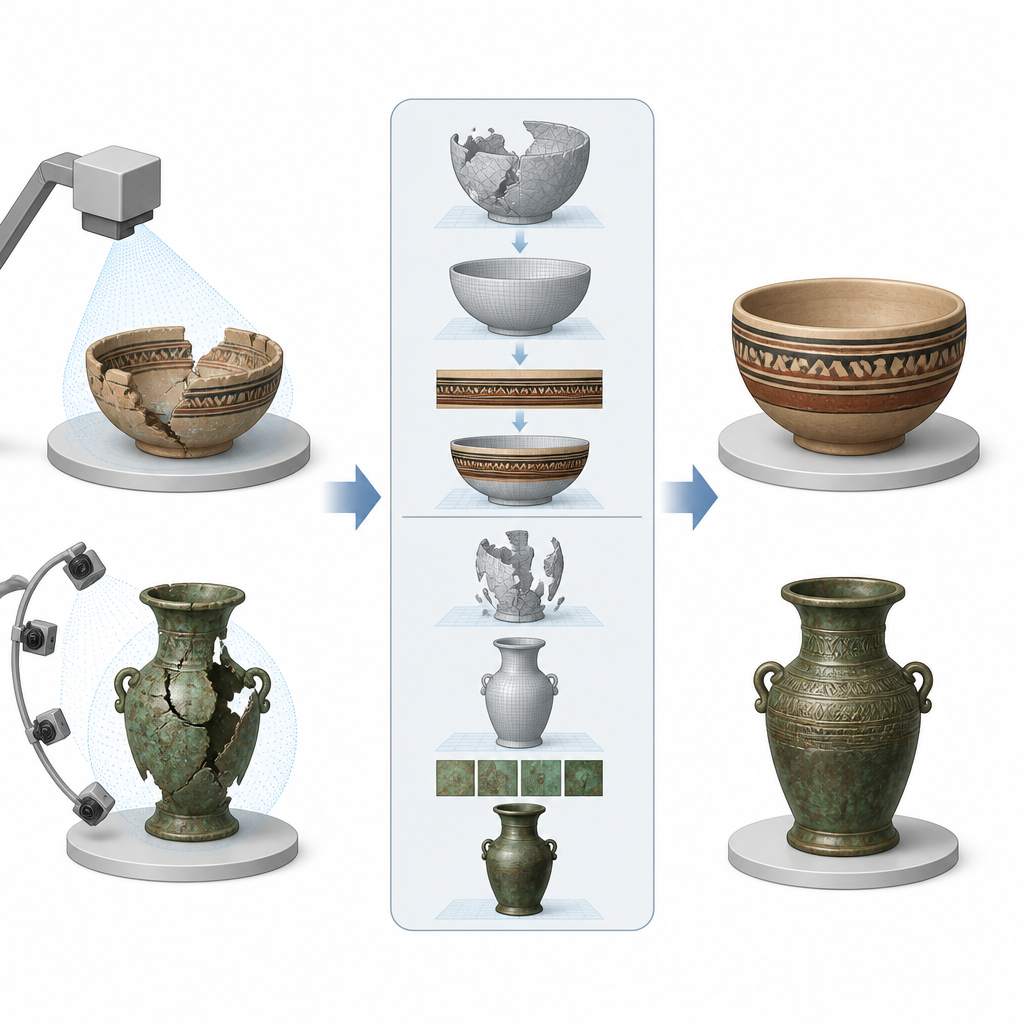
Why damaged artifacts are hard to fix
Cultural relics serve as physical traces of past societies, but centuries of burial, weather, and handling leave them chipped, faded, or missing large sections. Traditional repair depends on the restorer’s eye and experience, which makes it slow, expensive, and sometimes inconsistent. It is especially difficult to guess how missing patterns once flowed across a curved bowl or vase. As collections grow and more pieces are unearthed, museums need methods that can handle large numbers of relics while preserving fine details with minimal physical interference.
Capturing the full shape in three dimensions
The researchers first focus on rebuilding the complete form of an object. They scan a relic with lasers and cameras to collect a dense cloud of points that mark its surface in space. This raw data is cleaned and aligned, then algorithms search for key points and stable features across overlapping scans, stitching them into a single model. A carefully chosen mesh approach turns this point cloud into a smooth network of tiny triangles that follow the object’s curves and ridges. A special two-branch network then learns to fill in missing regions of the point cloud by comparing predicted points to real examples, producing a full 3D model even when the original object is incomplete.
Repainting worn patterns with smart images
Once the geometry is complete, the method restores the surface textures, such as painted bands or carved motifs. The team uses a class of artificial intelligence tools called generative adversarial networks, which learn to create new images that resemble real ones. They extend this idea with a conditional design that lets the system respond to guidance about the type of texture to produce. Extra tricks help it focus on what matters: gradient filters highlight sharp changes where edges should be, while a “gated” calculation tells the network which parts of the image to trust more. A contextual attention stage lets the system borrow patches from undamaged areas to fill gaps so that lines and motifs continue smoothly across the repaired zone.
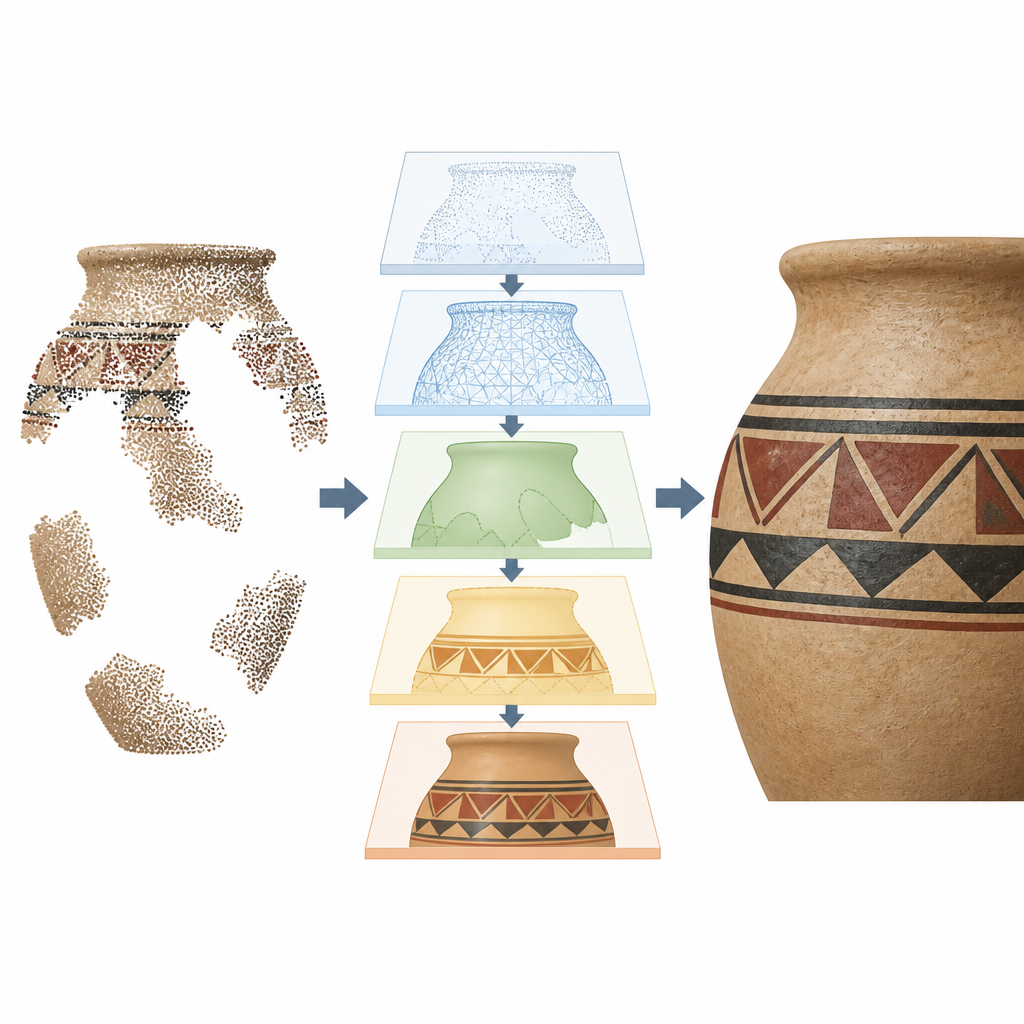
Testing the method on real museum pieces
To judge how well the approach works, the authors train and test it on public 3D models of bronze and ceramic objects, along with a large set of texture samples. They compare their point cloud completion and texture repair against several leading computer methods. Across multiple measures of shape accuracy and image quality, their system consistently makes smaller errors, produces smoother edges, and runs faster. Brightness and color of the restored surfaces come closer to reference charts, reducing visible mismatch. In practical trials on bowls and vases, both the overall form and the intricate decorative bands look more continuous and natural than with competing techniques.
How experts viewed the digital repairs
Beyond numbers, the team asks human evaluators to rate the results without knowing which method was used. Reviewers score how complete the decorations appear and how natural the repaired regions look beside original surfaces. The new method earns the highest marks, with most ratings at the top level for visual smoothness and only a small fraction judged obviously artificial. Step by step tests also show that each added component, such as conditional guidance, gating, and contextual attention, contributes to better continuity and realism in the final models.
What this means for museums and the public
The study concludes that combining careful 3D scanning with advanced image learning can restore damaged relics in the digital realm with high accuracy and speed. Curators can explore “finished” versions of fragile objects without further handling, create faithful replicas for display or teaching, and preserve detailed records for future study. While the current work focuses on bronze and ceramic pieces in stable indoor settings, the same ideas could be extended to other materials and harsher environments. In this way, digital tools become partners to human experts, helping to safeguard cultural treasures and make them more accessible to people everywhere.
Citation: Yu, J., Li, H. Digital restoration of cultural relics based on 3D modeling and machine vision. Sci Rep 16, 15124 (2026). https://doi.org/10.1038/s41598-026-45060-9
Keywords: cultural heritage, 3D modeling, image restoration, machine vision, GAN