Clear Sky Science · en
Techno-economic assessment of retrofit pathways towards near zero-energy performance in a Saudi residential villa
Keeping Homes Cool Without Breaking the Bank
In hot, sunny cities like Riyadh, keeping a home comfortable can send electricity bills soaring and strain the power grid. This study asks a simple question with big consequences for families and for climate goals: how far can a typical Saudi villa go toward using almost no electricity from the grid if owners choose smart upgrades to the walls, windows, shading, and rooftop solar panels—and which of those upgrades actually pay for themselves in a reasonable time?
A Typical Family House Under the Microscope
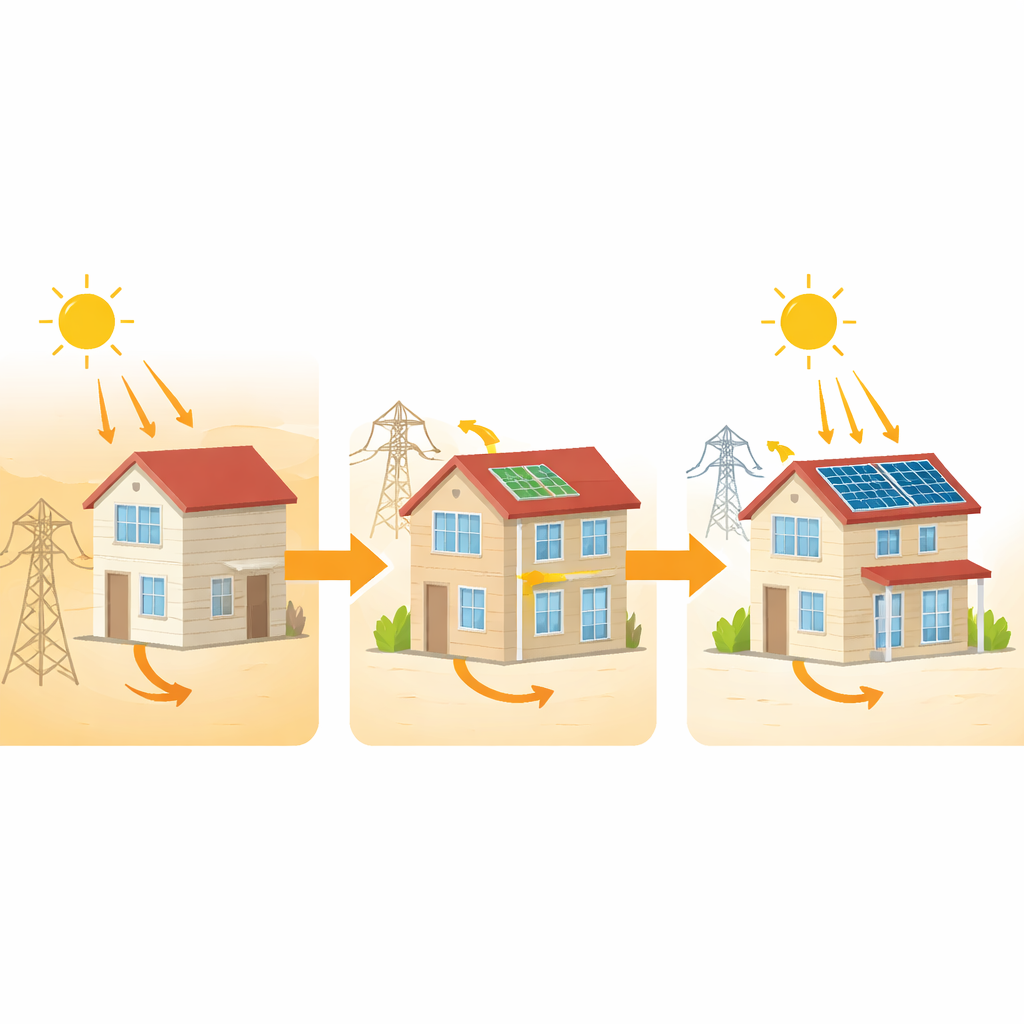
The researchers focused on one ordinary two-story villa in Riyadh, home to six people, as a stand‑in for many similar houses built before strict energy rules came into force. They built a detailed computer model of the house and checked it against a full year of real electricity bills from 2023. The model closely matched reality, showing about 60,000 kilowatt‑hours of electricity use per year, nearly half of it just for air‑conditioning. With this accurate "digital twin" in hand, they could safely test dozens of upgrade ideas on a computer instead of on the real building.
What Happens When You Upgrade the Shell
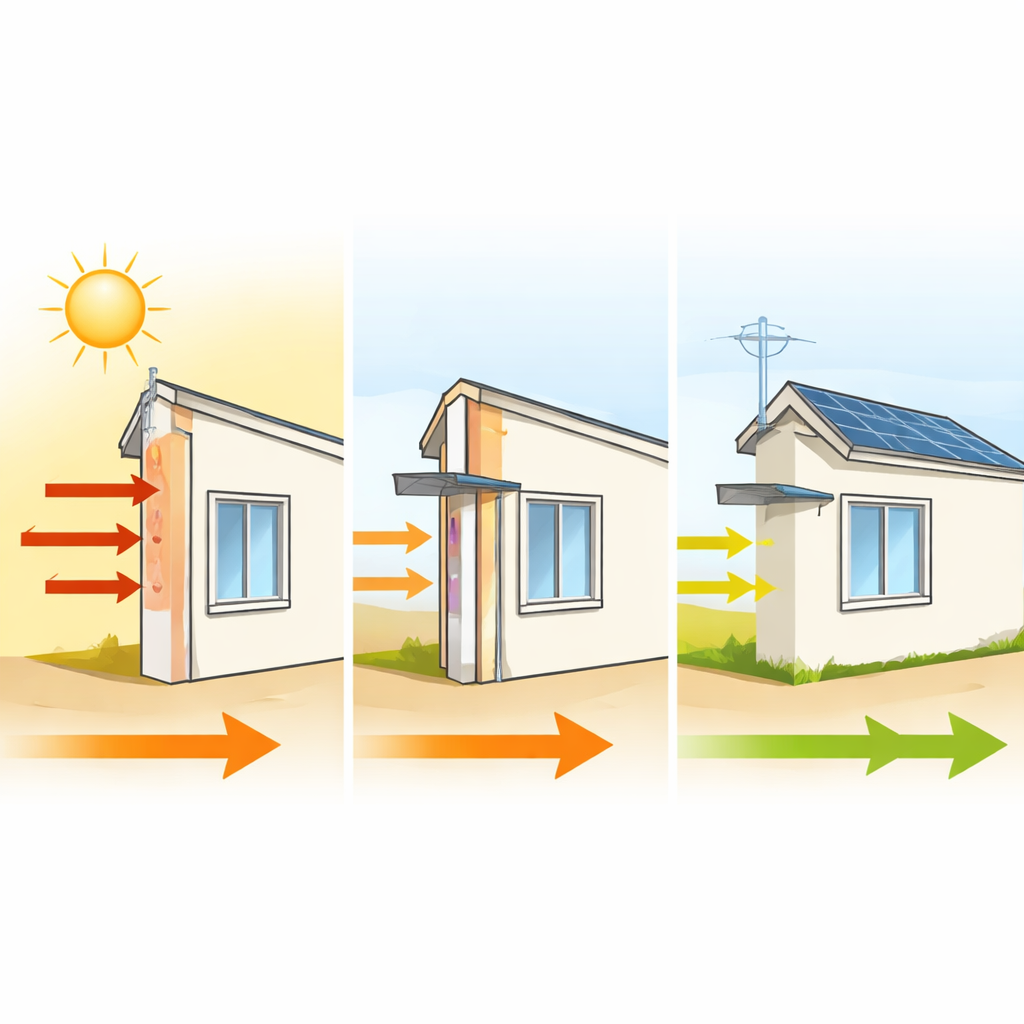
The first set of experiments looked at the house’s outer shell: the walls, roof, and windows. The team tried three kinds of added wall insulation, eight types of better double‑pane glass, and four versions of external window shades such as wide roof‑like overhangs and vertical fins. On their own, these changes did not always look attractive to a homeowner. Insulation cut electricity use the most, but the money saved on bills would take many years to repay the investment. New glass usually saved only a little energy, and some clear double glazing even made things worse. Simple shades over the windows were cheap to install but, used alone, hardly moved the needle on annual bills.
Combining Measures for Bigger Impact
Because single fixes were underwhelming, the researchers turned to combinations. Using an optimization method, they tested 130 different packages that mixed insulation, glass types, and shading in different ways, mainly on the sun‑hit east, south, and west sides of the villa. The best bundles cut annual electricity use by about one‑third—roughly 20,000 to 22,000 kilowatt‑hours—without changing the air‑conditioning equipment. The most aggressive packages, packed with extra insulation, delivered the lowest energy use but required six to nine years of bill savings to pay back. A leaner package that skipped insulation but used better glass and shading was slightly less efficient yet paid for itself in a little over two and a half years. This trade‑off between deeper savings and faster payback is central to making realistic upgrade plans.
Adding Rooftop Solar to the Mix
The next step was to place a sizable solar panel array on the villa’s roof, sized to the area actually available. These panels feed electricity directly into the home, shrinking what must be bought from the grid. When solar was added to the four best upgrade packages, the net electricity taken from the grid plunged from 60,000 kilowatt‑hours per year to as low as about 9,500 to 11,000—a reduction of roughly 80 percent. In other words, the house came close to what the authors call near zero‑energy performance: still using the grid at times, but only for a small fraction of its needs. The catch is cost. Even at competitive local prices, the solar system is a big one‑time expense, stretching total payback times to six to nine and a half years for the best cases.
What This Means for Homeowners
For a household in a hot, dry climate, the study’s message is practical. Large energy cuts and much smaller bills are possible, but they are easiest to achieve by thinking in stages and in bundles. The most financially appealing first moves are integrated packages that focus on better glass and smart shading layouts targeted where the sun hits hardest, rather than on expensive full‑house insulation or window upgrades in isolation. Once these cost‑effective steps are in place, owners who can afford a longer payback horizon—or who benefit from government incentives—can add rooftop solar to push their home’s grid use down toward a minimal level. In short, near zero‑energy living for Saudi villas is within reach, but the smartest path is a carefully planned sequence of upgrades rather than a single sweeping renovation.
Citation: Aloshan, M., Aldali, K. Techno-economic assessment of retrofit pathways towards near zero-energy performance in a Saudi residential villa. Sci Rep 16, 14295 (2026). https://doi.org/10.1038/s41598-026-45057-4
Keywords: building retrofits, hot climate housing, energy efficient homes, rooftop solar, Saudi Arabia villas