Clear Sky Science · en
Mineralogical imprints of earthquake activity in sedimentary structures
Hidden signs of past earthquakes
When an earthquake strikes, the shaking may last only seconds, but the ground can preserve a subtle record for thousands of years. This study asks a deceptively simple question: can we read past earthquakes not just from broken rocks and tilted layers, but from tiny mineral patterns that form in soft, water‑soaked sand and mud? If so, geologists could better reconstruct ancient quakes, refine hazard estimates, and understand how shaking reshapes sediments beneath our feet.
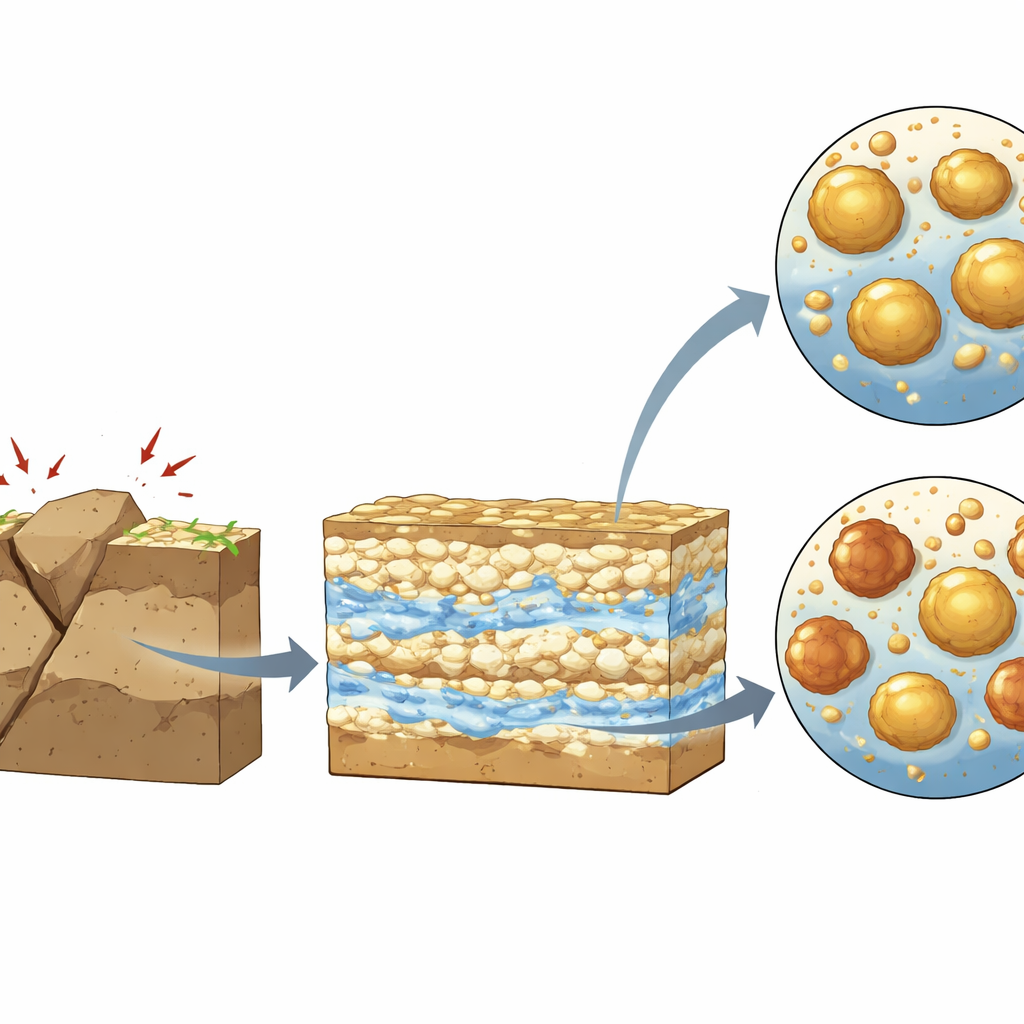
How shaking turns solid ground into a fluid
In many coastal, lake, and river settings, the ground is made of loose grains saturated with water. Strong shaking can temporarily cause these sediments to behave like a liquid, a process known as liquefaction. During such events, grains lose their grip on each other as water pressure between them rises, and the sediment can deform dramatically. It may bulge, sag, or even erupt in small sand volcanoes, leaving behind soft‑sediment deformation structures called seismites. These features are important clues to past earthquakes, but they can also form during severe storms or rapid sediment dumping, making it difficult to prove that a particular layer was shaken by a quake.
Recreating earthquake damage in the lab
To tackle this problem, the researchers combined fieldwork with carefully controlled laboratory experiments. They collected fine sand and silt from natural outcrops and packed them into more than a hundred transparent cylinders, saturating the sediments with waters of different mineral content. Some cylinders received iron in a form that dissolves easily, while others were supplied with iron minerals similar to those found in nature. After months of incubation in low‑oxygen conditions, each cylinder was subjected to a standardized burst of shaking on a mechanical table designed to mimic the accelerations of a moderate earthquake. The setup was engineered so that any deformation in the sediments could confidently be linked to the applied shocks rather than to loading or settling.
Tiny rings and iron bands left behind
Following the experimental quakes, the team solidified slices of the sediments and examined them under powerful microscopes. They compared these lab samples with naturally deformed layers from a well‑documented earthquake site on Germany’s Baltic coast and with a second site in Latvia where deformation is thought to result mainly from storm activity. Across all shaken lab samples and at the German site, they repeatedly found distinctive “core‑rim structures” – rounded features with an empty or grain‑poor interior surrounded by a smooth outer zone. These appeared whether the water was weakly or strongly mineralized, and regardless of which iron compounds were added. In contrast, these rings were absent from the Latvian site, where deformation was attributed to non‑seismic triggers. The researchers also identified iron‑rich, ring‑like “sideritic structures” – made largely of iron and carbonate minerals – but these occurred only where specific iron minerals and low‑oxygen conditions were present, both in the field site and in matching lab variants.
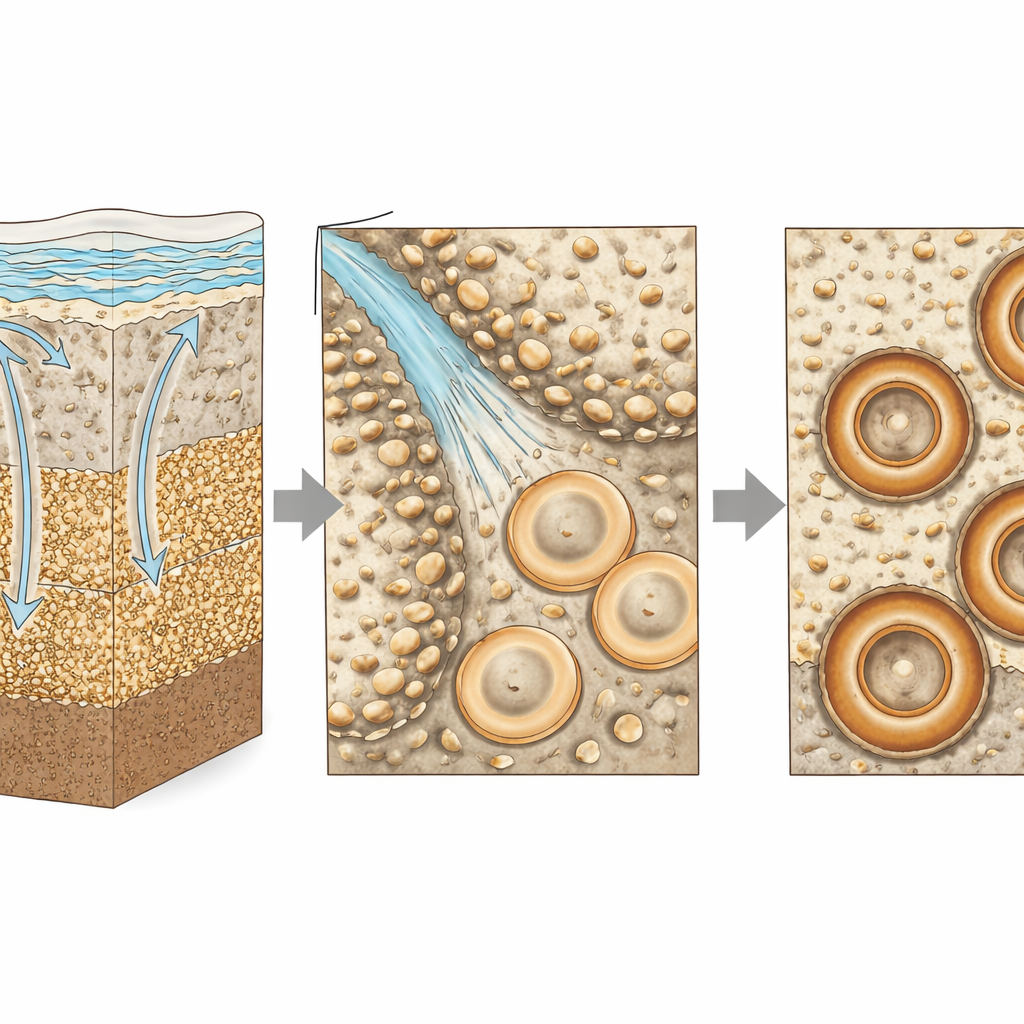
Tracking hidden fluid pathways during shaking
By mapping the distribution of chemical elements inside these microscopic features, the authors reconstructed how fluids moved through the sediment during shaking. The core‑rim structures were chemically similar to the surrounding material, suggesting they formed mainly through physical processes: intense pressure, grain movement, and rapid reorganization during liquefaction. Their shapes and alignment indicate that the central core marks the main path of escaping fluid, while the rim records material pushed aside and compacted as water forced its way out. Sideritic structures, by contrast, showed strong enrichment in iron and carbon and a consistent composition between lab and field samples. Statistical analyses of many measurements revealed that these iron‑rich rings formed under similar low‑oxygen, chemically reducing conditions in both settings, faithfully recording where iron‑bearing fluids once migrated.
Why these tiny minerals matter
Taken together, the findings point to a new way of reading the sedimentary record of earthquakes. Core‑rim structures seem to appear reliably when liquefied sediments are shaken by seismic waves and were not observed where deformation likely arose from storms, suggesting they may serve as a physical fingerprint of earthquake‑driven liquefaction. Sideritic rings, meanwhile, offer a complementary, chemistry‑based clue that highlights places where iron‑rich, low‑oxygen fluids once moved during or after shaking. By integrating laboratory simulations with natural examples, this work refines the toolkit geologists use to identify seismites and reconstruct hidden fluid flows, bringing us closer to a detailed, mineral‑scale history of past earthquakes.
Citation: Świątek, S., Lewińska, K., Pisarska-Jamroży, M. et al. Mineralogical imprints of earthquake activity in sedimentary structures. Sci Rep 16, 14307 (2026). https://doi.org/10.1038/s41598-026-45025-y
Keywords: earthquake liquefaction, seismites, sedimentary structures, mineral fingerprints, core-rim and siderite rings