Clear Sky Science · en
Machine learning-based prediction of compressive and flexural strength of wheat straw reinforced sustainable gypsum composites
Turning Farm Waste into Building Material
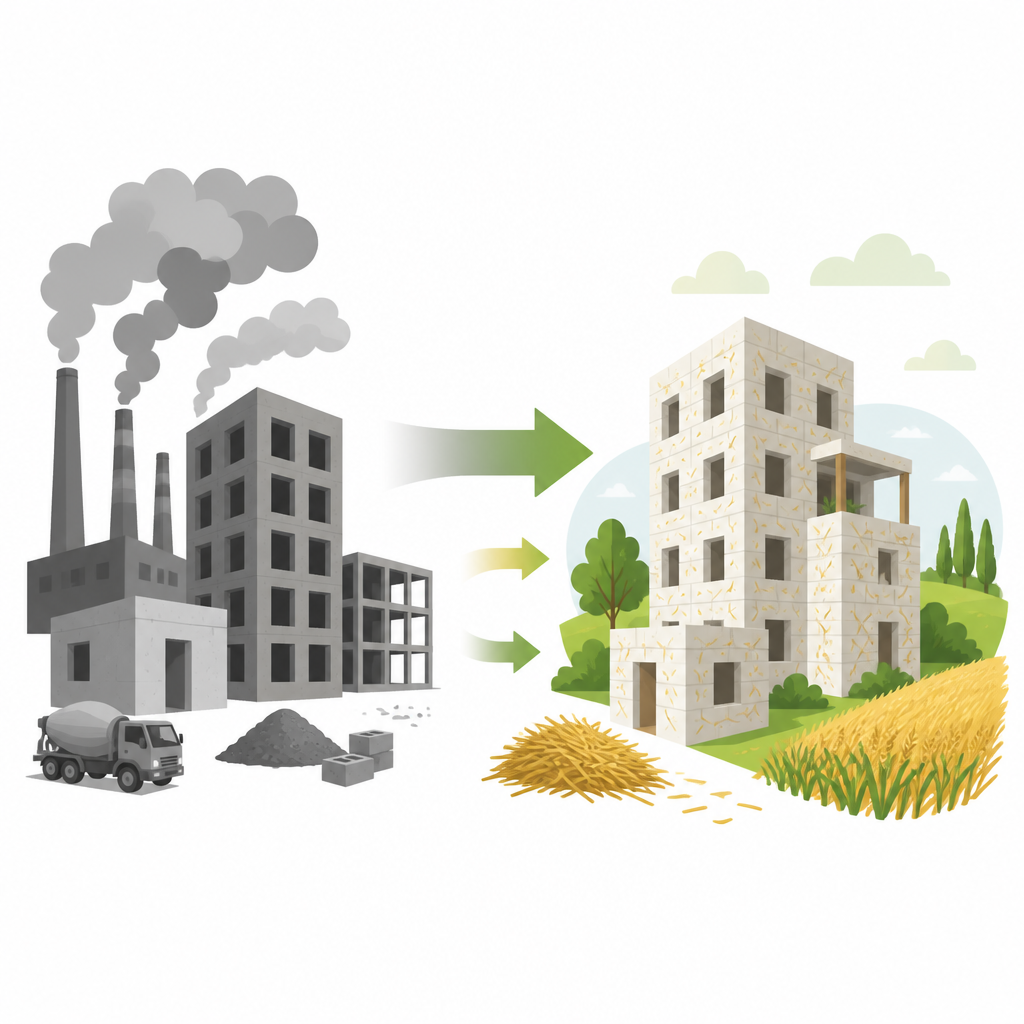
Every year, farmers around the world burn mountains of leftover straw, while cities pour vast amounts of concrete that release large quantities of carbon dioxide. This study explores a way to tackle both problems at once: using wheat straw, an agricultural waste, to reinforce gypsum-based building materials and using smart computer tools to predict how strong these greener materials can be.
Why Look Beyond Ordinary Concrete
Concrete is one of the most widely used materials on Earth, but making its key ingredient, cement, sends huge amounts of carbon dioxide into the atmosphere. In contrast, producing gypsum, another mineral binder, generates far less carbon. Gypsum already appears in familiar products such as plasterboard and interior partition walls, and it offers good fire resistance, sound insulation, and low weight. However, on its own, gypsum is brittle and not strong enough for many structural uses, which limits where it can safely replace concrete or bricks.
Giving Straw a Second Life
Modern agriculture produces enormous volumes of waste, and wheat straw is a prime example. In countries like Pakistan, much of this straw is burned in open fields, worsening smog and harming public health. Instead of treating straw as a problem to dispose of, the authors view it as a cheap, renewable ingredient for construction. When small amounts of straw fibers are mixed into gypsum, they can help the material bend a little more before breaking and make better use of a resource that would otherwise go to waste. But the final strength depends on many ingredients at once, including gypsum quality, water, straw content, and chemical additives, which interact in complex ways.
Letting Machines Learn from Experiments
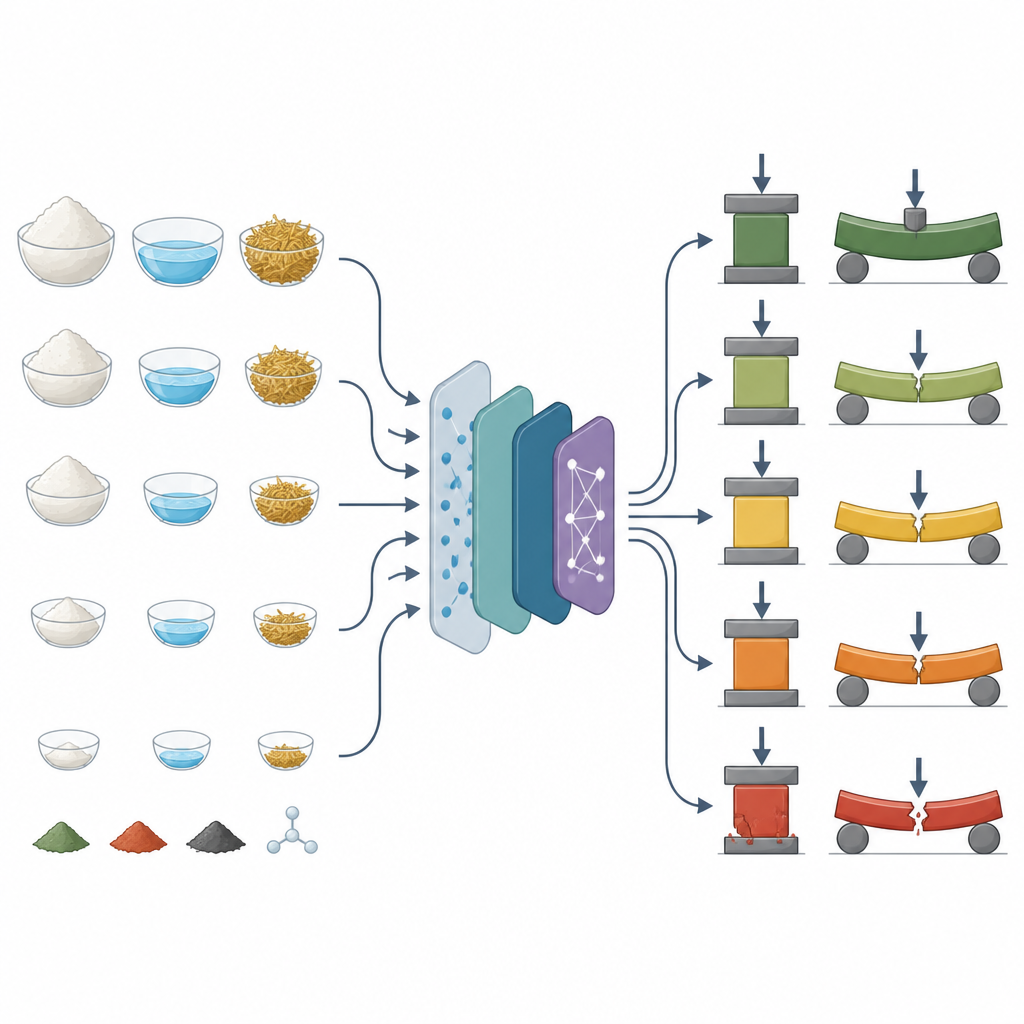
Running physical tests on every possible recipe for straw–gypsum mixes would be slow and expensive. To address this, the researchers gathered data from 161 previously tested mixtures reported in the literature. For each recipe, they recorded details such as gypsum strength and amount, water content and water-to-gypsum ratio, how much straw was added, and whether two common additives were present. They also noted two key outcomes: how strongly the samples could resist being squeezed (compressive strength) and being bent (flexural strength). Using this data, they trained five different machine learning models so that computers could learn how the inputs relate to these strengths without being given a fixed formula in advance.
Finding the Most Reliable Digital Predictor
The team compared artificial neural networks, Gaussian process regression, random forests, extreme gradient boosting, and support vector machines. They checked each model using a careful testing method called cross-validation, which repeatedly trains on a portion of the data and tests on the rest to avoid fooling themselves. Among all approaches, Gaussian process regression stood out: it predicted both compressive and flexural strength more accurately and more consistently than the others. A further advantage is that this method does not only give a single guess; it also provides an uncertainty range that shows how confident the prediction is, a useful feature when engineers must make safety-related decisions.
What Matters Most in the Mix
To keep the models from acting like mysterious black boxes, the authors probed which ingredients influenced the predictions the most. Across the better-performing models, the inherent strength of the gypsum itself emerged as the main driver of both compressive and flexural strength. The total amount of gypsum, and how much water was used, also played major roles because they change how dense or porous the final material becomes. Wheat straw and chemical additives had secondary effects: in some ranges they helped tailor behavior, but too much water, straw, or additive tended to lower strength by creating extra voids or disturbing the bonding inside the hardened mix.
From Smart Predictions to Greener Buildings
In simple terms, the study shows that computers can learn to accurately predict how strong straw-reinforced gypsum will be, based on its recipe, without the need to cast and crush every new sample in the lab. The best model, Gaussian process regression, not only gives reliable strength estimates but also shows how sure it is about each one. This combination of sustainable ingredients and smart prediction tools can guide designers toward gypsum–straw products that are strong enough for their intended uses, while cutting back on both cement use and agricultural burning. In doing so, it points toward construction methods that are kinder to the climate and make better use of materials we already have.
Citation: Ahmad, H., Ejaz, M.F., Riaz, M.R. et al. Machine learning-based prediction of compressive and flexural strength of wheat straw reinforced sustainable gypsum composites. Sci Rep 16, 15087 (2026). https://doi.org/10.1038/s41598-026-45024-z
Keywords: gypsum composites, wheat straw, machine learning, compressive strength, sustainable construction