Clear Sky Science · en
GFD analysis for BRE zeolite graph through reverse degree and reverse neighborhood degree based topological descriptors
Why the Shape of Tiny Crystals Matters
From cleaning water to refining fuels, zeolites—tiny sponge-like crystals—quietly power many technologies. This article explores a particular zeolite called brewsterite (BRE) and asks a deceptively simple question: how complex is its internal structure, really? By bringing together ideas from fractals, information theory, and graph mathematics, the authors develop new tools to measure that complexity, with the long-term aim of helping scientists design better, greener materials.
Rocks with Tiny, Organized Cavities
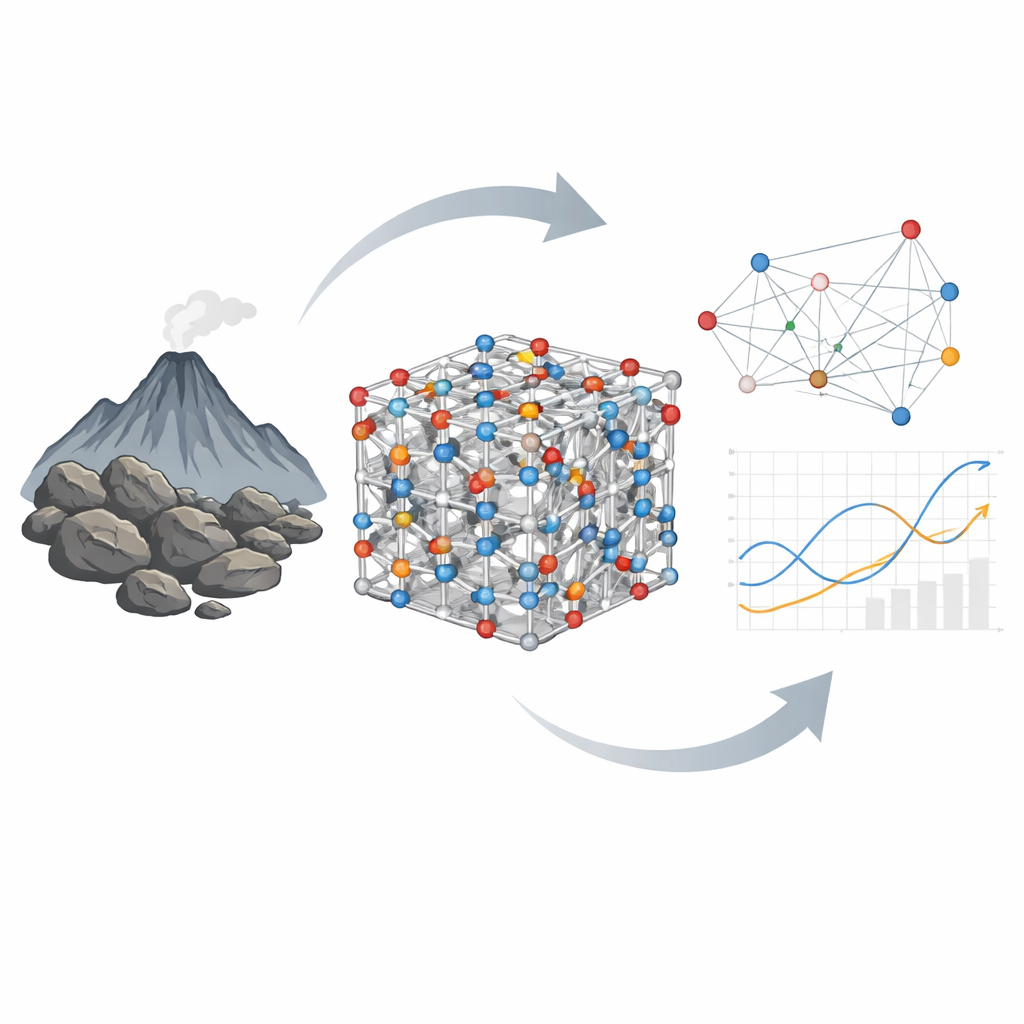
Zeolites are minerals made of aluminum, silicon, oxygen, and water arranged into rigid frameworks full of regular, nanometer-scale pores. Because these pores have well-defined sizes and shapes, zeolites can sift molecules much like a molecular colander, making them useful for gas separation, water purification, and catalysis. Brewsterite, the BRE zeolite studied here, forms intricate three-dimensional networks that can host different metal ions and water molecules. This structural richness makes it scientifically interesting but also challenging to model: understanding how its atoms connect and repeat is key to predicting how it will behave in real-world processes.
Turning a Crystal into a Network
To tackle this challenge, the authors treat the BRE zeolite framework as a network, or graph. In this picture, atoms become points and chemical bonds become links between them. Rather than focusing only on how many bonds an atom has, they work with "reverse" measures that emphasize less connected parts of the structure as much as highly connected ones. Two families of such measures are central in this study: the reverse degree, which counts how connected a site is compared with the most connected site in the structure, and the reverse neighborhood degree, which extends this idea to an atom’s immediate surroundings. From these ingredients, they build a suite of so‑called topological descriptors—compact numerical summaries that capture how the entire BRE framework is wired.
Fractals and Information in a Crystal Lattice
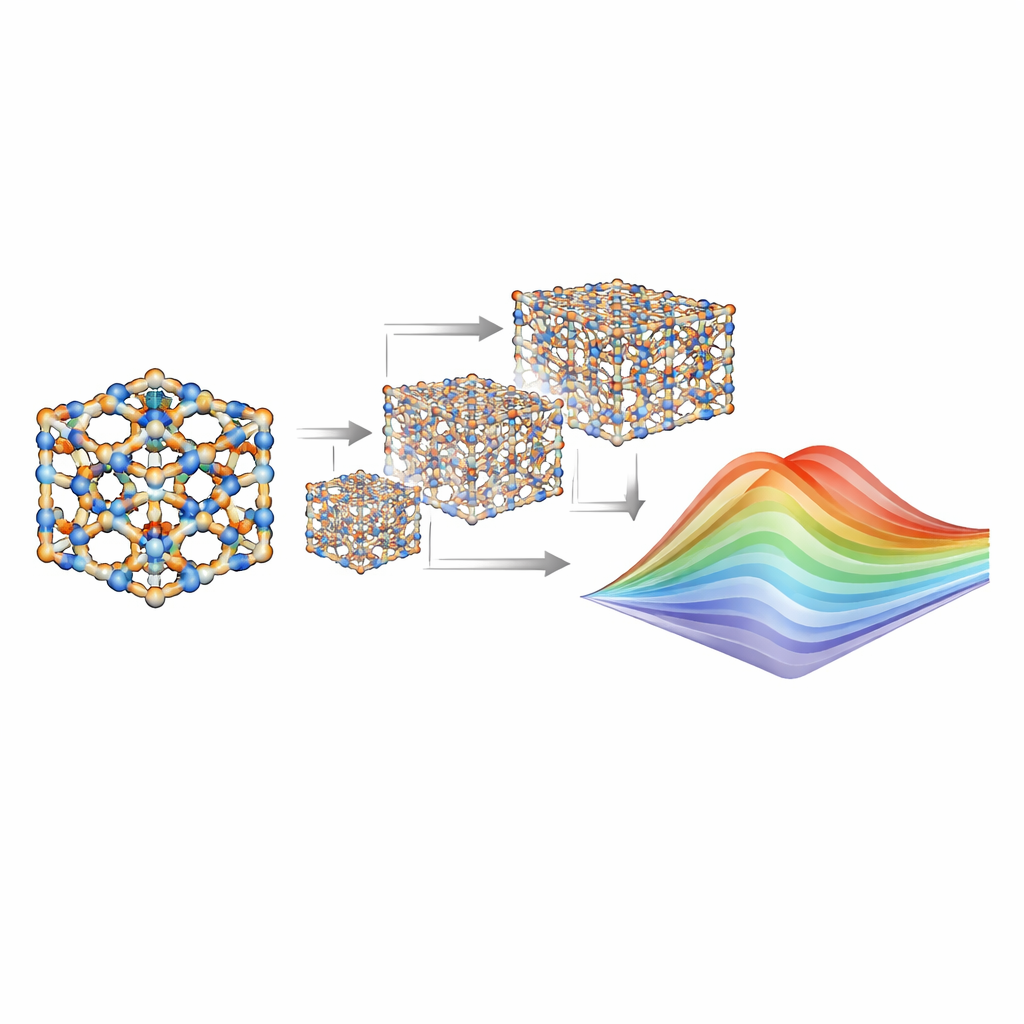
Complex systems such as turbulent flows, coastlines, or financial markets are often described using fractals—patterns that repeat at many scales. The authors bring this perspective into materials science using multifractal theory, which allows a structure to have not just one but many interlocking measures of irregularity. They apply Rényi entropy, a generalized form of information content, to probability distributions derived from their topological descriptors. From these entropies they compute Generalized Fractal Dimensions (GFD), a family of numbers that quantify how intricate the BRE framework is across scales. By growing the BRE model in three dimensions (increasing the number of rows, columns, and layers) and recalculating these measures, they track how structural complexity evolves as the crystal becomes larger and more richly connected.
What the Numbers Reveal About Hidden Order
The calculated values show clear trends. For almost all of the reverse-based descriptors, both Rényi entropy and GFD decrease as the order of the entropy measure increases, and as the size of the cubic BRE system grows in a controlled way. This behavior reflects how information becomes concentrated in certain parts of the network and how the framework’s connectivity organizes itself at multiple length scales. The authors find that descriptors built from the reverse neighborhood degree generally yield higher GFD values than those built from the simple reverse degree, indicating that the broader local environment around each atom carries more detailed structural information than single sites alone. They also show that GFD offers a richer picture of multiscale complexity than entropy by itself.
Predicting Patterns with Simple Curves
To make these complexity measures practically useful, the authors fit linear and cubic regression curves relating Rényi entropy to GFD for selected descriptors that proved especially sensitive to structural changes. In particular, a reverse-based version of the so‑called third Zagreb index and a harmonic measure built from reverse neighborhood degrees display strong, nearly linear relationships between entropy and fractal dimension. This means that, once calibrated, a relatively easy-to-compute entropy measure can quickly predict more detailed GFD values for a family of BRE structures, bypassing the need for repeated heavy calculations.
From Abstract Math to Better Materials
In accessible terms, the study shows that the internal maze of pores in BRE zeolite can be described by a compact set of numbers that reflect how ordered, heterogeneous, and self-similar the framework is. These numbers, especially the generalized fractal dimensions, respond systematically as the crystal grows or its arrangement changes. That makes them promising tools for linking structure to performance in future models, such as predicting how well a zeolite will separate gases or resist chemical attack. The authors suggest that their framework can be extended to other zeolite families, offering a kind of structural fingerprint that could guide the rational design of new, efficient, and more sustainable porous materials.
Citation: Yogalakshmi, K., Easwaramoorthy, D., Muhiuddin, G. et al. GFD analysis for BRE zeolite graph through reverse degree and reverse neighborhood degree based topological descriptors. Sci Rep 16, 11641 (2026). https://doi.org/10.1038/s41598-026-45013-2
Keywords: zeolite structure, fractal dimensions, graph-based descriptors, material complexity, porous crystals