Clear Sky Science · en
The proteome study of germinated Puccinia triticina urediniospores reveals a novel effector protein required for virulence
Why wheat rust matters to our food
Wheat is a staple food for billions of people, yet a microscopic fungus called wheat leaf rust can quietly strip away harvests across the globe. The study described here looks at this fungus at the very first moments it wakes up on a leaf, searching for the specific proteins it uses to invade the plant. By pinpointing which fungal proteins are critical for infection, the research opens doors to breeding wheat that can stay one step ahead of this persistent disease.
The hidden life of a rust spore
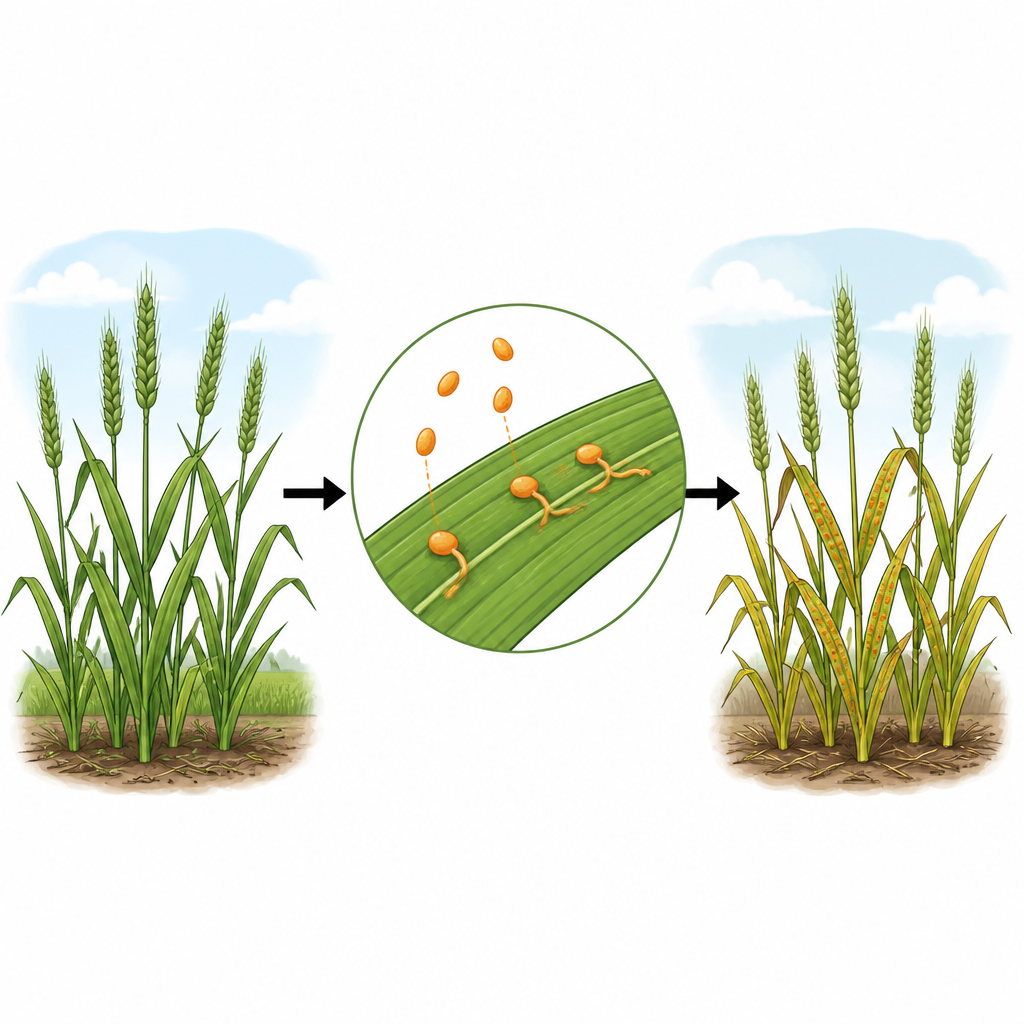
The disease starts when rust spores land on a wheat leaf and germinate, sending out thin germ tubes that seek tiny pores on the leaf surface. Once inside, the fungus builds a network of feeding structures that tap into living plant cells. Until now, scientists knew little about which fungal proteins are active during this early germination phase, even though it marks the first contact between fungus and host. The authors grew huge numbers of rust spores in controlled lab conditions, allowed them to germinate, and then extracted their proteins for detailed analysis.
Building a protein map of the invader
To chart this early-stage protein landscape, the team separated fungal proteins on two-dimensional gels, where each spot represents a different protein. Out of 167 recurring spots, they confidently identified 123 unique proteins using mass spectrometry and computer-based searches of rust fungus genomes. Many of these proteins are involved in energy production, metabolism, and stress handling, which fits the fungus’s need to switch rapidly from dormancy to active growth. Bioinformatics tools grouped these proteins into functional categories and suggested that a majority resemble known virulence factors from other plant and animal pathogens.
Finding the fungus’s secret weapons
Among the many proteins in the germinated spores, the researchers looked specifically for ones that are made to be secreted out of the fungus and into the plant, where they can act as “effectors” that sabotage plant defenses. They found six such candidates. One stood out: a protein encoded by a gene they call PtVF1, similar to a class of fungal proteases that can cut other proteins and have been tied to disease in several crop pathogens. Computer predictions indicated that PtVF1 carries a signal for secretion and might then move into key parts of the plant cell, such as the nucleus, energy-producing mitochondria, or the endoplasmic reticulum, where it could influence vital processes.
Switching off a key attack tool
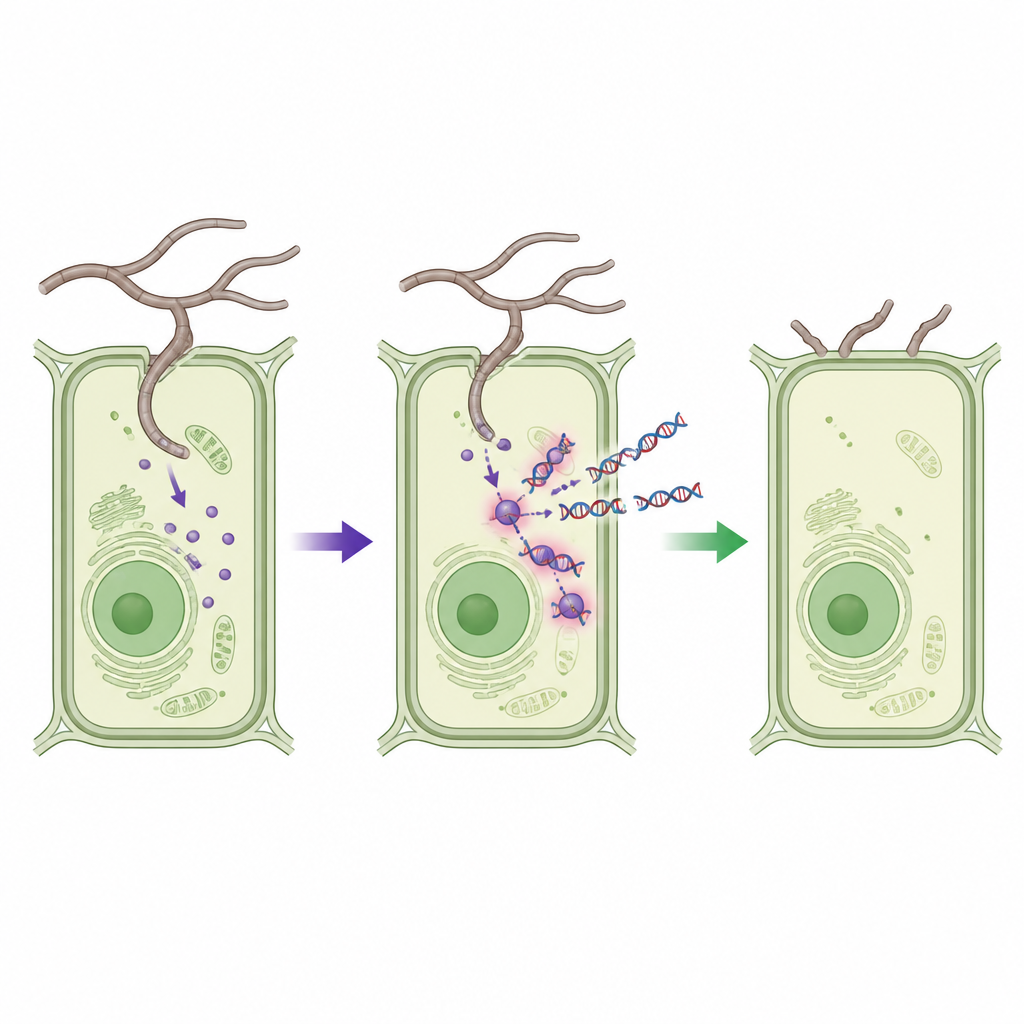
To test whether PtVF1 truly helps the fungus cause disease, the team used a technique known as host-induced gene silencing. Instead of altering the fungus directly, they engineered a virus that infects wheat to carry a fragment of the PtVF1 gene. When this virus infects wheat leaves, the plant begins to produce double-stranded RNA that specifically targets PtVF1, reducing the fungus’s ability to make that protein during infection. When rust spores later attacked these plants, the amount of PtVF1 messenger signal dropped by about three quarters, and disease symptoms fell by roughly 70 percent. The fungal growth inside the leaves was slower, with shorter hyphae and smaller rust pustules than in control plants.
What this means for protecting crops
By combining large-scale protein mapping with a targeted gene-silencing test inside wheat plants, this work moves one candidate effector, PtVF1, from a computer prediction to a demonstrated virulence factor. In simple terms, the fungus struggles to infect when this single protein is knocked down. The full protein map of germinating rust spores also highlights many other enzymes that likely help the fungus fuel its growth and dodge plant defenses. Together, these findings give breeders and plant scientists a more precise list of fungal weak points to exploit when designing rust-resistant wheat varieties or new control strategies.
Citation: Ozketen, A.C., Cetinturk, M., Rampitsch, C. et al. The proteome study of germinated Puccinia triticina urediniospores reveals a novel effector protein required for virulence. Sci Rep 16, 15726 (2026). https://doi.org/10.1038/s41598-026-44996-2
Keywords: wheat leaf rust, Puccinia triticina, fungal effectors, proteomics, plant immunity