Clear Sky Science · en
Controlled mild water stress as a priming tool to inherent defense mechanisms of navel orange against citrus nematode, Tylenchulus semipenetrans
Why thirsty orange trees matter
Citrus trees around the world are quietly attacked by microscopic worms called nematodes that feed on their roots and slowly drain their strength. Farmers usually fight these pests with chemicals, but those can be costly, polluting, and lose effectiveness over time. This study explores a surprisingly simple, eco-friendly idea: using carefully managed, mild water shortage to “train” navel orange trees to toughen their natural defenses and make life harder for the citrus nematode, without completely sacrificing tree growth.
Tiny worms with a big impact
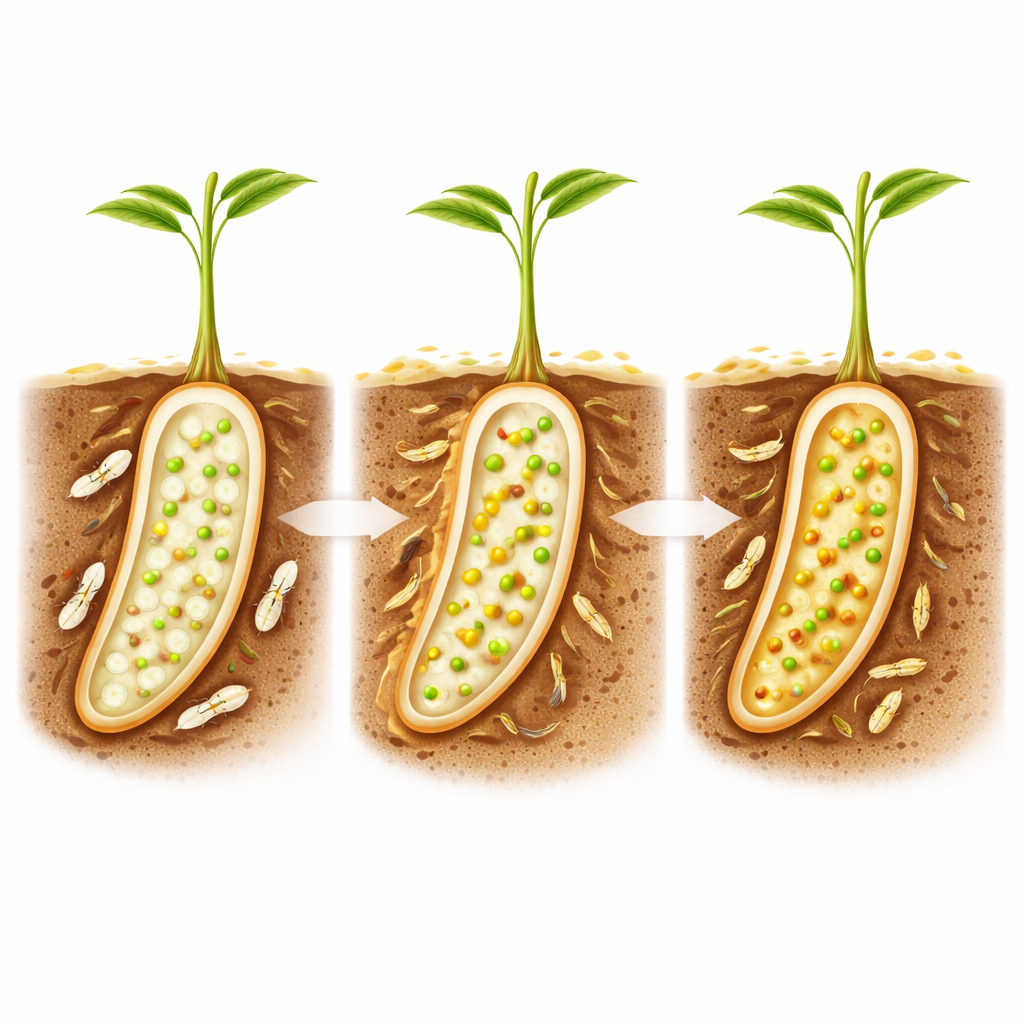
The citrus nematode Tylenchulus semipenetrans settles in the roots of orange trees, partly burrowing into the root tissue and setting up permanent feeding sites. Over time, infested trees suffer a “slow decline”: weaker roots, less water and nutrient uptake, and ultimately lower yields. In Egypt, where navel oranges are a major crop, these nematodes are widespread and can cut production by 10–30 percent or more. Because overreliance on nematicide chemicals raises environmental and health concerns, researchers are searching for ways to help the plant itself become a less welcoming home for the pest.
Using gentle drought as a wake-up call
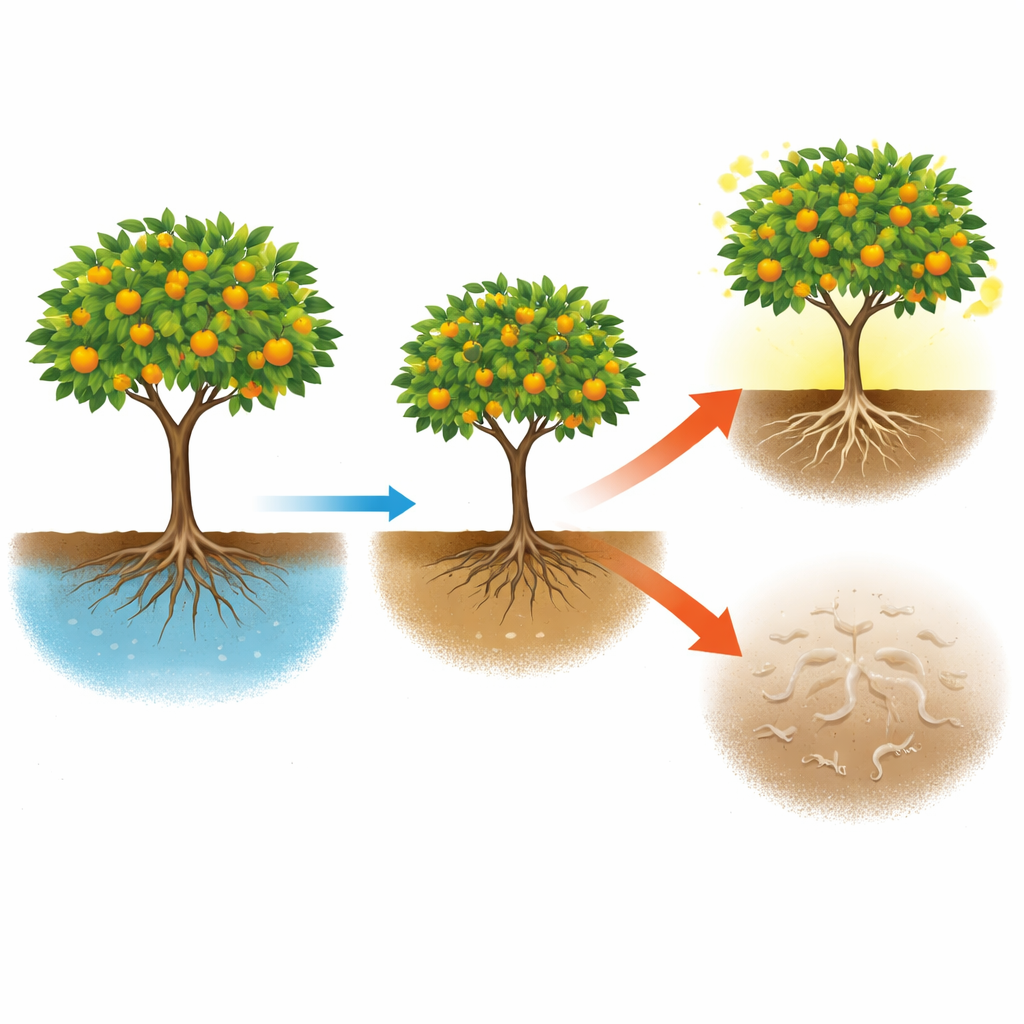
The researchers grew young navel orange trees in a greenhouse and exposed them to different watering regimes, with or without nematode infection. One group was well watered and nematode-free, serving as a healthy reference. A second group was well watered but inoculated with nematodes. Three other groups received controlled mild water stress at specific times: before infection, after infection, or as a continuous moderate deficit. The idea was that short, non-lethal “dry spells” could act like a rehearsal, prompting the plants to switch on internal alarm systems that later make it harder for nematodes to invade and reproduce.
Fewer worms, but also smaller trees
Carefully limiting water did in fact make life tougher for the nematodes. As stress levels increased, the number of juvenile worms in the soil, adult females in the roots, and egg production all dropped sharply. Under continuous mild stress, the nematode population and its rate of build-up were cut to roughly a third of the levels seen in well-watered, infested plants. Microscopic images showed that nematodes from stressed treatments appeared shrunken, full of vacuoles, and less vigorous, suggesting that the altered root environment and plant chemistry reduced their fitness. At the same time, however, the trees themselves paid a price: shoots and roots grew shorter and lighter, and leaves held less water as stress intensified, particularly under long-lasting deficit.
Inner chemistry of a stressed tree
Inside the leaves and roots, the plants responded to the combination of mild drought and nematode attack by reshaping their chemistry. Stressed seedlings built up higher levels of protective compounds such as flavonoids and phenolics, as well as proline, a small molecule that helps cells cope with dehydration. Enzymes that detoxify reactive oxygen molecules—natural by-products of stress—became more active, while the green pigments chlorophyll a and b declined as stress grew more severe. This pattern shows a trade-off: the plant diverts energy from photosynthesis and growth toward defense and survival, creating an internal environment less favorable for the nematode but also limiting the tree’s own productivity when stress is prolonged.
Finding the sweet spot for smart irrigation
Overall, the study suggests that mild, well-timed water stress can serve as a practical tool to strengthen orange trees’ built-in defenses and suppress citrus nematodes without relying solely on chemicals. Brief periods of reduced irrigation before or shortly after infection lowered nematode reproduction while still allowing reasonable growth, whereas continuous stress, although very effective against the pest, stunted the plants. For growers, this points to a delicate balance: by fine-tuning irrigation so trees “feel” just enough dryness to switch on their defense systems—but not so much that growth collapses—water management itself could become part of a broader, sustainable strategy to keep nematodes in check.
Citation: El-Sagheer, A.M., Saad, M.A. & Abdelghany, A.M.M. Controlled mild water stress as a priming tool to inherent defense mechanisms of navel orange against citrus nematode, Tylenchulus semipenetrans. Sci Rep 16, 12732 (2026). https://doi.org/10.1038/s41598-026-44988-2
Keywords: citrus nematode, mild drought, orange tree health, plant defenses, sustainable pest control