Clear Sky Science · en
Bridging laboratory findings and artificial intelligence for the design of TlInTe2 crystals
Why this crystal and computers story matters
Light sensing and energy harvesting devices, from cameras to solar panels, rely on materials that interact with light in just the right way. This study explores a little known crystal called TlInTe2 and shows how careful laboratory work, combined with modern artificial intelligence tools, can speed up the search for better materials for photonics and optoelectronic devices.
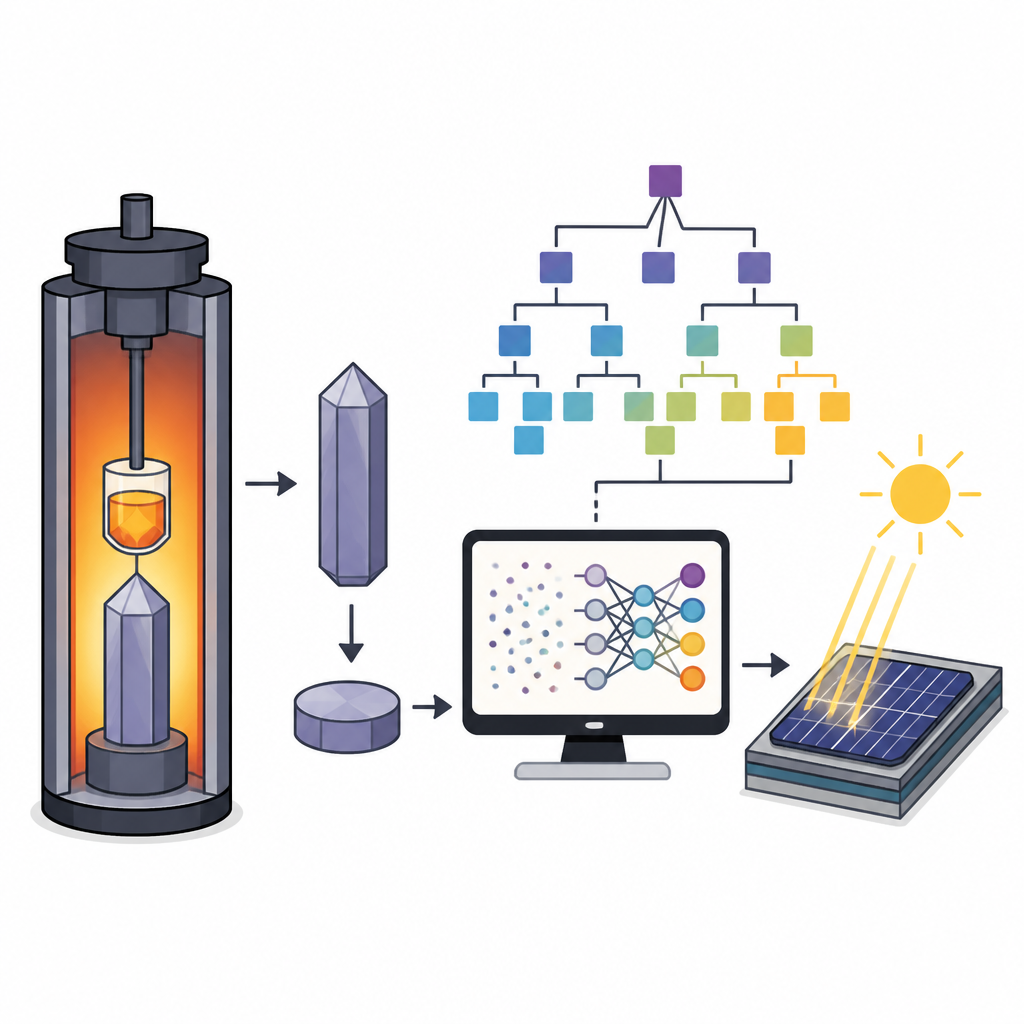
Growing a special light friendly crystal
The researchers first focused on making high quality TlInTe2 crystals in the lab. Using a carefully controlled furnace setup, they slowly solidified a molten mix of thallium, indium and tellurium to form single crystals. These crystals were then ground into powder and examined with X rays to reveal their internal arrangement of atoms. The pattern showed a layered, tetragonal structure, confirming that the crystal had formed as expected and allowing the team to estimate grain sizes, defects and tiny internal strains that can influence how light and electricity move through the material.
How the crystal talks to light and heat
Next, the team studied how TlInTe2 interacts with light across a wide range of colors, from ultraviolet to near infrared. By measuring how much light passed through and bounced off thin slices of the crystal, they calculated key quantities such as how strongly the material bends light and how much it absorbs. They found that the crystal is transparent for longer wavelengths, but strongly absorbs shorter wavelengths, with a direct band gap of about 2.08 electron volts. This means it can efficiently turn visible light into electronic signals, a useful trait for solar cells, photodetectors and other light based devices. They also examined how the internal electric response changes with light energy, which is important for understanding signal losses inside the material.
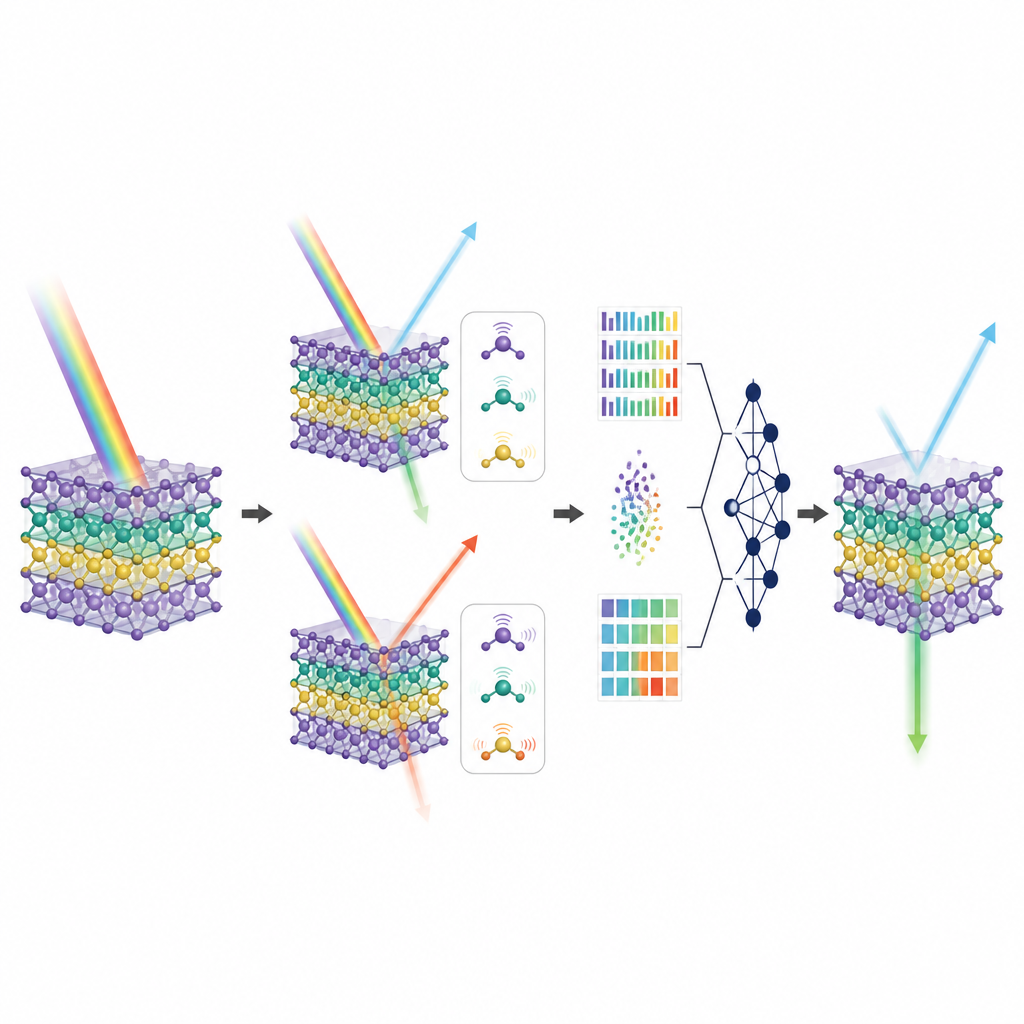
Listening to atomic vibrations
To probe the motion of atoms within the crystal, the scientists used micro Raman spectroscopy, a technique that shines a laser on the sample and listens to the tiny shifts in the scattered light caused by vibrations. The resulting spectrum revealed several distinct peaks that correspond to different bond movements between thallium, indium and tellurium atoms. Some of these vibration modes were found to be very sensitive to temperature and to the local bonding environment, making them a kind of fingerprint for detecting subtle structural changes or impurities. This information helps connect the way atoms vibrate to the way the material handles heat, charge and light.
Teaching machines to predict optical behavior
Beyond experiments, the study also asked how computers could help predict the crystal’s optical behavior without requiring countless measurements. The authors created a large synthetic dataset that mimicked how the material would respond to light over many wavelengths. Using this artificial data, they trained machine learning models, especially a technique called Random Forest, to predict properties such as refractive index, absorption strength and dielectric constants from basic inputs like wavelength, transmission and reflection. These models reached near perfect accuracy on the test data, indicating that they captured the complex relationships between the different optical quantities remarkably well.
What this means for future devices
In simple terms, the study shows that TlInTe2 is a promising candidate for devices that detect, control or harvest light, and that smart computer models can greatly cut down the experimental effort needed to explore its behavior. By combining precise crystal growth, detailed optical and vibrational measurements, and data driven modeling, the work demonstrates a path toward faster design and optimization of semiconductor materials. For a lay reader, the key message is that pairing hands on lab work with artificial intelligence can help engineers more quickly identify which crystals are worth turning into the next generation of sensors, lasers and solar technologies.
Citation: Ahmed, M.A.O., Alotaibi, H., Gami, F. et al. Bridging laboratory findings and artificial intelligence for the design of TlInTe2 crystals. Sci Rep 16, 15858 (2026). https://doi.org/10.1038/s41598-026-44965-9
Keywords: TlInTe2, optical properties, Raman spectroscopy, machine learning, optoelectronics