Clear Sky Science · en
A novel filtering T-shaped transmission line structure and its application in the design of reduced-size Butler matrix
Smaller hardware for smarter wireless beams
Modern wireless systems like 5G and radar often rely on special circuits to steer radio waves in different directions without moving the antenna. These steering networks can be large and waste valuable space in crowded devices. This paper introduces a new way to shrink one of these key circuits, called a Butler matrix, while also building in a useful filtering function that helps block unwanted high frequency signals.

A new T shaped building block
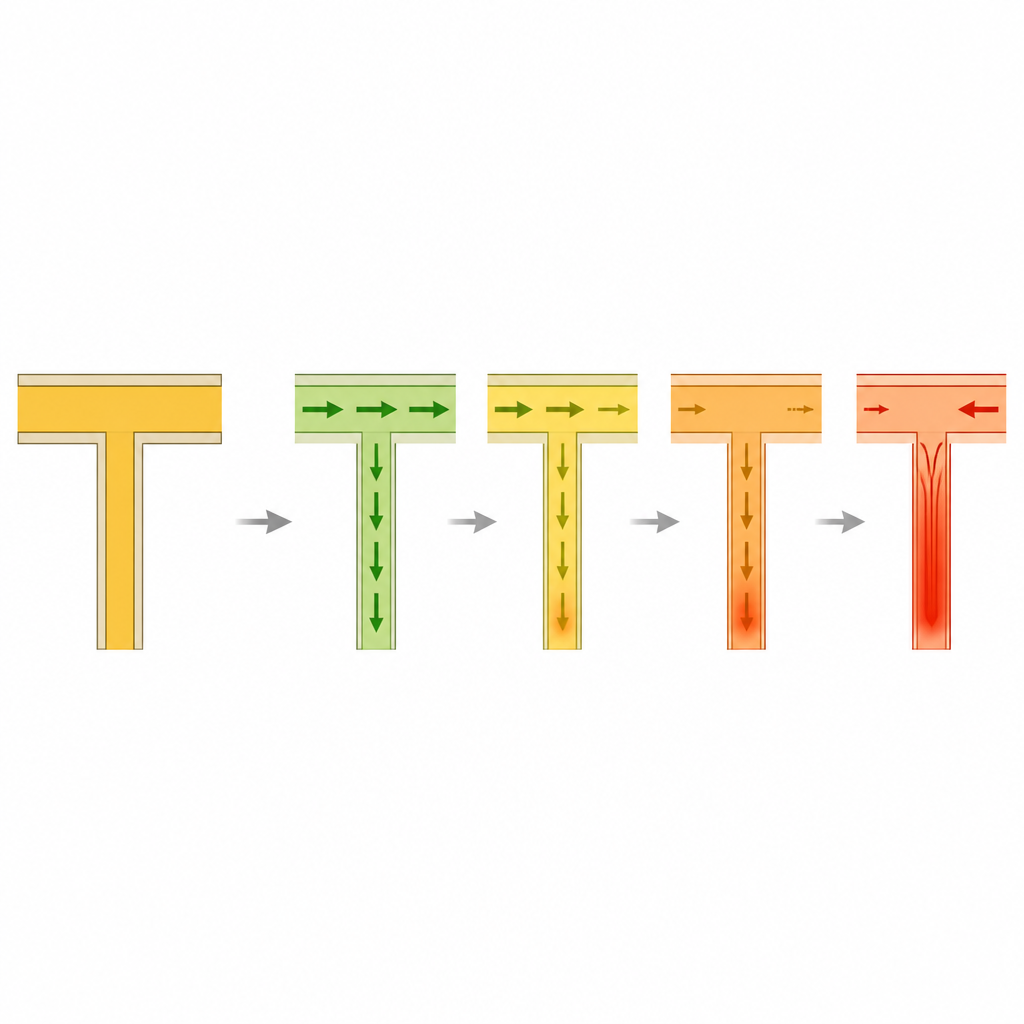
The researchers propose a simple T shaped pattern of metal tracks that carry radio signals on a circuit board. At the operating frequency, this pattern behaves just like a standard quarter wavelength section of transmission line, which is a basic building block in many radio circuits. The key difference is that the new pattern takes up only about half the horizontal space of the classic design, trading some extra vertical length for a much shorter footprint along the board. Because many steering networks use many of these quarter wavelength sections, replacing them with the T shaped version can shrink the whole system noticeably.
Built in signal cleanup
The vertical, open ended part of the T structure is not just for saving space. By carefully choosing its shape, the authors show that it can strongly block signals above a chosen cut off frequency. At the intended operating frequency, the circuit lets power pass through as desired. At roughly twice that frequency, however, the open branch behaves as if it were connected to ground, so almost no power reaches the output. By adjusting this branch, they can move the blocking band while still keeping the correct behavior at the main operating frequency, effectively giving each T section a low pass filter action.
Shrinking the steering network
To demonstrate the usefulness of this idea, the team redesigns the main building blocks of a four input, four output Butler matrix: the hybrid couplers and the crossovers that route signals between lines. In each case, they replace conventional quarter wavelength lines with the new T structure wherever possible. The resulting single layer circuit is built on a standard microwave circuit board material and tested at 2.5 gigahertz. Compared with a traditional layout, the new matrix occupies only about one third of the original area, corresponding to a size reduction of around 65 percent, while keeping all parts on a single layer instead of stacking several boards.
Performance in practice
Measurements of the fabricated circuit show that signals entering the matrix are well matched to the board, with low reflections at the operating frequency for the tested input ports. The power splits among the four outputs with only small differences between paths, and the relative phases between the outputs closely follow the values expected from an ideal Butler matrix. Above 4 gigahertz, the reflections become large, which confirms that the built in low pass behavior blocks higher frequency signals as designed. Small differences between the measured and simulated results are attributed to connector effects and slight variation in the circuit board material, both common issues in high frequency prototypes.
From circuit to beam steering
To show how this compact matrix can be used in a real system, the authors connect its outputs to an array of rectangular patch antennas, creating an analog beamforming setup. When they excite different input ports, the combined antenna pattern points the main beam at angles between about plus and minus 40 degrees, with a peak gain of around 10 dB and sidelobes kept below minus 5 dB. Isolation between input ports is better than about minus 15 dB, indicating that the ports do not strongly interfere with one another. Overall, the reduced size matrix behaves like a classic design in terms of steering and gain, but with a much smaller footprint and with the added bonus of filtering.
What this means for future wireless gear
This work shows that a simple T shaped transmission line element can both shrink and clean up key steering circuits used in 5G and radar systems. Because the design is single layer, easy to describe mathematically, and not tied to a specific Butler matrix layout, it can be reused in other microwave circuits that depend on quarter wavelength lines. Combined with other miniaturization methods, this approach could help build more compact, efficient beamforming hardware, cutting costs and saving space in future wireless devices.
Citation: Amangeldi, Y., Rano, D., Arzykulov, S. et al. A novel filtering T-shaped transmission line structure and its application in the design of reduced-size Butler matrix. Sci Rep 16, 15116 (2026). https://doi.org/10.1038/s41598-026-44962-y
Keywords: Butler matrix, beamforming, 5G antennas, low pass filtering, transmission line