Clear Sky Science · en
OpenStride: an inexpensive, open-source force plate actometry system for quantification of rodent motor activity and behaviour
Why measuring tiny footsteps matters
How an animal moves can reveal a great deal about its brain and body, from subtle tremors to clumsy, unsteady steps. Researchers often study these changes in mice and rats to explore conditions such as Parkinson like tremor, inherited ataxias, or the effects of new drugs. Yet the tools to measure natural movement precisely have been costly, closed, and hard to obtain. This paper introduces OpenStride, a low cost, open source system that lets laboratories around the world track rodent movement in fine detail using parts they can print and assemble themselves.
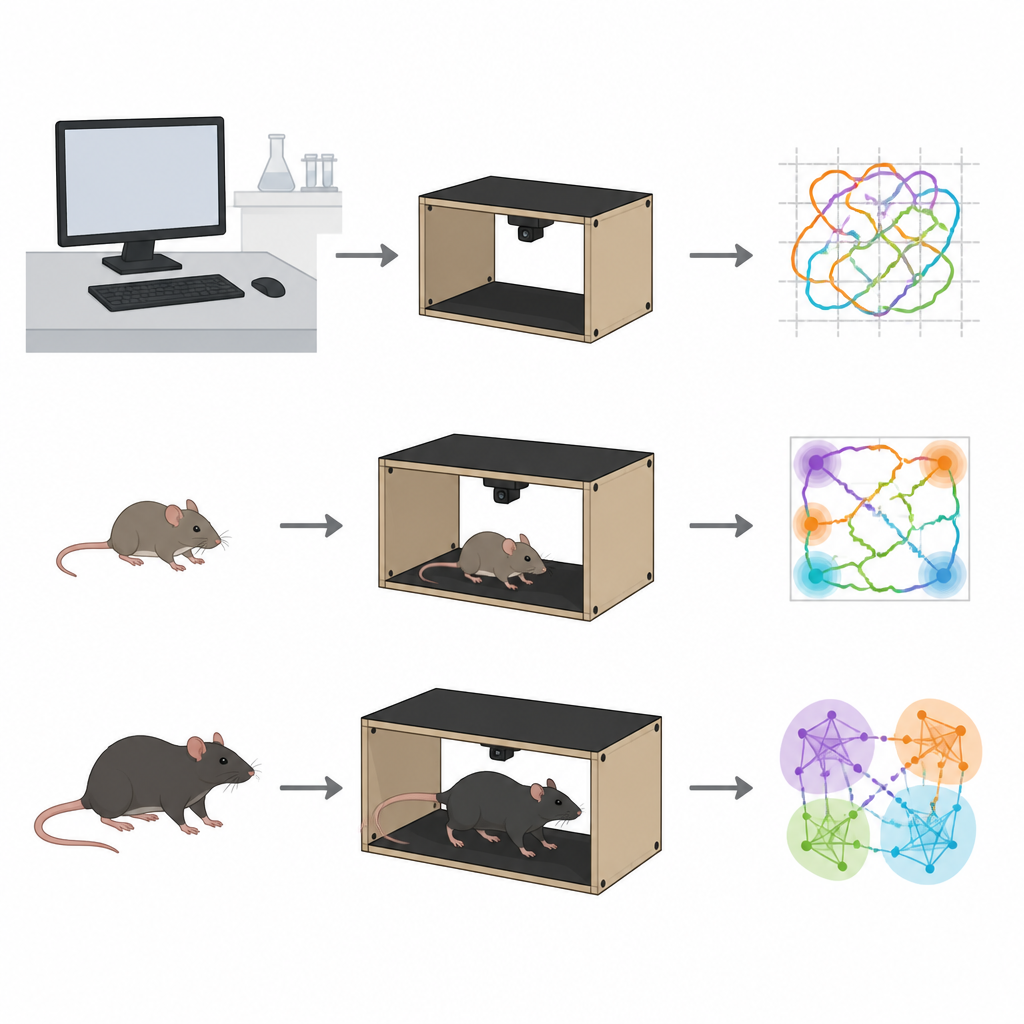
A simple platform with a hidden sense of touch
OpenStride looks like a small box with a flat floor, but its walking surface rests on four force sensors, one near each corner. As a mouse or rat moves around freely, its weight shifts across the sensors. From these shifting forces, the system calculates the animal’s center of mass hundreds of times per second, turning each step into a precise trail of positions. The hardware is built from 3D printed plastic parts, a clear acrylic enclosure, inexpensive load cells, and a single data acquisition board, all mounted on a heavy concrete base with foam pads to dampen vibration. The whole setup costs about 550 US dollars to build using tools common in university workshops.
From raw forces to maps of movement
The authors wrote software that records the raw signals from the four sensors, converts them into positions over time, and then computes useful measures of movement. For general activity, OpenStride sums up how far the animal travels, how fast it goes, and how often it pauses for at least a second. It also tracks whether the animal prefers the edges of the square arena or spends time in the open center, a classic test of anxiety like behavior. All of these calculations are based on the center of mass trajectory, after simple smoothing that users can adjust. Because the system stores unfiltered data, researchers can later apply new analyses without rerunning experiments.
Putting accuracy and stability to the test
To show that OpenStride’s measurements are trustworthy, the team first tested the device without animals. A small weight placed at the center of the plate barely drifted over a minute, with position changes measured in fractions of a millimeter. Heavier weights actually reduced tiny jitters and also made the system less sensitive to disturbances, such as a ping pong ball dropped nearby. Next, the researchers traced straight diagonal paths with a finger from corner to corner and back. The distances computed from the sensor data closely matched the true diagonal length of the 30 by 30 centimeter floor across repeated trials, confirming that the system can capture path length accurately.
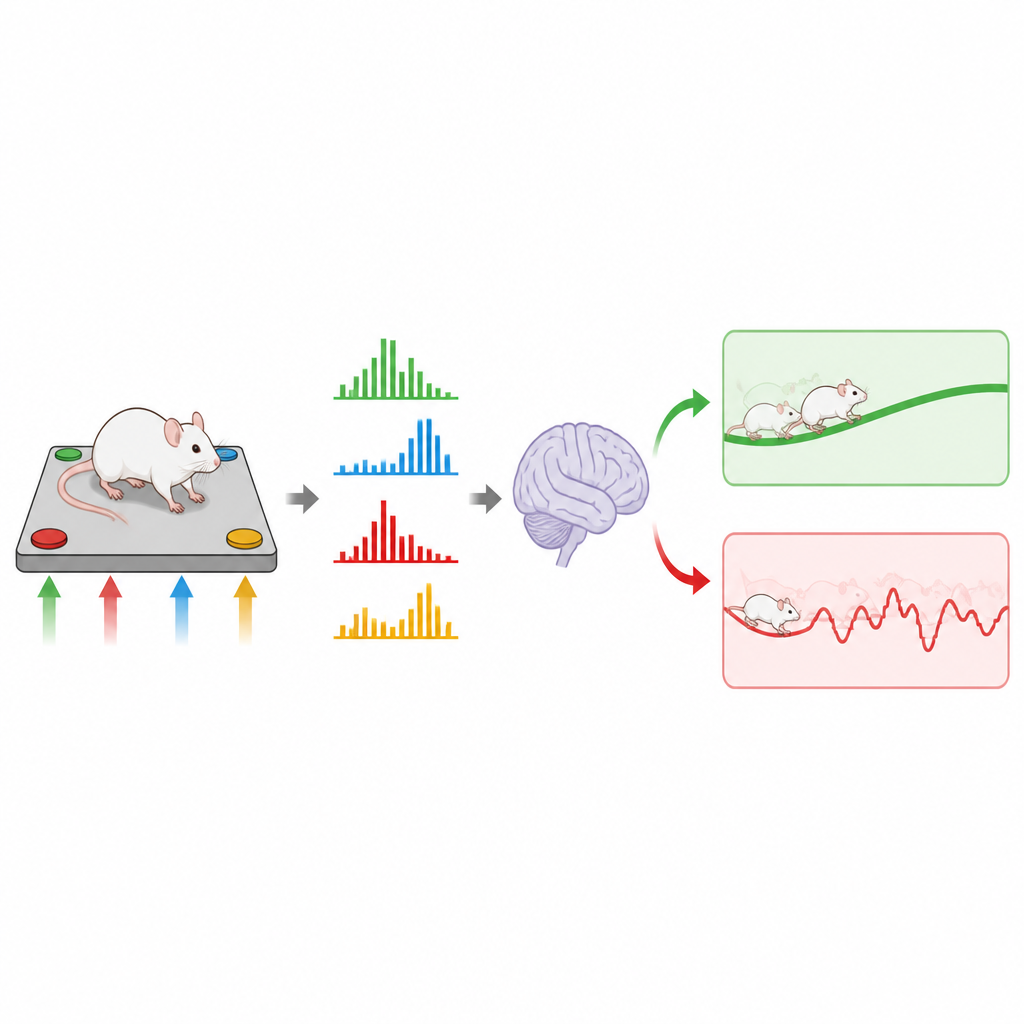
Watching healthy and unsteady animals move
The team then recorded real animals. A normal mouse and a normal rat each explored the arena for several minutes, producing tangled paths that reflected their different movement styles. The mouse roamed more continuously and stayed mostly near the walls, while the rat walked less and spent more time nearly still. From the same data, the software identified periods of low mobility and built up a running total, as well as center versus edge time. Finally, the researchers compared healthy rats with “shaker” rats that carry a mutation causing progressive cerebellar damage and unsteady gait. By examining how twisty each one second segment of the path was, they derived an “ataxia ratio,” which was higher in the shaker rats. They also analyzed the speed signal in the frequency domain and found extra power in the 3 to 8 Hertz band, reflecting stronger tremor in the affected animals.
What this new tool means for future studies
OpenStride does not match the finest precision of older, expensive commercial systems and records at a lower sampling rate, but this tradeoff allows it to be affordable, flexible, and easy to reproduce. The authors have released every design file, part list, and software script on a public code hosting site so that other groups can build, adapt, and extend the system. For many questions in neuroscience, psychology, and pharmacology, especially those focused on overall activity, simple measures of unsteady walking, or tremor in rats, OpenStride already performs well. As more researchers adopt and modify it, this open platform could help shift the study of animal behavior toward richer, more natural movement, measured with tools that any well equipped lab can assemble.
Citation: Yang, Y., Cooper, B., Houghton, M. et al. OpenStride: an inexpensive, open-source force plate actometry system for quantification of rodent motor activity and behaviour. Sci Rep 16, 15147 (2026). https://doi.org/10.1038/s41598-026-44953-z
Keywords: rodent behavior, force plate, gait analysis, tremor, open source hardware