Clear Sky Science · en
Development of biodegradable hydrogels with adjustable moisture retention capacity for agricultural applications
Helping crops weather a thirsty world
Farmers in dry regions walk a tightrope between feeding people and running out of water. This study explores a new kind of soil additive—a biodegradable gel made from plant leftovers and natural minerals—that soaks up water like a sponge and then slowly releases it to crops. By tailoring this material to the harsh conditions of East Kazakhstan, the researchers show how smarter water management in the soil itself could help stabilize harvests, cut pollution, and support food security as the climate gets hotter and drier. 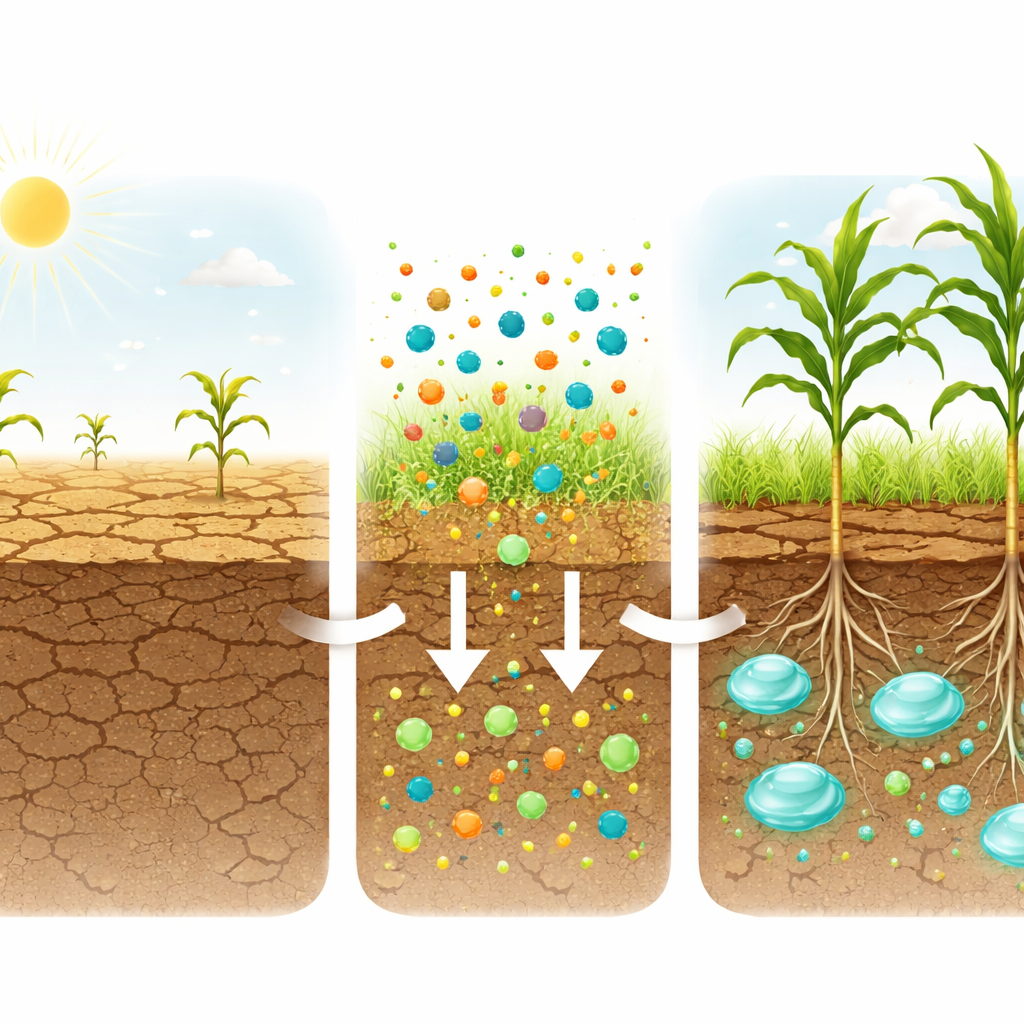
Why dry soils need a new kind of sponge
The team began by taking a close look at farmland in East Kazakhstan, a key grain-growing region where rain is scarce, summers are hot, and winds strip moisture from the ground. They monitored three types of land—irrigated fields, rainfed fields, and naturally arid areas—measuring rainfall, soil temperature, chemical residues, and basic fertility indicators such as organic matter and key nutrients. The driest sites not only had less water and hotter soils; they also showed higher levels of fertilizer leftovers and pesticide traces, a sign that stressed soils tend to hold on to pollution. This background survey confirmed that any new water-saving tool must also be safe for the environment and suited to the local climate.
Turning plant waste into smart water holders
Instead of relying on common synthetic gels that can linger in the environment and break down into microplastics, the researchers built their “soil sponge” from cellulose—an abundant building block of plants—sourced from cotton and wood-processing waste. They chemically linked different forms of cellulose into a three-dimensional network using mild organic acids such as citric and succinic acid. Under the microscope, the resulting particles looked like tiny porous bodies with many internal chambers; tests showed they could swell to more than twice their dry weight in water, especially in fresh water and near‑neutral pH conditions typical of agricultural soils. By adjusting the recipe—how much of each cellulose type and which acid they used—they could tune how much water the gel could hold, how strongly it kept its shape, and how quickly it let moisture trickle back out to the surroundings.
Adding minerals for a slow-drip plant buffet
To go beyond simple water storage, the team blended the gel with naturally occurring minerals such as zeolite and bentonite, which are already used in agriculture to hold nutrients. These composite particles acted as dual-purpose carriers: they trapped water within the gel structure while the minerals stored and then gradually released dissolved plant food. In lab tests, certain combinations—especially those containing both zeolite and bentonite activated with succinic acid—absorbed around twice their weight in water and released up to two-thirds of their nutrient load over two weeks. Tiny test plants grown in soil with these gels produced up to one-quarter more biomass than plants in untreated soil, and statistical analysis showed clear links between the gel’s water and nutrient release behavior and plant growth. 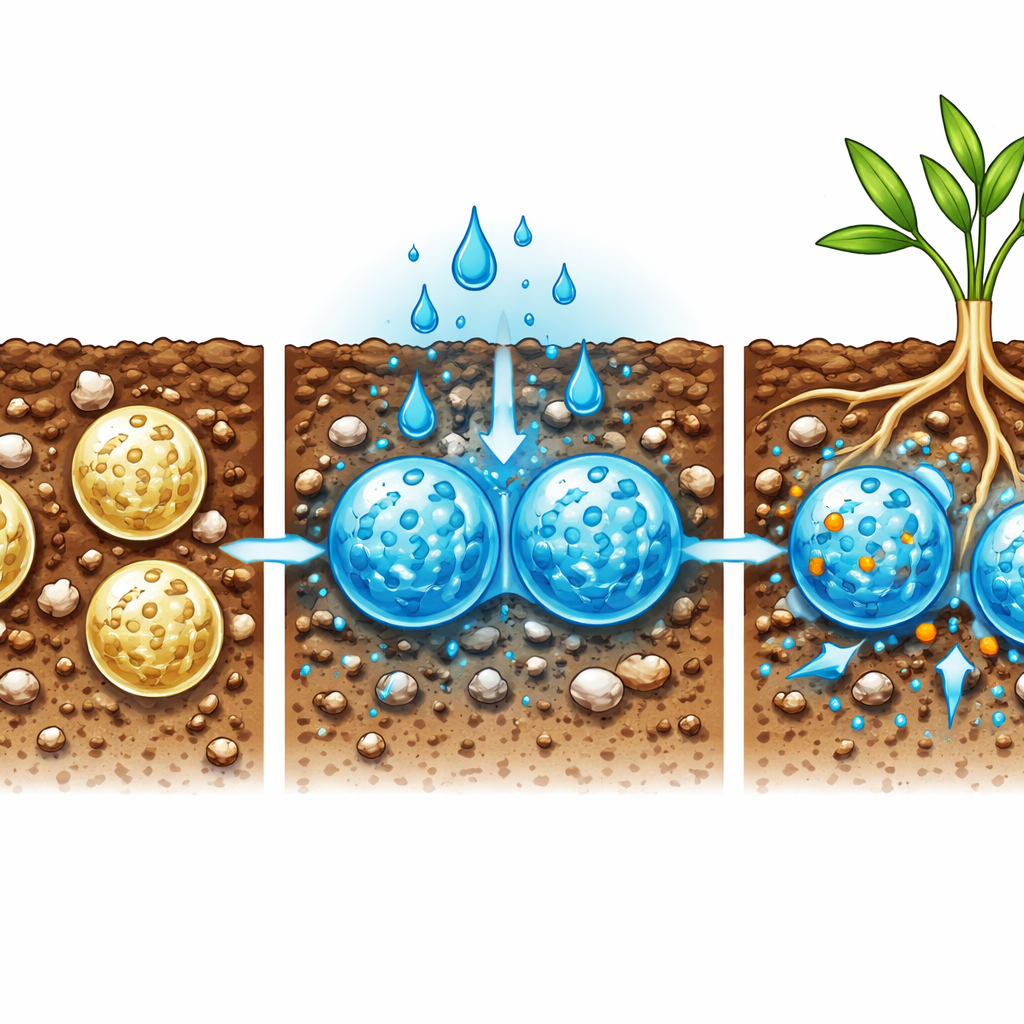
Putting the hydrogel to work in real fields
The researchers then tested the most promising gel formulations in wheat plots across irrigated, rainfed, and arid sites. They compared plots with and without gel, keeping seed, tillage, and watering practices the same. In every setting, soils treated with the biodegradable gel held more water and supported more active soil life. The benefits were most striking under the harshest, driest conditions: arid plots with gel showed higher soil moisture, better seed germination, and notably greater plant biomass than untreated plots. In irrigated fields, the gel still boosted plant mass by more than one‑fifth, suggesting that it can help crops ride out dry spells even when irrigation is available, potentially allowing farmers to reduce watering frequency without sacrificing yield.
What this means for farmers and the future
For non‑specialists, the takeaway is simple: this study presents a soil additive made from plant scraps and natural minerals that soaks up water during wet moments and shares it back with roots during dry ones, all while slowly feeding the plants and then breaking down harmlessly in the soil. Because the material is tailored to the tough climate and soils of East Kazakhstan, it offers a realistic path to help farmers in similar dry zones grow more grain with less water and fewer chemical inputs. With further testing across crops and regions, such biodegradable hydrogels could become a key tool in climate‑smart farming, making fields more resilient to drought without adding new pollution problems.
Citation: Azimov, A., Bolysbek, A., Iztleuov, G. et al. Development of biodegradable hydrogels with adjustable moisture retention capacity for agricultural applications. Sci Rep 16, 14098 (2026). https://doi.org/10.1038/s41598-026-44948-w
Keywords: biodegradable hydrogel, soil moisture, drought-resilient crops, sustainable agriculture, water-saving farming