Clear Sky Science · en
Petrography and physical-mechanical evaluation of mafic-ultramafic rocks from Atud-Um Khasila, Egypt for dimension stone
Rocks Beneath Our Feet
From temple columns to kitchen countertops, much of our built world rests on stone. But not all rocks are equally suited to stand up to decades of footsteps, weather, and wear. This study explores dark, dense rocks in Egypt’s Eastern Desert to find out which ones can safely be cut into large slabs and blocks for buildings and decoration, and which are better left in the ground.
Stones from a Desert Mountain
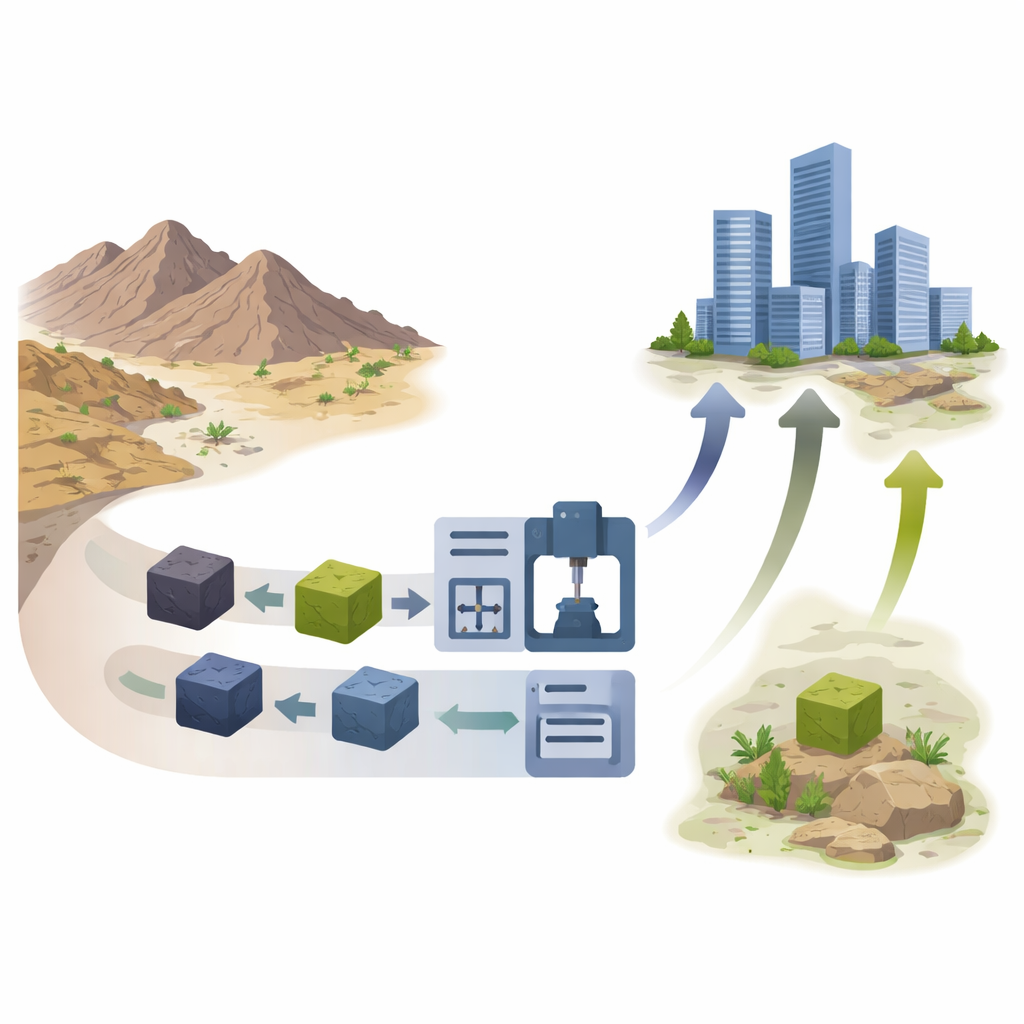
In the Atud–Um Khasila area, about 60 kilometers west of the Red Sea coast, three main rock types crop out together: two kinds of gabbro (metagabbro and olivine gabbro) and a greenish rock called serpentinite. All three belong to a family of dense, dark "mafic" and "ultramafic" rocks formed deep in Earth’s crust and upper mantle. The region is part of the Arabian–Nubian Shield, an ancient geologic collage that has long supplied stone for Egyptian monuments. Because these rocks are widespread and visually attractive, the authors asked a practical question: which of them can reliably serve as dimension stone—large, precisely cut pieces used in facades, floors, and cladding?
Looking Inside the Rock Fabric
The team collected eighteen representative samples and examined thin slices of each under the microscope. The metagabbro and olivine gabbro are dominated by hard, interlocking crystals of feldspar, amphibole, pyroxene, and in places olivine. This tight, puzzle-like fabric tends to lock grains together and resist breakage. In contrast, the serpentinite is mostly made of flaky and fibrous serpentine minerals, with patches and veins of softer carbonates and opaque grains like magnetite. These sheeted and vein-rich textures introduce planes of weakness that can act as ready-made crack paths when the rock is stressed.
How the Stones Performed in the Lab
To translate these microscopic features into real-world behavior, the researchers cut the rocks into cubes and measured properties important for construction: density, how much water they absorb, how many pores they contain, and how much pressure they can withstand before failing. The two gabbro types showed similar performance: relatively high density, very low water uptake, low porosity, and medium compressive strength around the mid-70s megapascals. Serpentinite, although often just as dense, absorbed more water and had lower and more variable strength, averaging about 10 megapascals less than the gabbros. When compared with international standards set by ASTM for structural stone, both gabbros meet key requirements, whereas most serpentinite samples fall short on strength, with only two borderline exceptions.
Testing Weather and Wear
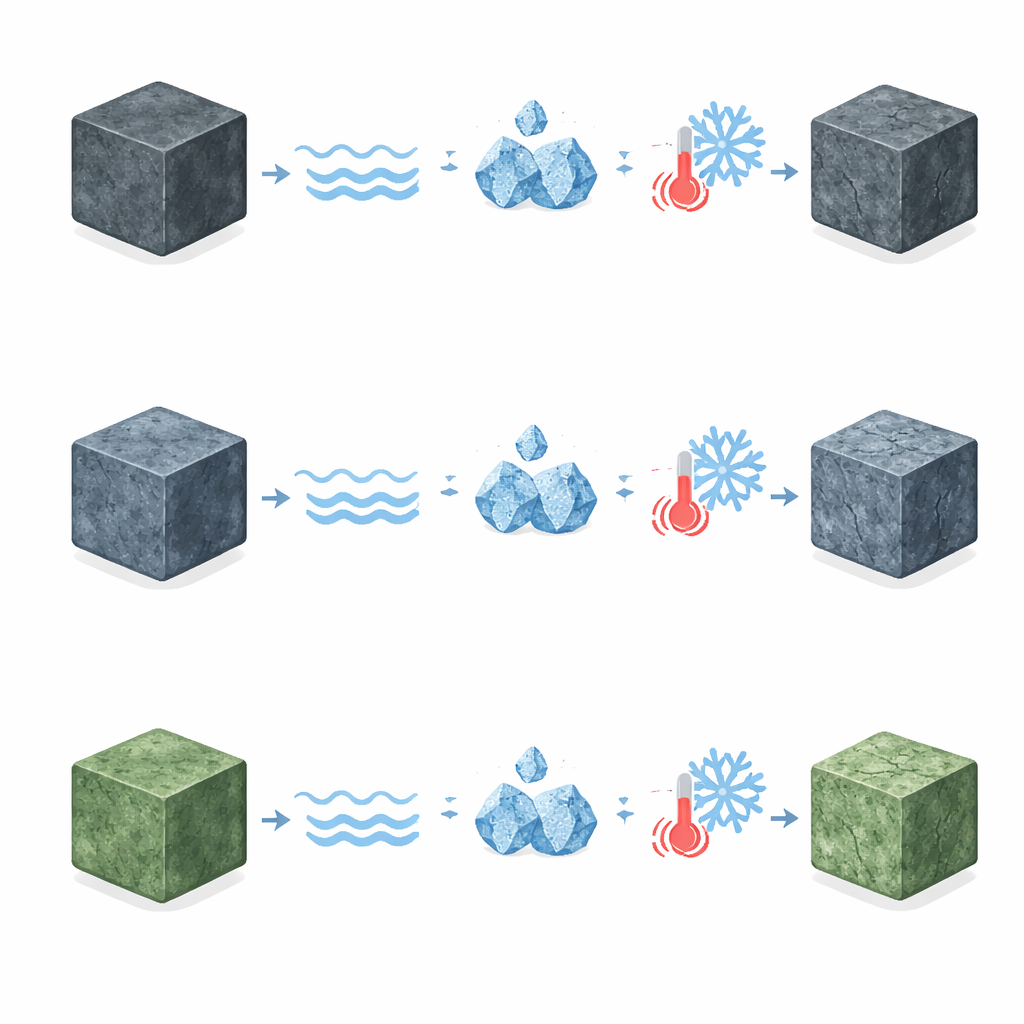
Because serpentinite is widely used for decorative tiles, the team also checked how it stands up to harsh treatment that mimics real environments. Samples were repeatedly soaked in salty solution and dried to encourage salt crystals to form, and were cycled between hot and cool conditions to simulate thermal shock. Visually, the serpentinite cubes developed surface salts and a lightening of color during the salt test, but they did not crack apart. In both tests, weight loss stayed below one percent, indicating that, despite their lower strength, these rocks are not easily eaten away by salt or rapid temperature swings under the conditions studied.
What It Means for Builders and Designers
Taken together, the study shows that not all dark desert rocks are equal as building materials. Metagabbro and olivine gabbro, with their tightly interlocked hard minerals, combine low porosity, low water absorption, and reliable strength, making them solid candidates for load-bearing or exterior uses as dimension stone. Serpentinite, while attractive and fairly durable against salt and heat–cold cycling, tends to be mechanically weaker because of its flaky minerals and vein networks. It may be better reserved for non-structural, decorative applications, and even then only where its variable quality is carefully screened. More broadly, the work highlights that understanding a stone’s mineral makeup and texture is essential before trusting it to support the structures we live and work in.
Citation: Abdel-Rahman, A.M., Latif, M.L.A., Khedr, M.Z. et al. Petrography and physical-mechanical evaluation of mafic-ultramafic rocks from Atud-Um Khasila, Egypt for dimension stone. Sci Rep 16, 12066 (2026). https://doi.org/10.1038/s41598-026-44938-y
Keywords: dimension stone, gabbro, serpentinite, rock strength, Egypt Eastern Desert