Clear Sky Science · en
A novel arc signal and motor power synchronization-based method for precise contact fault diagnosis of GIS disconnector
Keeping the lights on
Modern cities rely on complex high voltage hardware hidden inside metal tanks filled with gas. Among these devices, gas insulated switchgear disconnectors quietly connect and disconnect parts of the power grid. If their moving contacts do not close or open properly, they can overheat, wear out, or even cause blackouts. This study introduces a new way to watch how these hidden parts behave, using tiny flashes of electrical activity and the power drawn by the drive motor to spot problems early and keep electricity flowing safely.
Why hidden switches matter
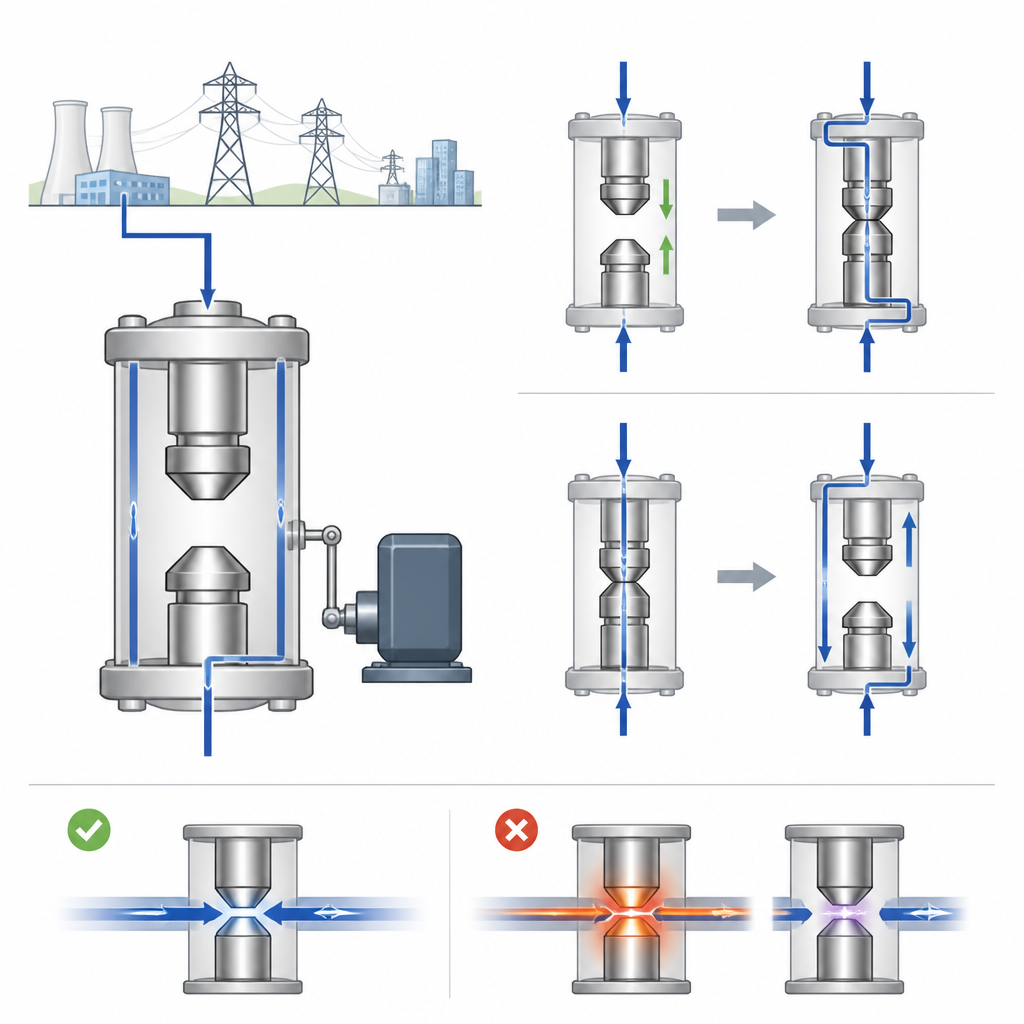
Gas insulated disconnectors sit inside sealed chambers, so engineers cannot see whether the metal contacts inside really touch or separate as intended. Faults such as refusing to close, refusing to open, or not moving far enough can leave only a small contact area or an unsafe gap. That raises electrical resistance, heats the metal, and increases the risk of failure. Traditional monitoring approaches look at overall motor power, vibration, or torque, often feeding these measurements into machine learning tools. While useful, they struggle to pinpoint the exact instant when contacts first touch or finally part, which is vital for judging how far the contacts travel and how safely they separate.
Listening to tiny sparks
The authors focus on the brief electrical arcs that form when contacts in the disconnector approach or pull away from each other. As the gap narrows during closing, an arc appears and then disappears at the exact moment the metals first make solid contact. During opening, the reverse happens: an arc lights up once the gap is large enough and dies out when the separation is safely wide. A simple sensor called a Rogowski coil picks up these arc events as sharp high frequency pulses. By lining up these pulses in time with the motor’s power curve, the method gives a direct, physics based marker of when contacts begin to move, first touch, and finally separate, rather than relying only on pattern recognition.
Cleaning up a messy signal
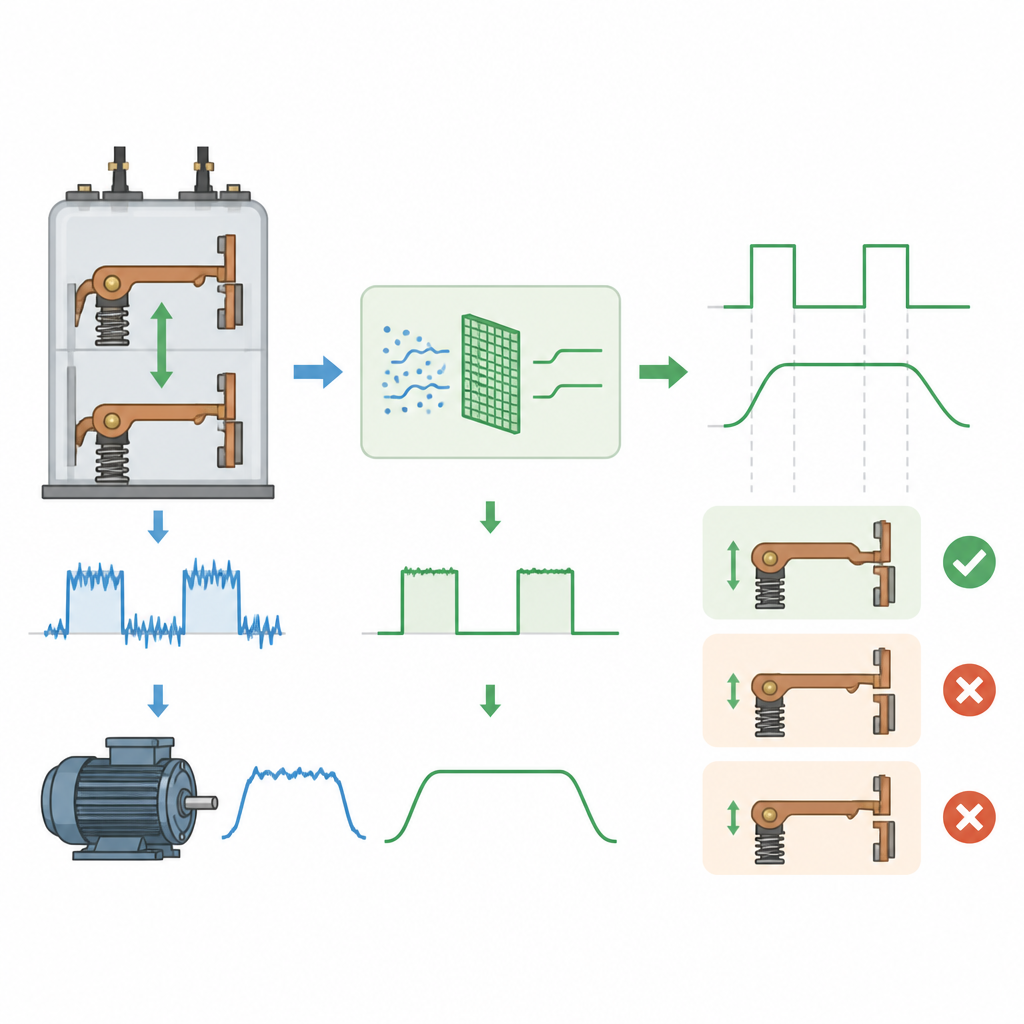
Real world arc signals are buried in noise from the environment and from the measurement electronics, which can hide the true start and end of each arc. To reveal the useful information, the researchers apply a step by step signal cleaning process known as wavelet packet decomposition. This breaks the signal into many frequency bands, allowing noise in some bands to be reduced while keeping the core arc features. They use a measure called power spectral entropy to judge how complex the signal is at each stage. As the signal is decomposed further, the entropy suddenly drops once noise has been separated from the real arc patterns. At that point the process stops, avoiding both under filtering and over smoothing, and leaving a clear picture of when each arc begins and ends.
Spotting unhealthy motion
With denoised arc signals and motor power perfectly aligned in time, the researchers can diagnose several common mechanical faults. If no arc appears during closing, the moving contact never comes close enough, showing a refusal to close. If an arc appears but disappears too soon before the motor stops, the extra travel after first contact is too short, signalling insufficient overtravel and a small contact area. During opening, the absence of an arc indicates a refusal to open, while an arc that ends too early suggests that the contacts did not separate far enough to provide a safe insulating gap. Tests on different disconnector models under real switching conditions show that these patterns repeat reliably, confirming that the approach works across a range of equipment.
What this means for power reliability
By combining the physics of tiny arcs with the more familiar motor power trace, this work turns otherwise hidden motions inside sealed high voltage hardware into clear, measurable events. The adaptive cleaning of the arc signal makes it possible to time the first touch and final separation of contacts with high precision, even in noisy substations. This lets operators distinguish healthy switching from dangerous short travel or stuck contacts without opening the equipment, supporting earlier maintenance decisions and more reliable grids.
Citation: He, S., Ruan, J., Liu, Y. et al. A novel arc signal and motor power synchronization-based method for precise contact fault diagnosis of GIS disconnector. Sci Rep 16, 15655 (2026). https://doi.org/10.1038/s41598-026-44930-6
Keywords: gas insulated switchgear, disconnector fault diagnosis, arc signal, motor power analysis, power system reliability