Clear Sky Science · en
Volcanic tuff as a sustainable precursor for geopolymer synthesis: optimization and microstructural insight
Turning volcanic rock into greener building blocks
Concrete is everywhere around us, but the cement that holds it together releases large amounts of carbon dioxide during production. This study explores whether a common volcanic rock, called tuff, from Algeria can be turned into a strong, low‑carbon binder to replace some traditional cement in future buildings.
From ash-like rock to cement-like binder
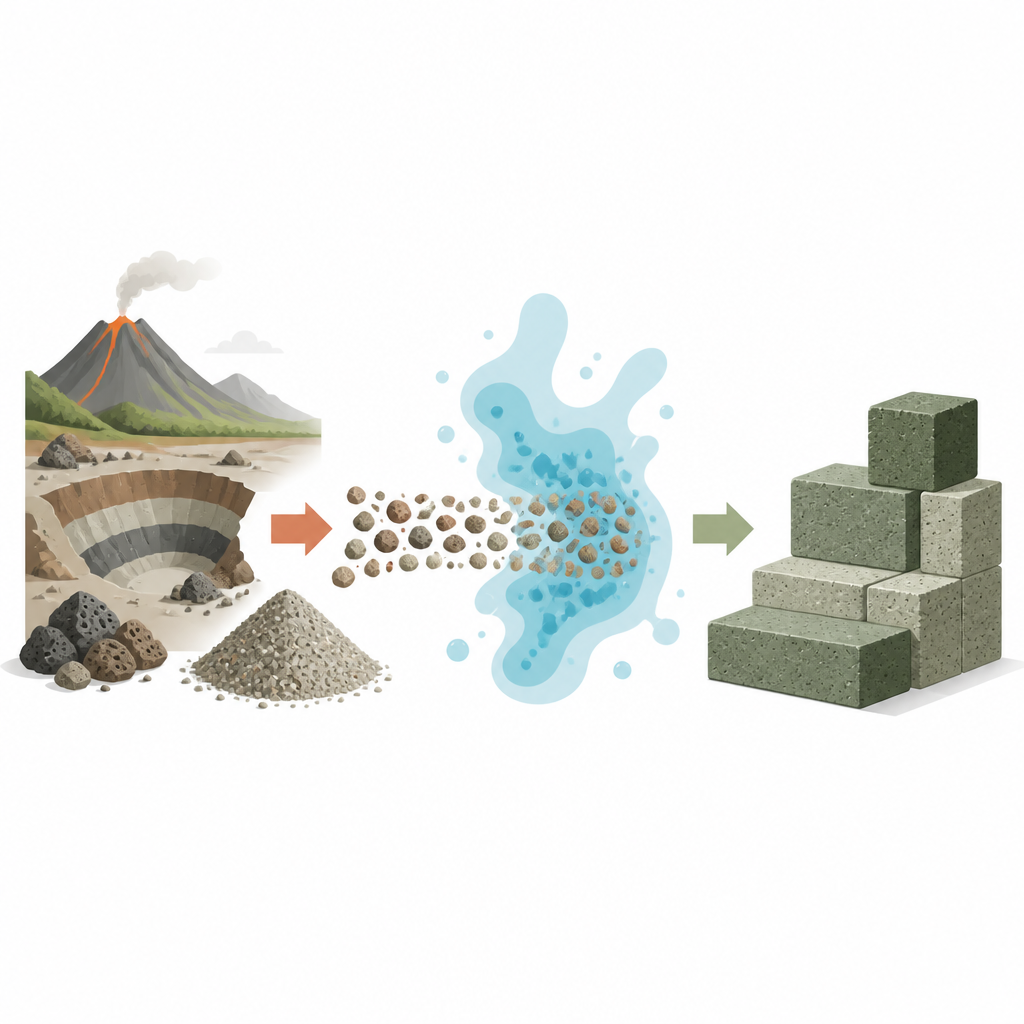
The researchers focused on volcanic tuff from a quarry in northeastern Algeria. This rock is naturally rich in silica and alumina, ingredients that can form a hard, stone-like network when mixed with an alkaline liquid. First, the tuff was dried, finely ground, and chemically analyzed. Tests showed that it meets international criteria for a reactive “pozzolanic” material, meaning it can react with alkaline solutions to form a cement-like binder. The team then combined the tuff powder with sodium hydroxide and sodium silicate solutions to create what is known as a geopolymer paste, which hardens into a solid material.
Tuning the recipe for strength
Rather than changing one ingredient at a time, the team used a statistical design method to search efficiently through many possible combinations. They varied four key factors: how concentrated the sodium hydroxide was, how much extra dissolved silica was added, the curing temperature, and the ratio of liquid solution to solid tuff. Small test samples were cast and then cured at room temperature or in an oven at higher temperatures before being crushed to measure their compressive strength, a simple way to judge how much load the material can bear.
Finding what matters most
The analysis showed that curing temperature had the biggest impact on strength, followed by the amount of added silica in the activator solution and the liquid‑to‑solid ratio. Raising the curing temperature from room temperature to 60 and 80 degrees Celsius greatly increased strength and made the results more consistent. A higher silica content in the solution also helped, strengthening the internal network that forms as the material hardens. By contrast, beyond a certain point, adding more liquid weakened the material, likely because too much water left extra pores behind as it evaporated. The exact concentration of sodium hydroxide mattered less than these other factors, as long as it stayed within a moderate range.
Looking inside the new stone
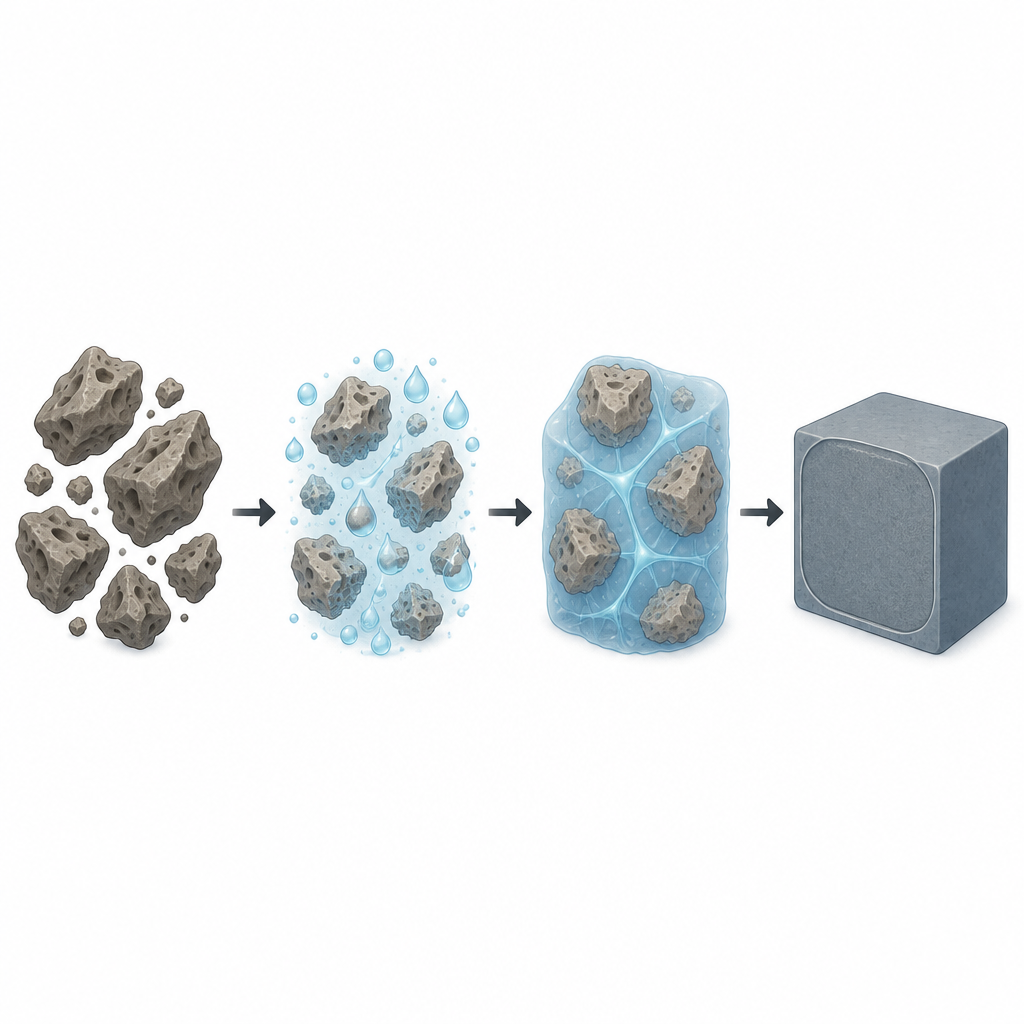
To understand why some mixes were stronger, the team used several tools to peer into the hardened material. X‑ray diffraction and infrared spectroscopy showed that successful mixes formed large amounts of a glassy, gel‑like phase that binds the particles together. Electron microscope images revealed that the best‑performing samples had a dense, crack‑free texture, with gaps between tuff grains filled by this gel. Weaker samples, especially those cured at room temperature with lower silica content, showed more unreacted particles, larger pores, and visible cracks, all of which reduce strength.
Optimizing a practical recipe
Using a mathematical “desirability” approach, the researchers identified a combination of ingredients and curing conditions predicted to give especially high strength. This optimized recipe involved a relatively concentrated alkaline solution, a high silica content, a modest amount of liquid, and curing at 80 degrees Celsius. When this recipe was tested in the lab, the measured strength came close to the predicted value, confirming that the optimization method was reliable and that Algerian volcanic tuff can indeed form a robust geopolymer binder.
What this means for future construction
For non-specialists, the key message is that a widely available natural rock, already quarried in large quantities in Algeria, can be transformed into a strong, cement‑like material when activated with the right alkaline solution and heat. While more work is needed to test long‑term durability and large‑scale production, this study shows that volcanic tuff could help reduce reliance on traditional cement and lower the climate impact of future buildings and infrastructure.
Citation: Boumaza, A., Khouadjia, M.L.K., Belebchouche, C. et al. Volcanic tuff as a sustainable precursor for geopolymer synthesis: optimization and microstructural insight. Sci Rep 16, 14932 (2026). https://doi.org/10.1038/s41598-026-44923-5
Keywords: volcanic tuff, geopolymer, low carbon concrete, curing temperature, sustainable construction