Clear Sky Science · en
Hamiltonian simulation for nonlinear partial differential equation by Schrödingerization
Why this research matters
Many of the patterns we see in nature—from chemicals reacting and diffusing in a petri dish to cells spreading through tissue—are described by equations that are both complex and nonlinear. Accurately simulating these systems on today’s computers quickly becomes overwhelmingly expensive as the system size grows. This study introduces a way to harness quantum computers to tackle an important family of such equations, opening a possible route to analyzing huge, real-world systems far beyond classical reach.
From messy reality to solvable equations
Scientists and engineers often use partial differential equations to describe how quantities like temperature, concentration, or deformation change in space and time. When these equations are linear, there are already quantum algorithms that can simulate their behavior very efficiently. However, many real phenomena—such as turbulent flows, large material deformations, and reaction–diffusion processes—are governed by nonlinear equations, where the rules of change depend on the current state itself. These nonlinearities are precisely what make such systems rich in behavior but also hard to solve, both for classical and quantum methods.
Turning nonlinear problems into linear ones
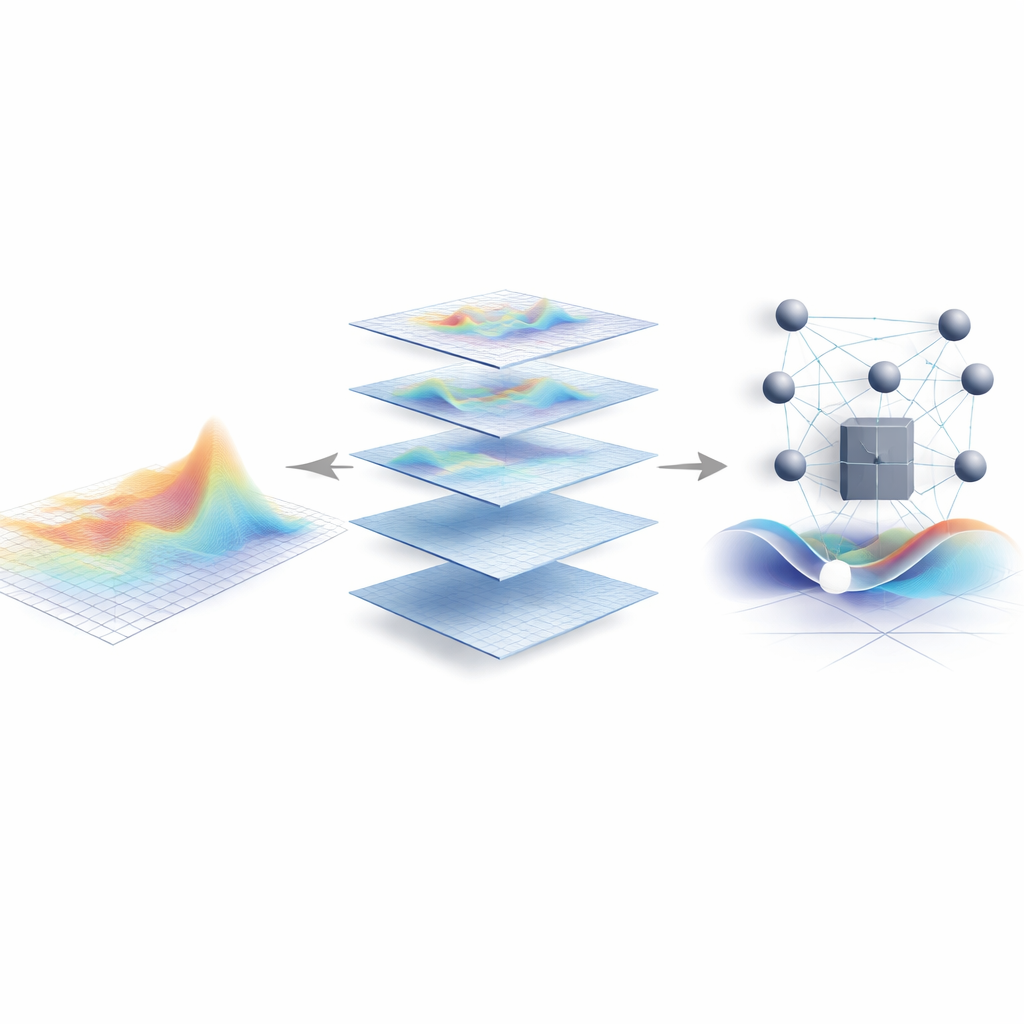
The authors focus on a particular nonlinear equation known as a reaction–diffusion equation, widely used to model patterns in materials and biology. Their first step is to apply a mathematical technique called Carleman linearization. Conceptually, this method replaces the original nonlinear system with a much larger linear one by tracking not only the basic variables, but also all of their products up to a chosen order. In practice, this infinite hierarchy is truncated at a manageable level, producing a large but purely linear system that still approximates the original nonlinear dynamics. This step makes the problem more compatible with quantum hardware, which naturally deals with linear evolution.
Making dissipative dynamics look quantum
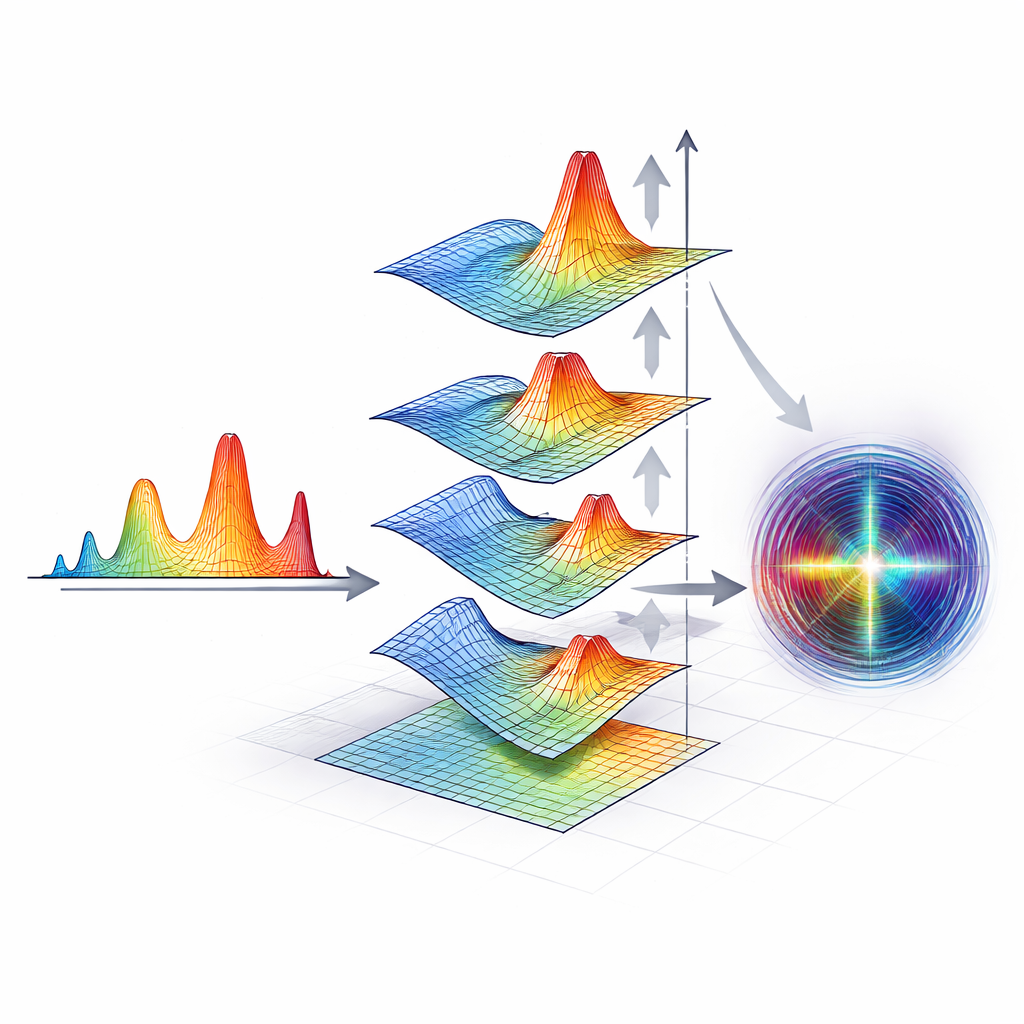
Even after linearization, the resulting equations typically describe a dissipative system, where quantities may decay or spread irreversibly. Quantum evolution, by contrast, is conservative: it preserves overall probability and is mathematically represented by unitary operations. To bridge this gap, the authors use a method called Schrödingerization based on warped phase transformation. They introduce an extra artificial variable and reformulate the linear system so that its evolution can be written in the same mathematical form as the Schrödinger equation that governs quantum mechanics. In this enlarged space, the time evolution is unitary, meaning it can, in principle, be implemented directly as a quantum Hamiltonian simulation.
Testing the method on a model problem
To evaluate their approach, the researchers apply their combined procedure—Carleman linearization plus Schrödingerization, or CLS—to a classic nonlinear reaction–diffusion model known as the KPP–Fisher equation. They discretize space and the auxiliary variable, then simulate the time evolution using standard numerical techniques, comparing the CLS-based results with those from more conventional finite difference methods. The shapes and motion of the simulated waves agree closely across methods, and a detailed error analysis shows how the accuracy depends on choices such as the truncation order in the linearization and the fineness of the spatial grids. The study finds that errors behave in a controlled, predictable way, primarily governed by standard numerical approximations rather than any fundamental flaw in the CLS transformation itself.
What this means for future quantum simulations
In plain terms, the work demonstrates that a broad class of nonlinear equations can be systematically recast into a form that a quantum computer is designed to handle. While the present study uses classical simulations to validate the scheme, the same steps could be translated into quantum circuits that implement the corresponding Hamiltonian evolution. If future quantum devices can realize these circuits at scale, CLS could enable efficient simulations of enormously complex systems—such as large chemical reaction networks or intricate phase separation processes—where classical methods become prohibitively slow. The main takeaway is that nonlinear behavior in the physical world does not necessarily exclude the use of powerful Hamiltonian-based quantum algorithms; instead, with the right mathematical bridge, it can be brought into the quantum realm.
Citation: Sasaki, S., Endo, K. & Muramatsu, M. Hamiltonian simulation for nonlinear partial differential equation by Schrödingerization. Sci Rep 16, 11743 (2026). https://doi.org/10.1038/s41598-026-44920-8
Keywords: quantum computing, Hamiltonian simulation, nonlinear PDEs, reaction–diffusion, Carleman linearization