Clear Sky Science · en
Germ cells are essential for testicular morphogenesis and functional reconstruction in a porcine xenograft model
Why rebuilding testis tissue matters
Heat stress and other environmental changes are making it harder for farm animals to reproduce, threatening food production worldwide. Scientists are therefore searching for ways to grow sperm outside the body, which could protect valuable breeding lines and help restore fertility when testicles are damaged. This study explores how to rebuild working testis tissue from pig cells placed under the skin of mice, and asks a simple but crucial question: are the sperm‑producing germ cells themselves needed to organize the whole structure, or can the support cells do it alone? 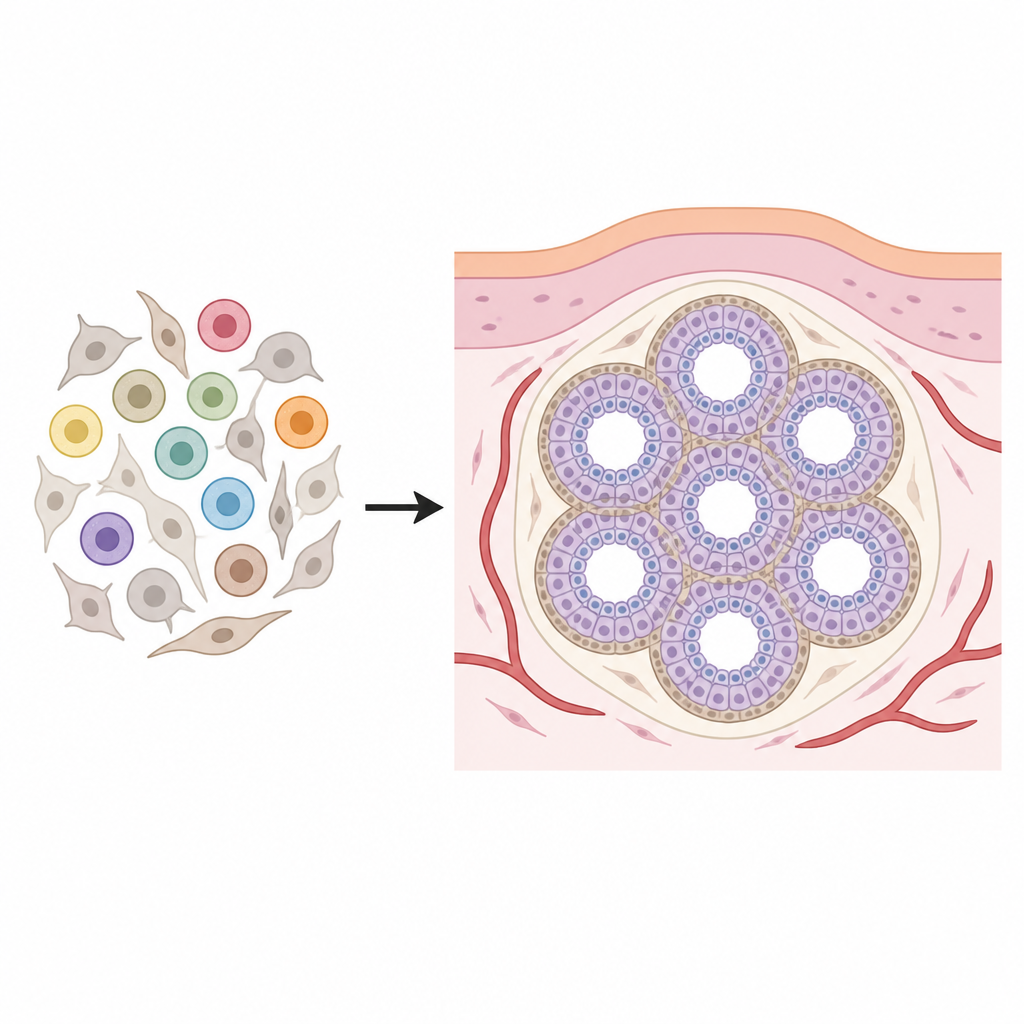
Building tiny testes in a new home
The researchers began with testicles from newborn piglets and separated the cells into two main groups. One mixture contained both germ cells, including spermatogonial stem cells that can start the sperm‑making process, plus a rich collection of support cells. The other mixture had only support cells and was deliberately stripped of germ cells. Both mixtures were combined with a jelly‑like scaffold and carefully injected under the skin of immune‑deficient mice, where they were left for six months to see whether they could self‑assemble into testis‑like tissue.
When germ cells are present, full structures form
Grafts that contained germ cells grew into round, cohesive balls of tissue with many blood vessels running through and around them. Under the microscope, these grafts showed well‑organized circular tubules closely resembling those in a normal testis. Support cells lined up neatly along the outer edge of each tubule, while layers of developing germ cells filled the inside and formed clear central spaces. The team detected multiple stages of sperm development, from early germ cells on the tubule wall to later spermatids closer to the center, along with proteins that mark the different steps of maturation. Gene activity patterns in these grafts were rich in signals associated with cell division and sperm formation, indicating that the rebuilt tissue was not just structurally correct but also functionally active.
Without germ cells, structure and identity fall apart
The story was very different in grafts made only from support‑cell‑rich mixtures. These grew as flatter, fragmented pieces with fewer blood vessels and simple, misshapen tubules. The outer layers lacked the normal basement membrane, and the inner cell masses often pulled away instead of forming a stable wall. Key support cells lost their usual position and molecular identity, and some began to show traits more typical of female reproductive cells. Genetic analyses showed that, rather than switching on sperm‑related programs, these germ‑cell‑free tissues activated genes linked to blood clotting, scarring, inflammation, and early, non‑specific tissue development. In essence, they formed a kind of generic, partially tubelike tissue rather than a true testis. 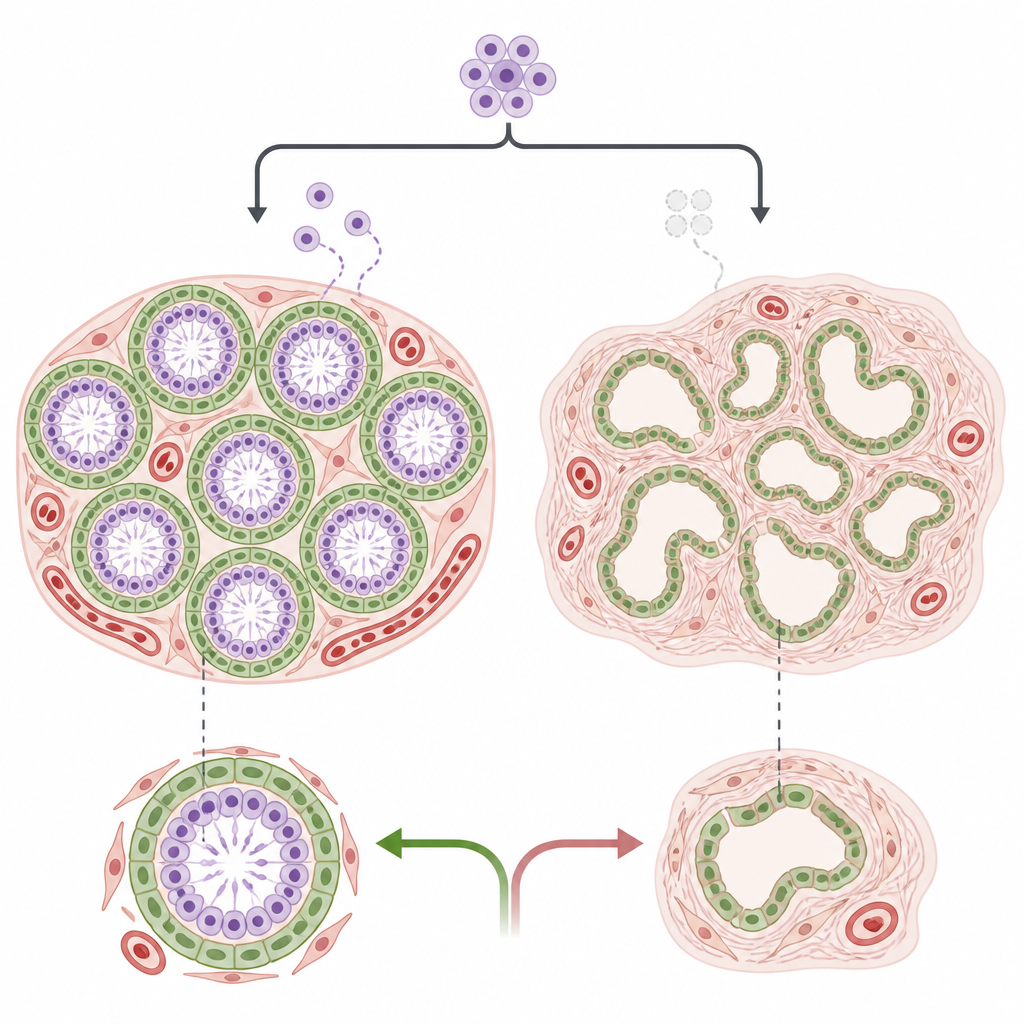
A new model for livestock reproduction
By comparing these two outcomes side by side, the study demonstrates that germ cells do far more than simply sit inside tubules and turn into sperm. They help guide blood vessel growth, keep support cells in the right place, and lock in the male identity of the tissue. In this pig‑to‑mouse graft system, only mixtures that included germ cells rebuilt testis‑like structures capable of progressing toward sperm production. This model therefore offers a powerful tool for refining lab‑based sperm production in large animals, which could eventually support livestock breeding, preserve elite genetic lines, and aid fertility recovery after damage, all while highlighting that healthy sperm‑forming cells are central architects of the testis itself.
Citation: Han, MG., Jeon, Y., Maeng, H. et al. Germ cells are essential for testicular morphogenesis and functional reconstruction in a porcine xenograft model. Sci Rep 16, 14719 (2026). https://doi.org/10.1038/s41598-026-44916-4
Keywords: germ cells, spermatogonial stem cells, testis reconstruction, xenograft, livestock fertility