Clear Sky Science · en
Forecasting of global water usage in agriculture and total global consumption by using the Bi-GRU model
Why future water use matters to everyone
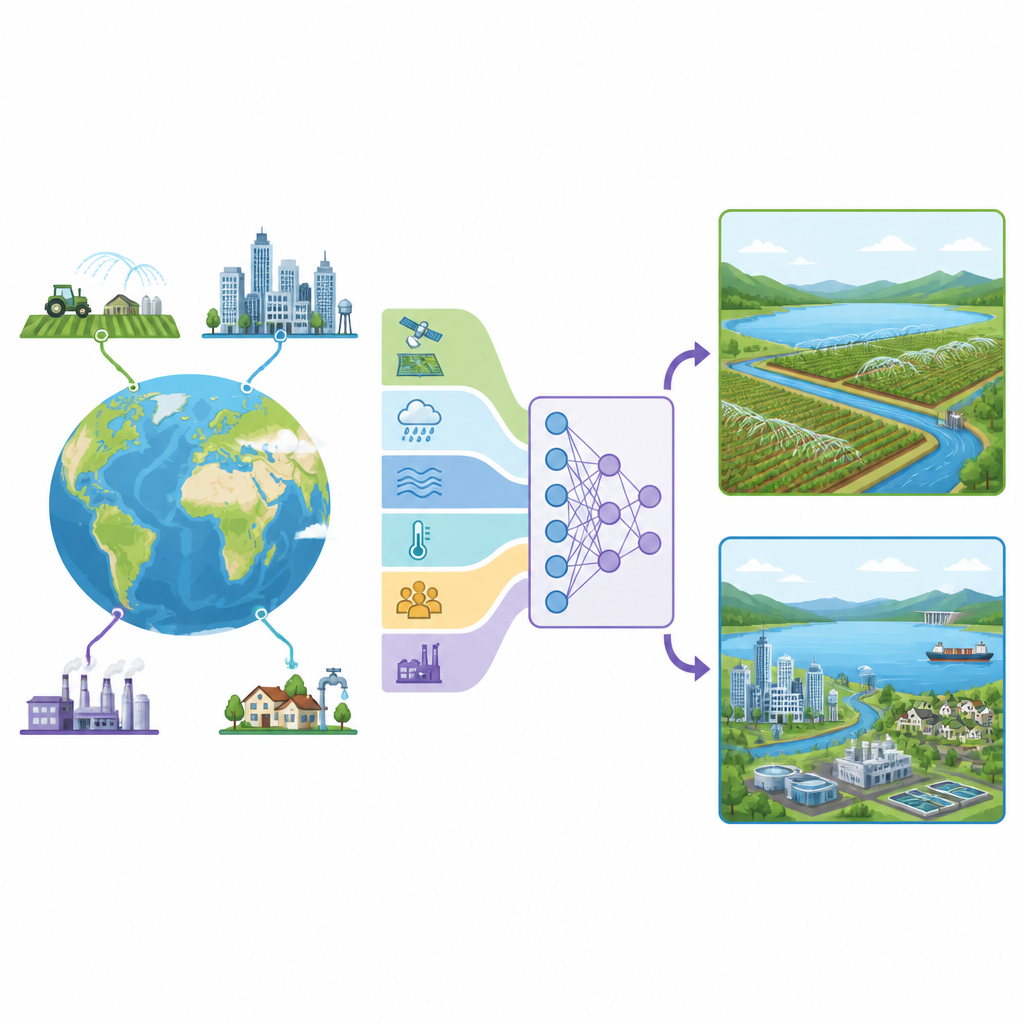
Clean water underpins our food, cities and industry, yet many regions already face shortages. This study asks a simple but urgent question: how much water will the world need in the coming decades, especially for farming, which uses most of our freshwater? By combining global records of water use with a modern artificial intelligence tool, the authors estimate future demand up to 2040 and test how well different forecasting methods work. Their results can help governments and planners prepare for a drier, more crowded world.
Growing pressure on rivers and aquifers
The paper begins by setting the stage: water covers most of Earth’s surface, but the portion that is fresh and readily usable is limited. Global demand has risen about sixfold over the last century, with roughly 70 percent of withdrawals going to agriculture, 20 percent to industry and the rest to homes. Much of the expected population growth will occur in Africa and Asia, regions already vulnerable to water stress and climate change. Countries such as India, China, Indonesia, Saudi Arabia and Turkey are seeing rapid increases in water use as cities expand, economies grow and more land is irrigated. In contrast, places like Germany, Japan and the United Kingdom show stable or slightly declining use thanks to conservation and efficiency measures.
Turning worldwide water records into a usable dataset
To move from concern to prediction, the authors assemble a Global Water Consumption Dataset covering the years 2000 to 2024 for twenty major economies spread across different climates and income levels. For each country and year, the dataset includes total water use, water devoted to agriculture, household and industrial use per person, rainfall effects and the rate at which groundwater is being depleted. The team carefully cleans the data, checks for missing or abnormal values and rescales all numbers to a common range so that no single country or variable dominates the learning process. They then split each country’s time series into training, validation and testing segments, ensuring that later years remain unseen during training so that the forecasts can be fairly judged.
How a smart sequence model reads the past
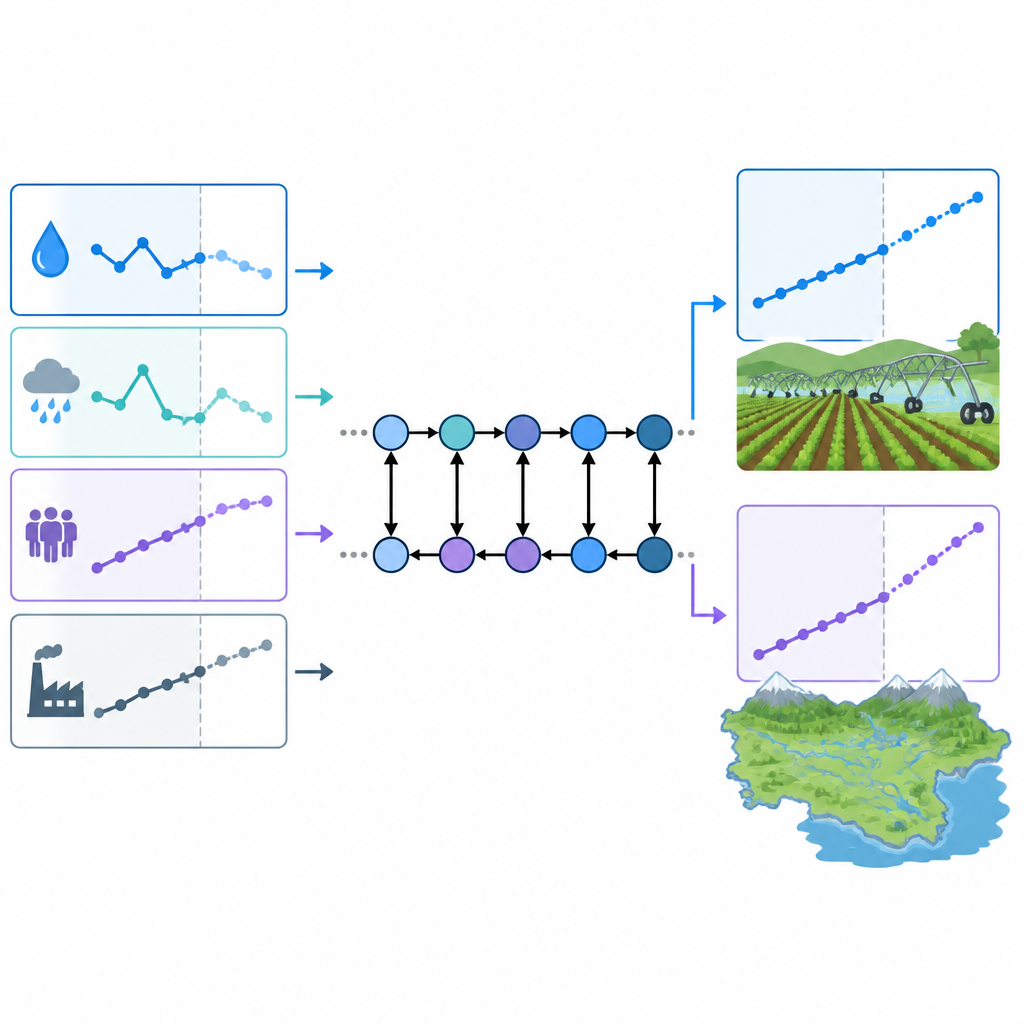
The core of the study is a deep learning model called a bidirectional gated recurrent unit, or Bi GRU. Unlike simple trend lines, this model is designed to read sequences. It processes the history of water use and related factors in both forward and backward directions, allowing it to pick up patterns that depend on long runs of good or bad rainfall, gradual policy changes or slow shifts in population and industry. The network layers compress these patterns into an internal representation and then output two main quantities for each country: total water use and agricultural water use. The authors compare Bi GRU against several advanced alternatives, including long short term memory networks, a temporal transformer model, a graph based model that links countries and a probabilistic forecasting method.
How well the forecasts hold up
When tested on unseen data from 2021 to 2024, the Bi GRU consistently makes the most accurate predictions overall. Measured by common error scores, it outperforms all rival models for most countries, especially those with relatively stable long term patterns such as India, Germany and the United Kingdom. The authors also perform statistical tests to show that the improvements are not due to chance. Using the best performing model, they project total and agricultural water use from 2025 to 2040. Some countries, including India, Turkey and several rapidly growing economies, are expected to see continued increases in demand, particularly for irrigation. Others may stabilize or even reduce their consumption if current efficiency trends continue.
What the findings mean for food and water security
For a non specialist reader, the key message is that better long range forecasts can turn vague worries about “future water shortages” into concrete numbers that planners can act on. The study shows that modern sequence based artificial intelligence can track how climate, population and development interact to shape national water use, and can do so more accurately than earlier methods. These forecasts do not guarantee what will happen, but they highlight where agricultural and total demand are most likely to strain supplies, guiding investments in irrigation technology, storage, recycling and policy reforms. In short, smarter forecasting is one practical tool for keeping taps running and fields productive in a warming, more crowded world.
Citation: Irfan, M., Rashid, J., Bibi, J. et al. Forecasting of global water usage in agriculture and total global consumption by using the Bi-GRU model. Sci Rep 16, 15071 (2026). https://doi.org/10.1038/s41598-026-44885-8
Keywords: global water use, agricultural water, deep learning forecast, Bi-GRU model, water demand prediction