Clear Sky Science · en
Optimizing photoperiod for growth and centellosides biosynthesis in Centella asiatica under vertical farming conditions
Why light schedules matter for a healing herb
Many people know Centella asiatica, also called gotu kola, from skin creams and traditional remedies for wound healing and circulation. As demand grows, farmers and companies are looking for ways to grow this delicate herb indoors, where light, temperature, and water can be carefully controlled. This study asks a simple but powerful question: how many hours of light and darkness per day give the best mix of plant growth, medicinal ingredients, and energy savings when Centella is grown in stacked, indoor vertical farms?
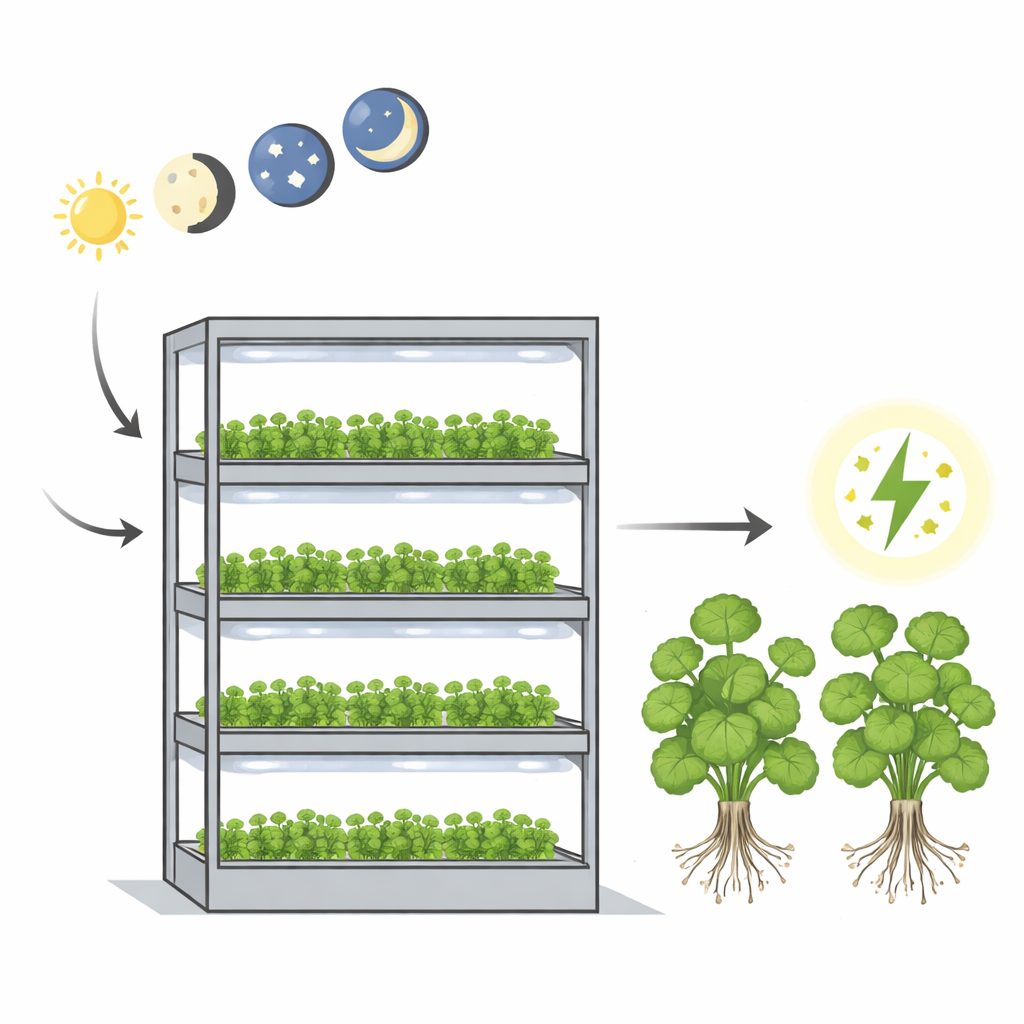
Farming upwards instead of outwards
Vertical farms grow plants on shelves under artificial lamps, allowing year-round harvests in cities or harsh climates. But the lights are both the engine of growth and the main cost. Too little light and plants stay small; too much and electricity bills soar and leaves can become damaged. The researchers grew Centella asiatica for four weeks under white LED lamps at the same brightness, but with four different day–night schedules: very long days (20 hours light, 4 dark), long days (16/8), equal days and nights (12/12), and short days (8/16). Because brightness was fixed, changing the length of the day also changed how much total light the plants received each day.
Growth trade-offs under different day lengths
The team measured how big the plants became—fresh and dry weight of shoots and roots, leaf size, and the number of leaves and creeping stems (runners). In general, Centella grew poorly under the shortest days: plants exposed to only eight hours of light had the smallest shoots, roots, and leaf area. Growth improved as days got longer, but not in a simple straight line. Shoots were heaviest at the 12-hour day, slightly less at 16 and 20 hours, suggesting that more light beyond a certain point did not keep boosting aboveground growth. Roots behaved a bit differently, with the heaviest roots under the very long 20-hour day. However, the plants under 16- and 20-hour days began to show stress symptoms like darkened leaves, curling edges, and dead leaf tips, warning signs that the light dose was becoming too much for healthy development.
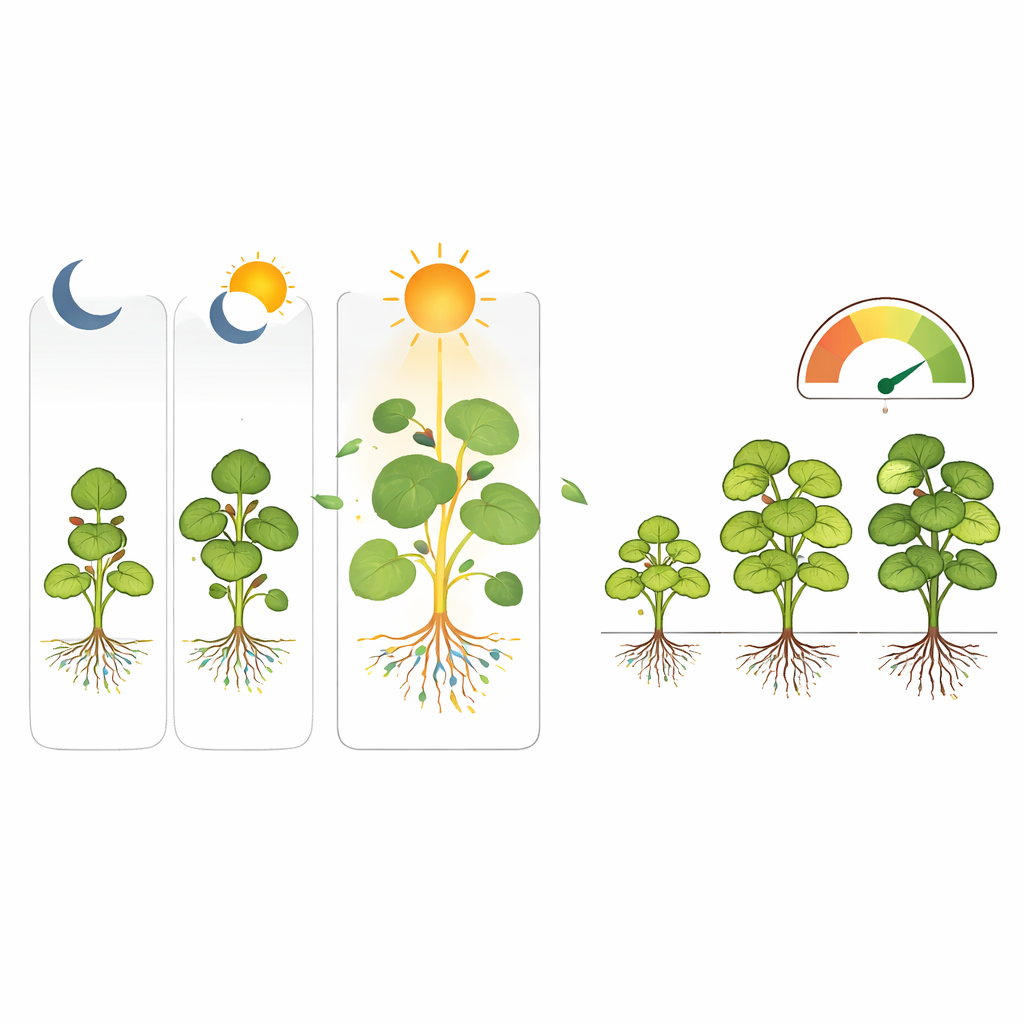
Medicinal ingredients and natural defenses
Centella is prized for compounds called centellosides—madecassoside, asiaticoside, and their related acids—as well as other natural chemicals that act as antioxidants. The researchers tested leaves for total phenols, flavonoids, and antioxidant strength, along with the four key centellosides. Longer days generally raised the levels of phenols, flavonoids, and antioxidant activity, with the highest values under the 20-hour day and the lowest under the 8-hour day. The centellosides responded more subtly. The sugar-linked forms (madecassoside and asiaticoside, favored by the cosmetics and pharmaceutical industries) were higher once day length reached 12–16 hours, while the acid forms were most abundant under the short 8-hour day. This pattern suggests that moderate to long days steer the plant’s chemistry toward the more desirable, gentle saponins, whereas short days favor a different branch of the pathway.
Balancing plant growth and power bills
Because indoor farming runs on electricity, the team also asked which light schedule gave the most plant matter per unit of light and energy. They calculated light-use efficiency (how much dry biomass is produced for a given light dose) and energy-use efficiency (how much biomass per unit of electric power and time). While total biomass tended to rise with longer days, the 12-hour day provided the best overall balance. At this setting, the plants grew vigorously, produced attractive amounts of valuable centellosides, and used light and electricity more efficiently than those under very short or very long days. Pushing beyond 12 hours of light further increased some antioxidant measures but at the cost of visible stress and poorer use of energy.
Take-home message for future indoor herb farms
For growers aiming to produce high-quality Centella asiatica in vertical farms, this study points to a simple target: about 12 hours of light and 12 hours of darkness each day, under moderate white LED brightness. Under these conditions, plants reach a healthy size, pack their leaves with sought-after centellosides, and do so using electricity more efficiently than under both shorter and much longer days. In other words, for this healing herb, an even split between day and night offers the sweet spot where plant health, product quality, and energy savings come together.
Citation: Yang, GS., Kang, IJ., Sim, HS. et al. Optimizing photoperiod for growth and centellosides biosynthesis in Centella asiatica under vertical farming conditions. Sci Rep 16, 14537 (2026). https://doi.org/10.1038/s41598-026-44883-w
Keywords: vertical farming, Centella asiatica, photoperiod, medicinal plants, LED lighting