Clear Sky Science · en
Model test study on the vertical bearing performance of post-grouted piles based on different grouting materials
Stronger supports beneath our feet
Modern cities rely on deep foundations—long columns called piles that carry the weight of buildings, bridges, and rail lines down into the ground. But in sandy soils, especially where groundwater is flowing, these piles can lose strength over time. This study explores a simple idea with big consequences: if we inject different kinds of liquid mixtures around the piles after they are built, which recipe makes the ground grip the pile best and keep heavy structures safer and steadier?
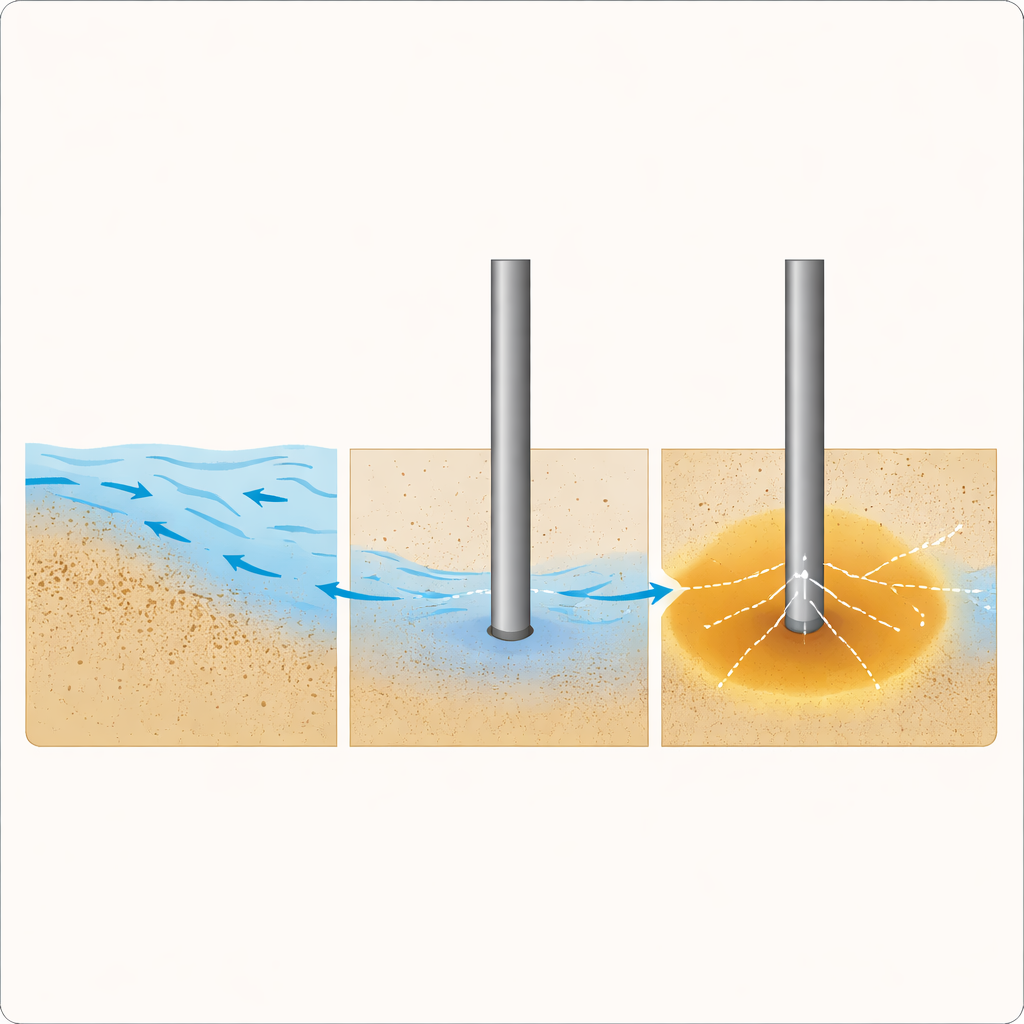
How engineers strengthen hidden foundations
The researchers focused on a technique known as post-grouting. After a pile is installed, thin tubes along its sides are used to pump a watery cement mixture into the sand. As this mixture hardens, it forms a strengthened shell around the pile that can share more of the load. The team compared four such mixtures—ordinary cement, cement mixed with sodium silicate, a blend of fly ash and cement, and a newer material called a geopolymer—against piles with no grouting at all. They built carefully controlled small-scale piles in a large steel container filled with sand, and even mimicked natural groundwater flow through the soil for some of the tests.
Watching piles carry more load with less sinking
Each model pile was loaded step by step from the top while instruments measured how much it sank and how forces traveled down its length. All four grouted piles carried much more weight than the ungrouted pile before showing signs of failure. The fly ash–cement and geopolymer mixtures nearly doubled the pile’s capacity, while the ordinary cement mixture more than tripled it. The star performer was the cement–sodium silicate mixture, which increased capacity to almost five times that of the bare pile and kept the load–settlement curves smooth, meaning the pile did not suddenly plunge as the load increased.
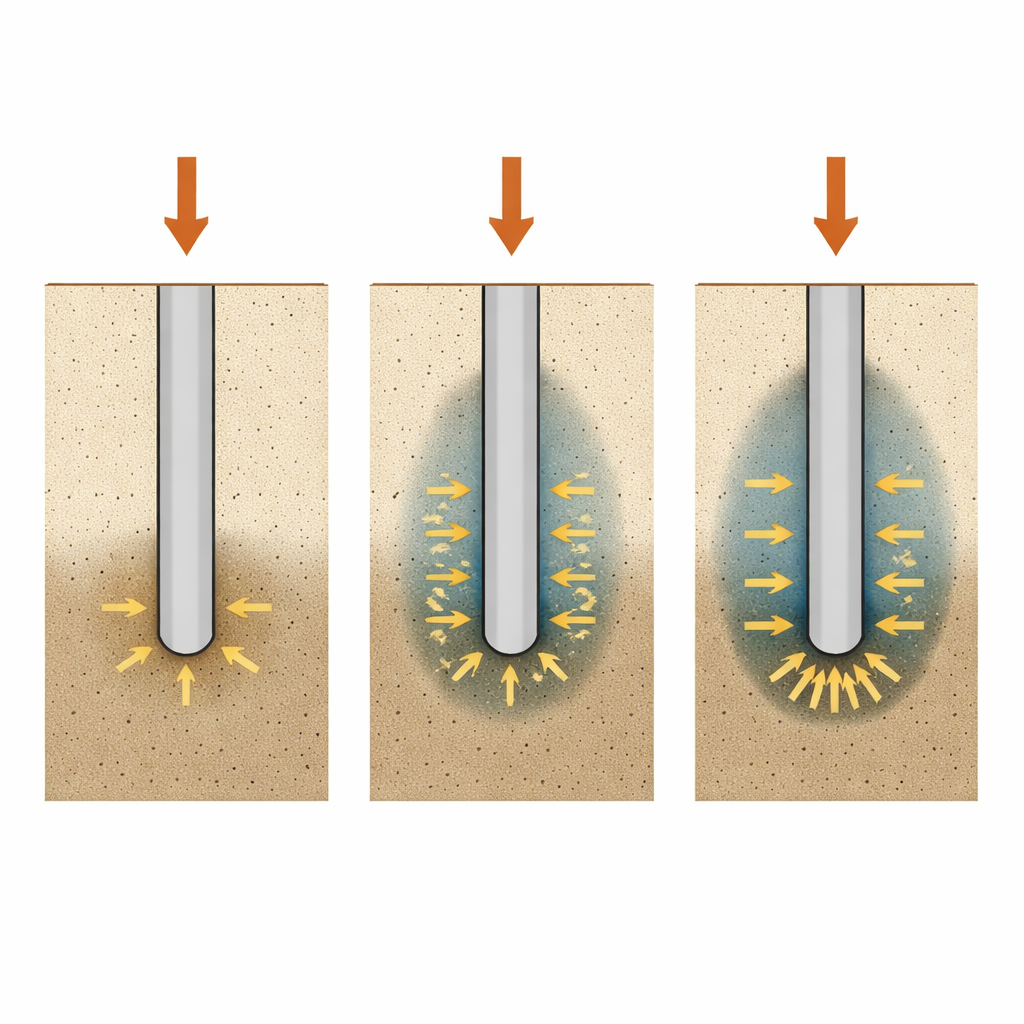
How the ground grips the pile
The measurements revealed that most of the extra strength did not come from pushing on the soil at the very tip of the pile, but from friction along its sides. With grouting, forces dropped off more quickly from the pile head to the tip, showing that the surrounding sand was engaging more strongly. In the best case, the average side resistance for the cement–sodium silicate mixture was more than five times that of the ungrouted pile. Under flowing water, this dual-liquid grout held a clear edge over plain cement, because it hardened quickly, leaked less, and created a thicker, more effective reinforced zone along the shaft.
What happens at the grain level
To understand why some mixtures worked better, the team cut out samples of the hardened grout and examined them with a scanning electron microscope. Untreated sand grains looked sharp-edged and loosely packed, with many open gaps. After grouting, all mixtures left behind networks of microscopic crystals and gels that glued grains together and filled spaces. The cement–sodium silicate mixture produced the densest mesh of interwoven products, creating a tightly locked structure. The geopolymer mixture also formed abundant bonding material, whereas the fly ash–cement blend showed many unreacted spheres of ash, suggesting that its strength was limited by incomplete hardening.
What this means for real-world projects
For non-specialists, the takeaway is straightforward: injecting the right liquid around piles can dramatically boost how much weight they safely carry and how little they settle, even in sandy ground swept by groundwater. While all tested grouts helped, the cement–sodium silicate mixture stood out for its quick setting, strong bonding, and ability to resist being washed away. This points engineers toward more reliable and potentially shorter or slimmer foundations, reducing material use and cost while improving the safety of the structures resting on top.
Citation: Chu, C., Yi, T., Qin, Y. et al. Model test study on the vertical bearing performance of post-grouted piles based on different grouting materials. Sci Rep 16, 14635 (2026). https://doi.org/10.1038/s41598-026-44882-x
Keywords: pile foundations, ground improvement, grouting materials, sandy soil, geopolymer