Clear Sky Science · en
Identification of heat-treated lithic artifacts via quantitative surface gloss characterization
Shiny stones and ancient skill
Why do some stone tools from the distant past look almost waxy and bright, while others appear dull and rough? That glossy sheen is more than a visual curiosity: it can reveal how early craftspeople carefully heated their raw stone to make better tools. This study shows how a simple light test can reliably spot such heat-treated pieces, giving archaeologists a portable way to read traces of ancient know-how from a stone’s shine. 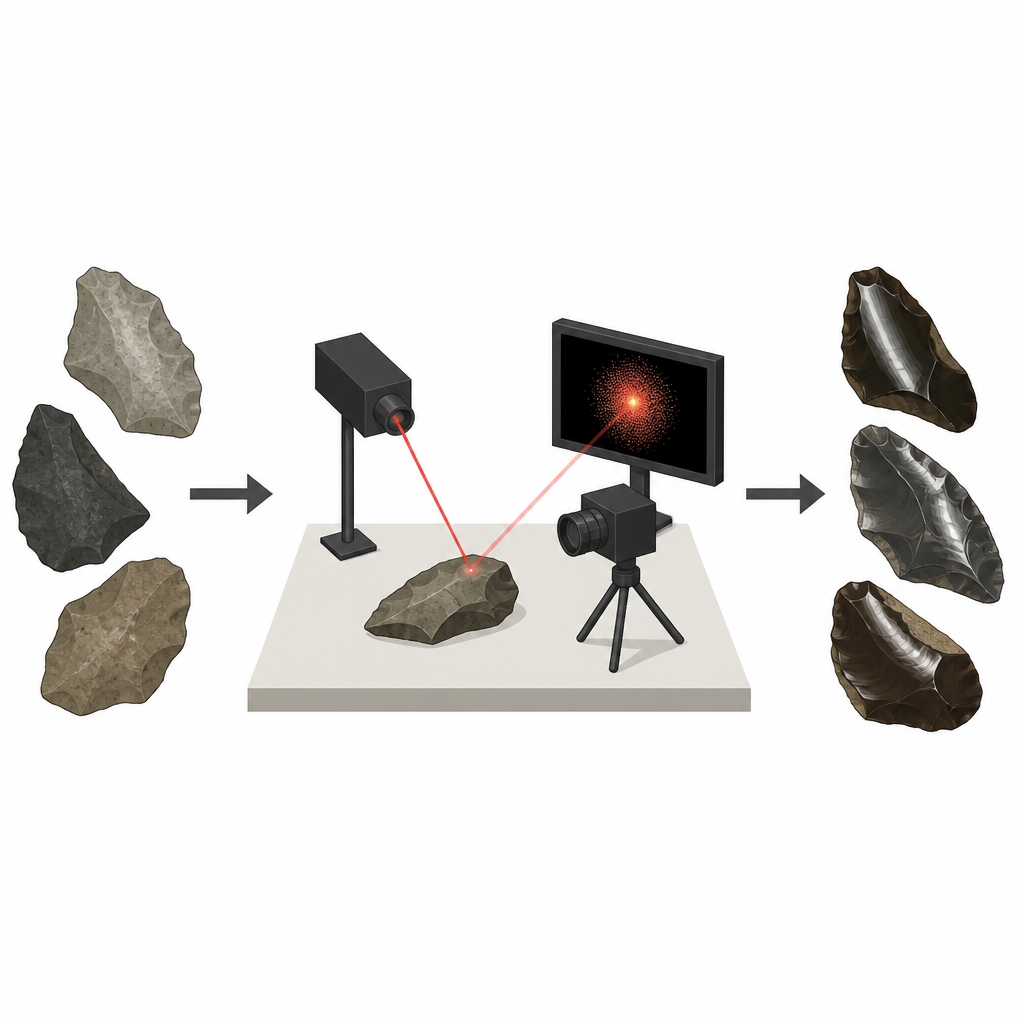
Making stone easier to shape
For hundreds of thousands of years, people have struck flakes from stone to make cutting tools. At some point between about 400,000 and 200,000 years ago, they began deliberately heating certain types of stone before shaping them. This heat treatment changes the internal structure of stones like chalcedony and flint, making them more brittle in a controlled way so flakes detach more easily and predictably. A successful heat treatment smooths the stone’s microscopic surface and lowers the force needed to break it, which in turn often gives the worked surfaces a noticeable glossy appearance.
Why measuring gloss is hard
Archaeologists have long suspected that gloss is a good clue that a stone was heat treated, and experiments have linked shine with better flaking behavior. However, turning this visual impression into solid numbers is tricky. Standard lab tools that measure surface roughness or gloss are expensive, bulky, and work best on flat, opaque samples. Real stone tools tend to have curved, uneven faces and can be partly translucent, which confuses many instruments. As a result, researchers have often had to rely on destructive tests or specialized machines housed far from the artifacts, limiting how widely such studies can be done.
A simple light trick with lasers and cameras
The authors developed a compact setup that uses a small laser, ordinary paper, and consumer-grade cameras to quantify gloss on real stone flakes. A narrow laser beam is focused onto a chosen spot on the tool’s surface. Light bouncing off that spot hits a nearby paper screen, which is photographed. On a very smooth, glossy surface, the reflected light stays concentrated in a small bright patch. On a rough, matte surface, the light is scattered widely and the bright patch spreads out. By processing these images, the team calculates how tightly the light is focused and how much energy is packed into the bright region. They also record microscopic images of the same area to gauge how diffuse the scattered light looks close to the surface. Together, these measurements create a set of simple numerical markers that describe how glossy a flaked surface really is. 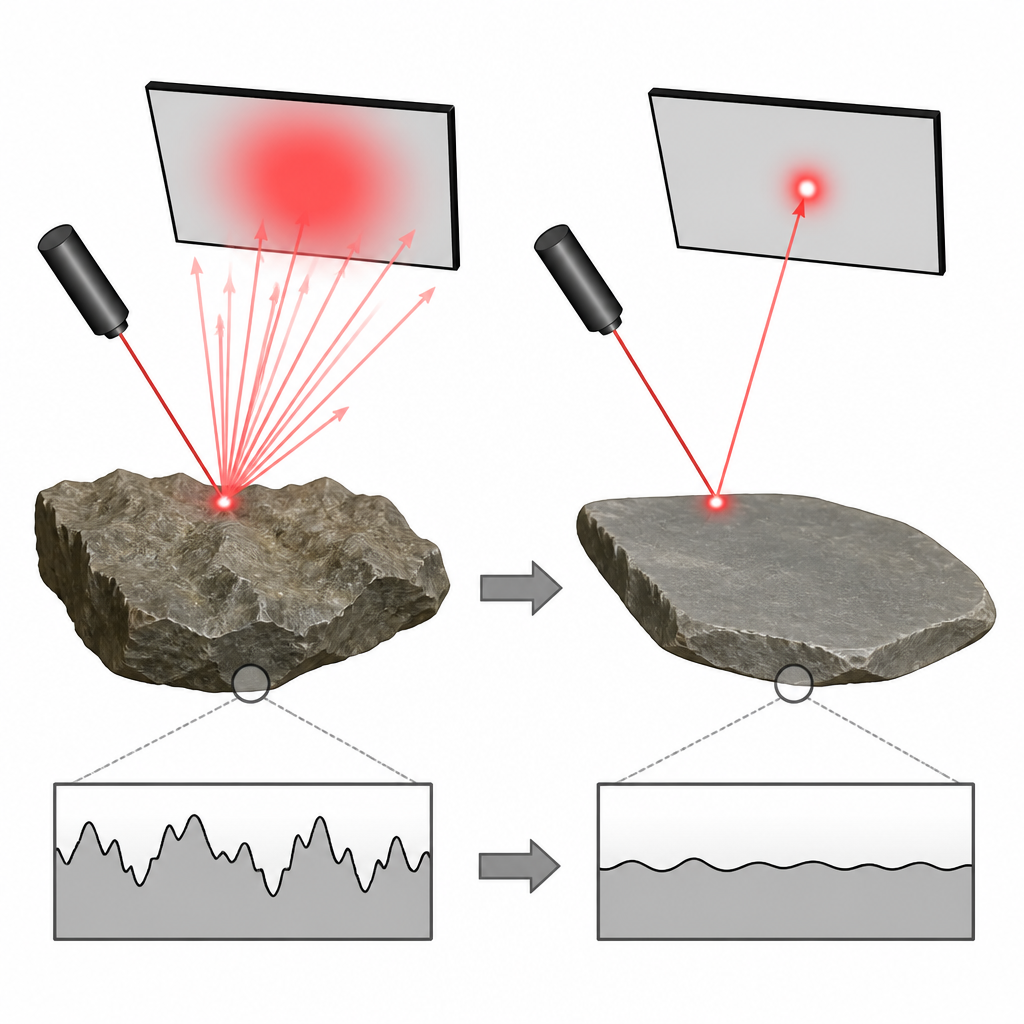
Testing real tools from traditional craftspeople
To see how well the method works, the researchers studied chalcedony stones from Konso in Ethiopia, where present-day craftspeople still heat treat their toolstone in carefully managed pits. For each of six heated and six unheated samples, they measured several small areas and compared the laser reflections with highly precise roughness readings from a laboratory confocal microscope. In general, the heat-treated flakes were much glossier: their reflected light was far more concentrated, and the calculated energy density at the bright spot differed from unheated pieces by about two orders of magnitude. Using a statistical classifier based solely on the gloss-related numbers, they were able to correctly separate heated from unheated samples in all of the test cases and estimated that the true success rate is at least 90 percent.
What bright stone surfaces can tell us
The team stresses that surface shine alone cannot prove that a stone was deliberately heated, because natural wear, soil movement, or polishing during use can also create glossy patches. Instead, gloss measurements should be combined with other evidence, such as contrasts between inner and outer surfaces on the same artifact, traces of heating pits, or patterns in how tools were shaped. Even so, this low-cost method offers archaeologists a practical way to gather quantitative gloss data in field labs and museums, without harming precious artifacts. By turning the sparkle of a stone into numbers, the work opens new possibilities for tracing when and where ancient people mastered the subtle art of improving their raw materials with fire.
Citation: Stárek, R., Sahle, Y., Atnafu, B. et al. Identification of heat-treated lithic artifacts via quantitative surface gloss characterization. Sci Rep 16, 15830 (2026). https://doi.org/10.1038/s41598-026-44878-7
Keywords: heat-treated stone tools, surface gloss, archaeology methods, stone tool technology, optical measurement