Clear Sky Science · en
Controls on hydrocarbon accumulation in ultra-deep carbonate reservoirs of the Ordovician Yingshan Formation, Catake Uplift, Tarim Basin
Why Deep Rocks Matter for Our Energy Future
Far beneath the deserts of northwestern China, more than five kilometers down, lie some of the world’s most challenging oil and gas reservoirs. These rocks are so deeply buried, and their hidden spaces so unevenly distributed, that drilling a successful well can feel like winning the lottery. This study takes a detailed look at one such ultra-deep limestone and dolomite formation in the Tarim Basin and asks a practical question: what really separates gushers from dry or water-filled holes? The answer helps guide safer, more efficient exploration of difficult resources that many countries increasingly rely on.
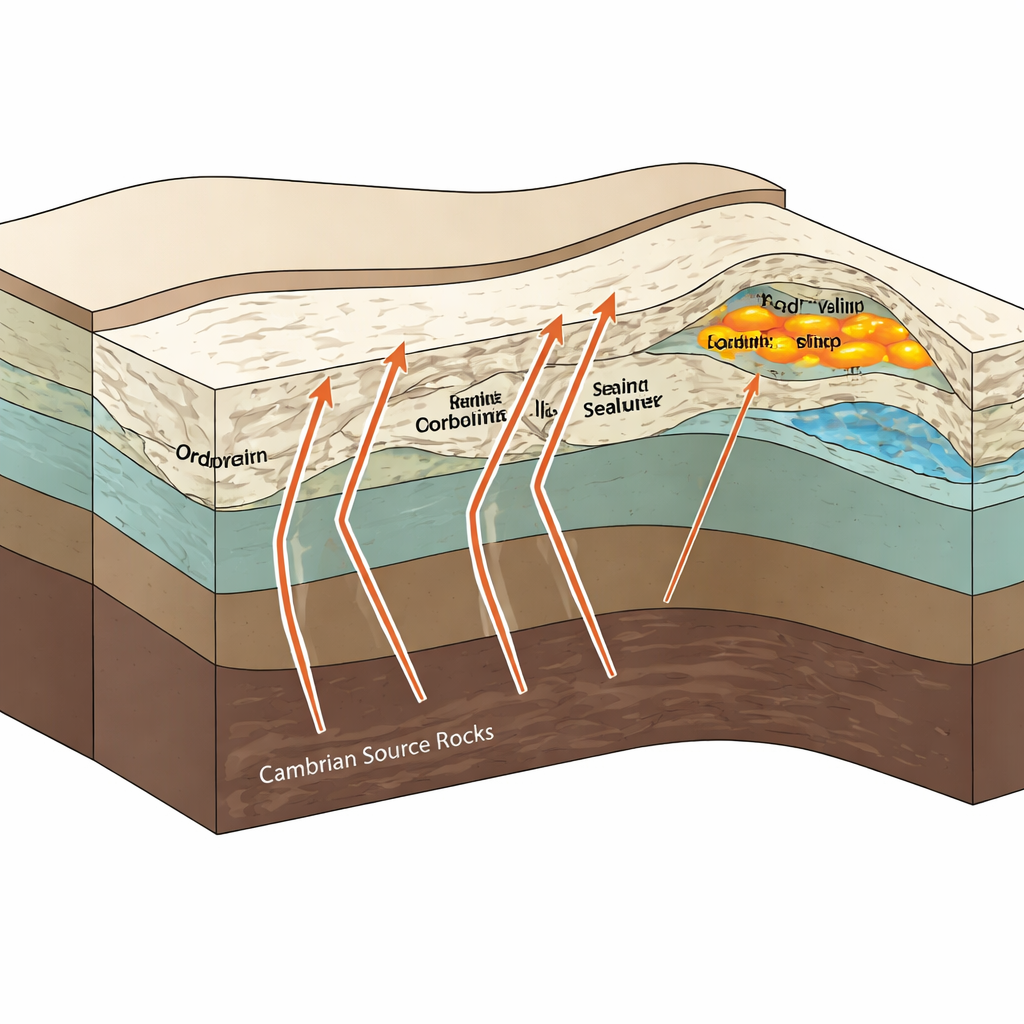
A Hidden Landscape in Stone
The research focuses on the Ordovician Yingshan Formation in the Catake Uplift, a buried high in the center of the Tarim Basin. These rocks began as limy seafloor sediments on a broad, warm-water platform hundreds of millions of years ago. Over time, they were turned into hard limestone and dolomite and then pushed down to ultra-deep levels. Instead of being naturally porous like some sandstones, these rocks are mostly tight. What open space they do have was carved out later by water and other fluids, forming a complex network of pores, enlarged cavities, and fractures. The team shows that this network is strongly layered: an upper zone of weathered, cave-rich rock just below a major ancient erosion surface, and a deeper zone of banded, vuggy dolomite tied to repeated rises and falls in sea level.
Cracks as Highways for Oil and Gas
A key player in this story is the region’s system of strike-slip faults, large cracks where blocks of rock have slid past one another. Using advanced 3D seismic imaging, the authors map these faults and show how some of them cut all the way from deep Cambrian source rocks up into the Yingshan reservoir. Along these deep-reaching breaks, hydrocarbons generated far below can travel upward, then spread into nearby cavities and fractures in the carbonate rock. The study also traces the timing: early uplift created the cavities, later burial and heating generated oil and gas, and even later mountain-building episodes reactivated the faults, allowing multiple rounds of charging and rearrangement before the present-day accumulations were locked in.
Why So Many Wells Miss the Prize
Despite widespread traces of oil and gas in drill cores, most wells in this area have failed to produce commercially. By comparing five producing wells with four dry wells and five water-bearing wells, the authors identify why. In some dry wells, faults delivered hydrocarbons but the surrounding rock lacked enough open, connected pore space; fractures were sealed or cavities were filled with calcite or asphalt, so there was nowhere for large volumes of oil or gas to reside or flow. In other wells, the rock fabric and cavities were good, but the borehole did not intersect faults that connect down to the source layers, so little hydrocarbon ever arrived. Several water wells sit structurally lower than nearby gas producers, meaning they lie below the local oil–water contact, or they occupy positions that act more as sideways escape routes than storage traps.
Three Conditions That Must Work Together
From these contrasts, the study distills a simple but powerful rule for this ultra-deep play: successful accumulations require a “triple coupling” of conditions. First, there must be effective migration pathways—faults that truly link the deep source rocks to the target interval. Second, there must be high-quality storage space—unfilled dissolution pores, cavities, and fracture networks that together form a continuous pathway for fluids to move and be stored. Third, the trap must sit high enough in the structure to lie above the oil–water level and not leak sideways. When any of these three elements is missing, wells tend to encounter only minor shows, dry layers, or water-bearing zones. When all three align, as in the standout Well W10 and a newer successful gas well W11, operators can tap rich hydrocarbon pockets.
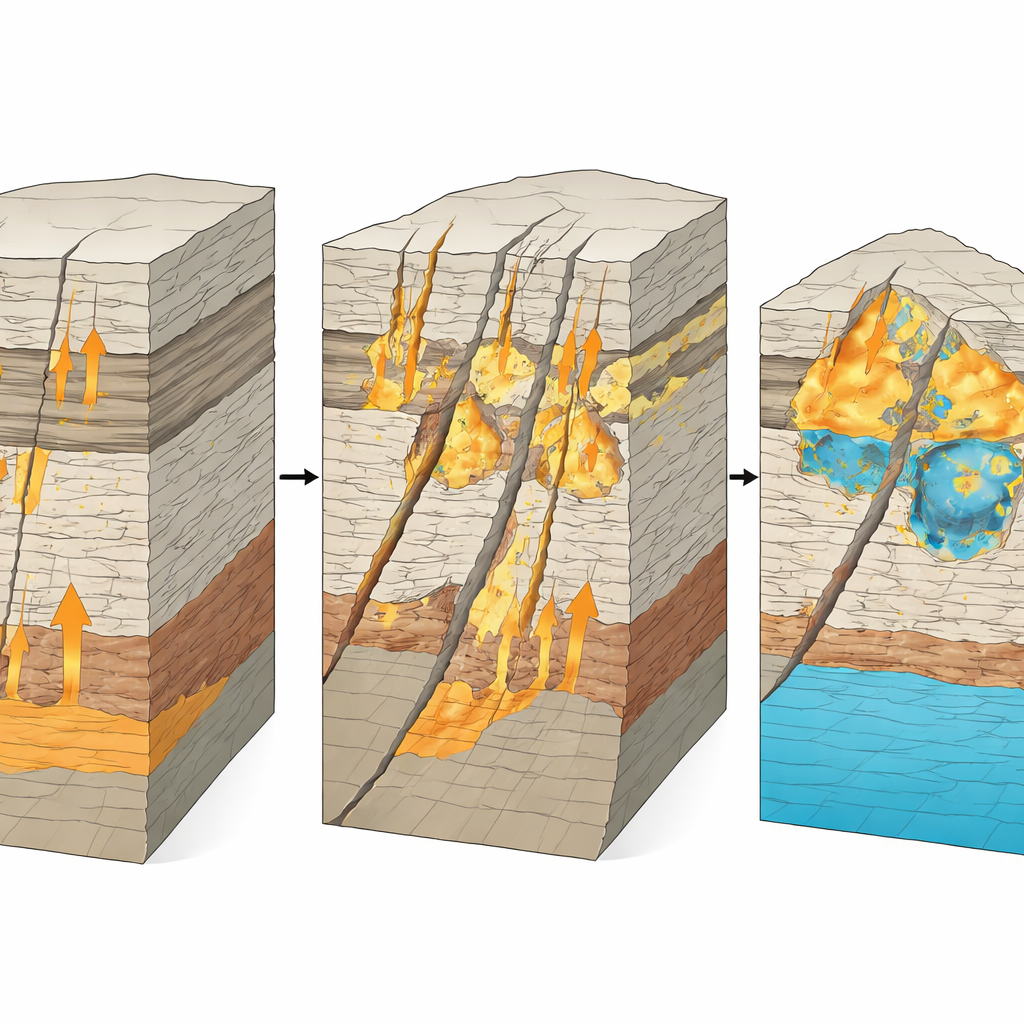
What This Means Going Forward
To a non-specialist, the conclusion is straightforward: in these ultra-deep carbonate rocks, it is not enough just to drill near a big fault or into rock that once held caves. Productive wells appear only where deep-feeding faults, good open rock space, and a favorable high position in the buried landscape come together. The study turns this insight into a practical risk map, flagging high- and low-risk zones for future drilling and warning about special hazards, such as magmatic intrusions that can destroy reservoir quality. As exploration worldwide moves toward more complex, deeper targets, this kind of integrated, three-part recipe offers a clearer, less trial-and-error path to finding the elusive pockets of oil and gas hidden in the deep crust.
Citation: Wang, L., Yang, R., Geng, F. et al. Controls on hydrocarbon accumulation in ultra-deep carbonate reservoirs of the Ordovician Yingshan Formation, Catake Uplift, Tarim Basin. Sci Rep 16, 10932 (2026). https://doi.org/10.1038/s41598-026-44873-y
Keywords: Tarim Basin, ultra-deep reservoirs, carbonate rocks, strike-slip faults, hydrocarbon accumulation