Clear Sky Science · en
Electronic, magnetic, optical, and thermoelectric properties of K₂OsCl₆ for spintronic and energy harvesting applications
Why this new crystal matters
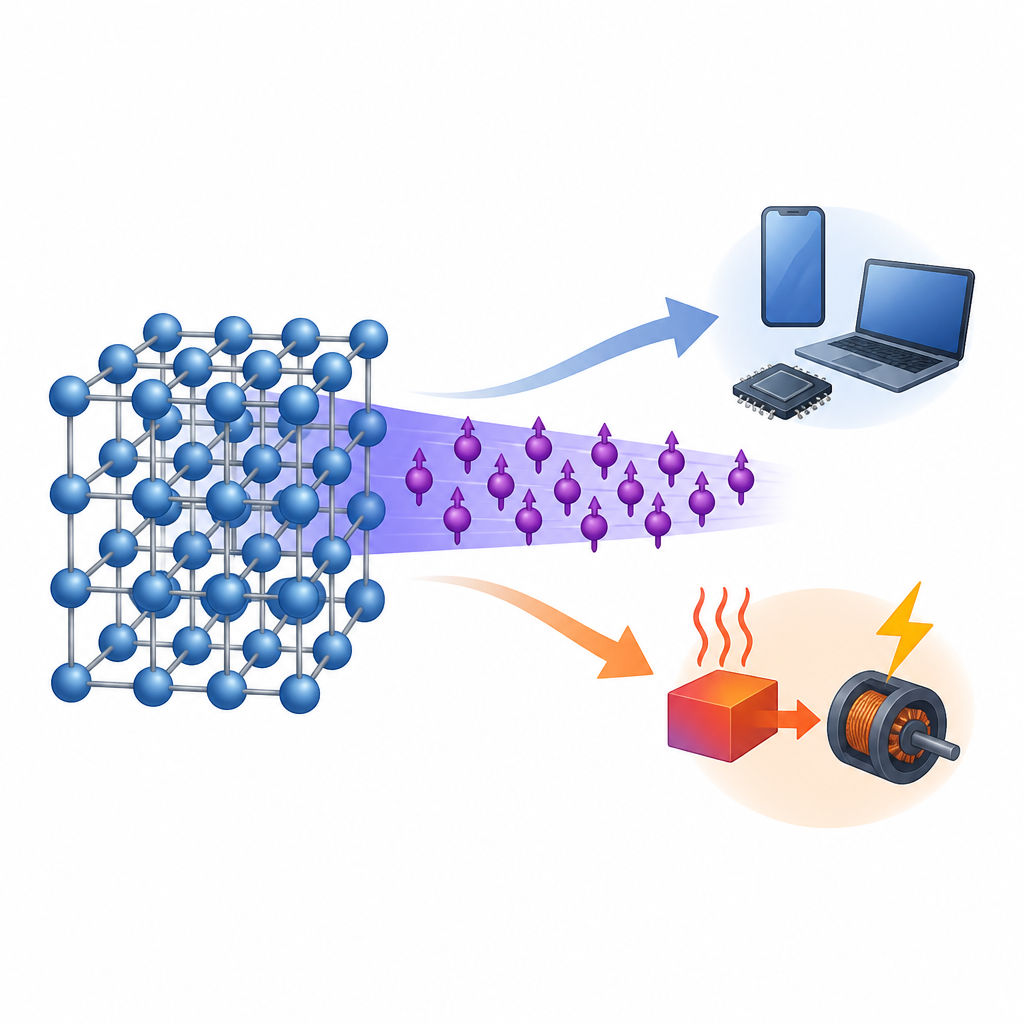
Modern electronics increasingly rely not just on electric charge, but also on the spin of electrons and on clever ways to turn waste heat into useful power. This study explores a little-known crystal called K₂OsCl₆, showing that it may act as a rare all-in-one material that can filter electron spins, interact strongly with light, and potentially help convert heat into electricity, making it interesting for future spin-based gadgets and energy-harvesting devices.
A designer crystal built on a simple framework
K₂OsCl₆ belongs to the family of double perovskites, a group of crystals whose atoms sit on a highly regular three-dimensional grid. In this compound, potassium, osmium, and chlorine arrange into a cubic framework where osmium sits at the center of chlorine cages and potassium fills the corners. The authors used advanced computer simulations based on quantum mechanics to check whether this structure is stable and what physical traits it should have. Their calculations show that the crystal is both mechanically and dynamically stable, meaning it should be possible to make it in the lab and that its atoms would not spontaneously rattle into a different arrangement.
A built-in spin filter for electrons
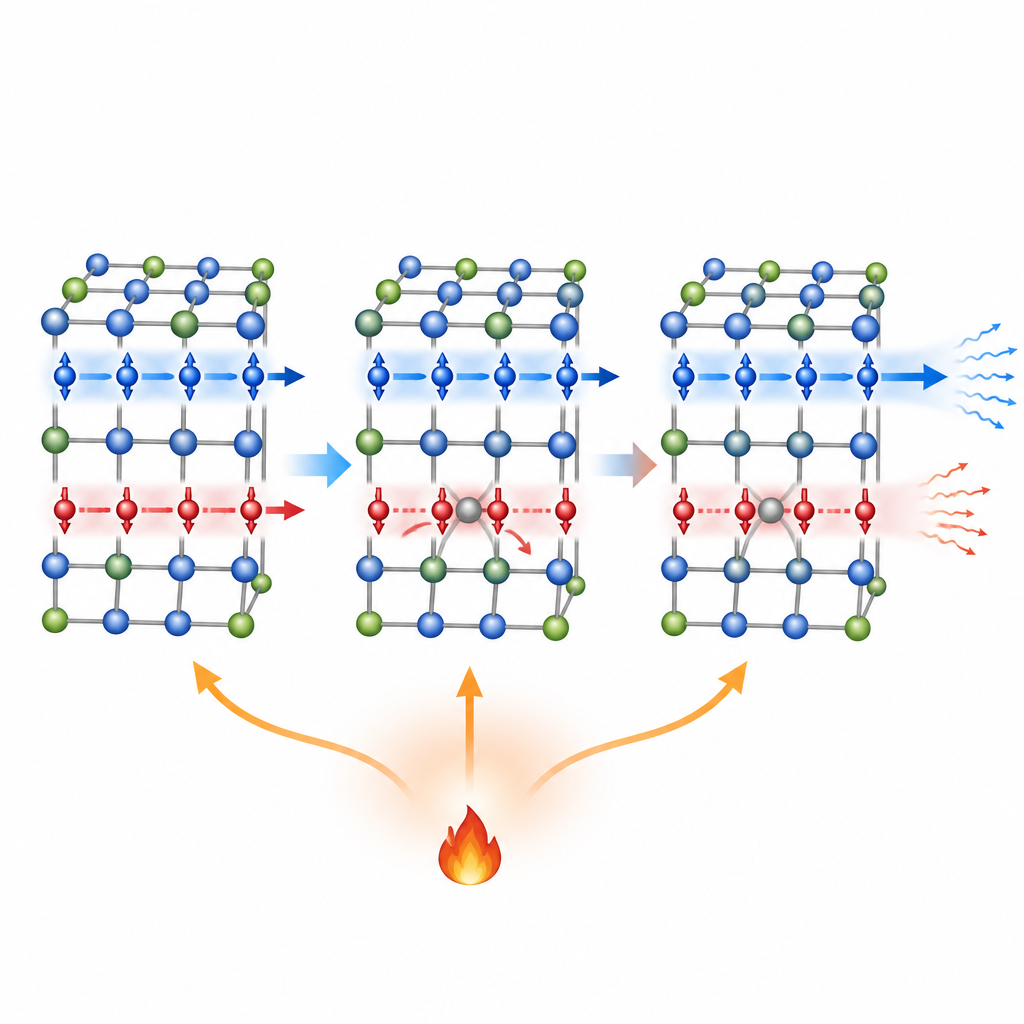
The most striking feature of K₂OsCl₆ is how it treats electrons with opposite spins. The simulations reveal a ferromagnetic ground state, where most electron spins line up in the same direction. For one spin orientation the material behaves like a metal, allowing electrons to flow freely. For the opposite spin, it behaves like a semiconductor with a clear energy gap. This special mixed personality is known as half-metallicity and leads to nearly perfect spin polarization at the energy level that controls conduction. In practical terms, K₂OsCl₆ would naturally let through electrons of one spin while blocking the other, acting as an efficient spin filter without extra layers or complex device designs.
How light and charge move through the crystal
Because of its unusual electronic structure, K₂OsCl₆ responds strongly and differently to light depending on spin. The calculations show high absorption of visible and ultraviolet light, with absorption strengths comparable to those found in good solar absorbers. The way the material bends and slows light, quantified by its refractive index, also differs for the two spin channels and varies in a way that hints at rich optical behavior. These traits suggest that the crystal could be useful in magneto-optical devices, where light is used to read or control magnetic states, as well as in optoelectronic components that need strong and tunable light–matter interaction.
Turning heat into electricity
Beyond spin and light, the team examined how well K₂OsCl₆ might convert temperature differences into electrical power. They calculated the Seebeck coefficient, which measures the voltage created by a temperature gradient, along with the electrical and thermal conductivities. At high temperatures around 900 K, the material shows a relatively large Seebeck coefficient together with decent electrical conductivity and moderate heat flow through the lattice. Putting these pieces together suggests that K₂OsCl₆ could reach a respectable thermoelectric performance under the right doping and operating conditions, especially for devices that reclaim waste heat at elevated temperatures.
A multifunctional platform for future devices
Overall, the study paints K₂OsCl₆ as a versatile platform where magnetism, light response, and heat-to-electricity conversion coexist in a single crystal. For a non-specialist, the key message is that this material can act at once as a spin-selective wire, a strong light absorber, and a potential thermoelectric element. While the results are theoretical and practical challenges remain in synthesizing and handling osmium-based compounds, the work points toward a new class of crystals that could simplify future spintronic and energy-harvesting technologies by packing several useful functions into one material.
Citation: Elkenany, E.B., Fatmi, M., Yaylacı, M. et al. Electronic, magnetic, optical, and thermoelectric properties of K₂OsCl₆ for spintronic and energy harvesting applications. Sci Rep 16, 16465 (2026). https://doi.org/10.1038/s41598-026-44862-1
Keywords: spintronics, half-metallic ferromagnet, double perovskite, thermoelectric materials, magneto-optical properties