Clear Sky Science · en
Environmental and microbial factors shaping SARS-CoV-2 RNA decay in wastewater: insights from batch tests and a lab-scale sewer pipeline simulator
Why Sewers Can Tell Us About Community Health
During the COVID-19 pandemic, scientists learned that traces of the virus’s genetic material show up in wastewater long before people show up in clinics. This "sewer signal" can warn officials that infections are rising, even when testing is limited. But that signal can fade as wastewater travels through pipes. This study asks a simple but crucial question: how quickly does coronavirus genetic material break down in wastewater, and what conditions make it disappear faster or slower?
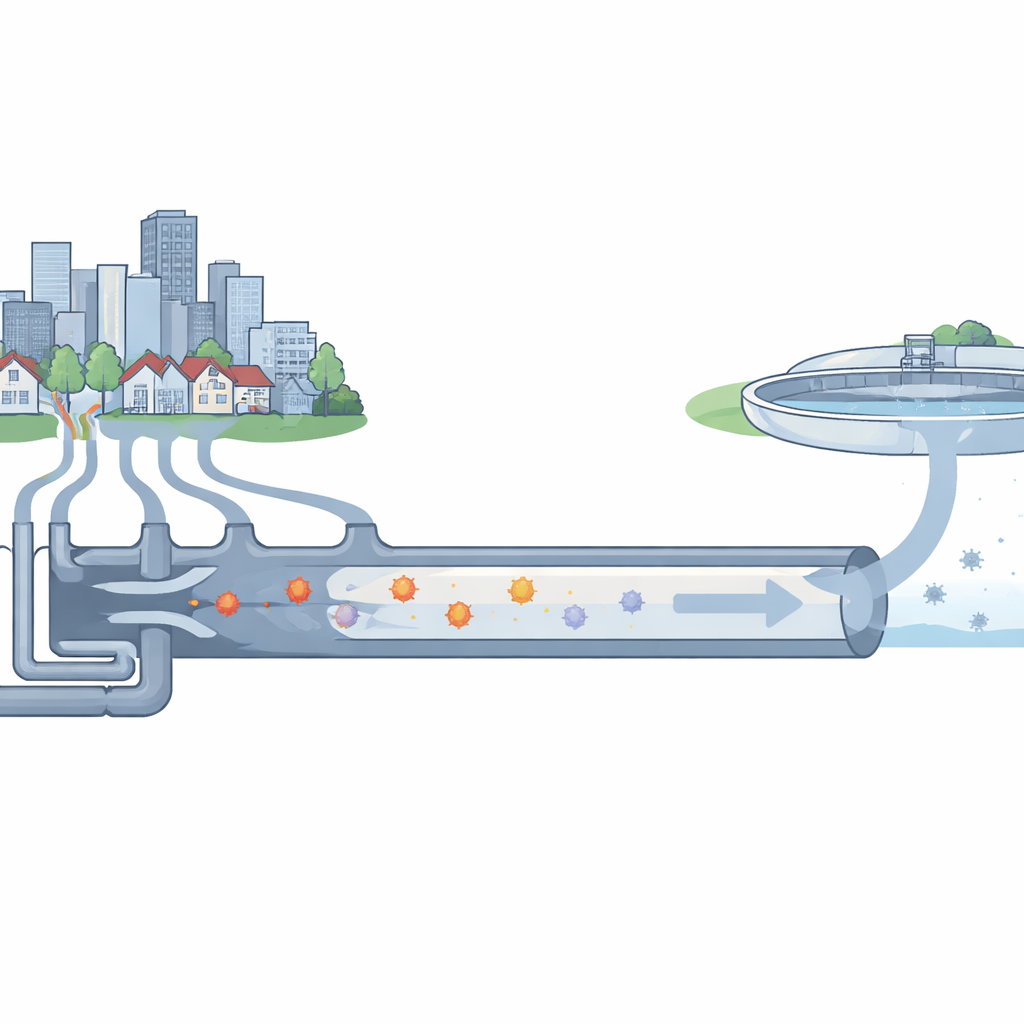
Following Viral Traces Through the Underground
The researchers focused on viral RNA, the genetic material measured in wastewater-based surveillance. Because working directly with SARS-CoV-2 requires high biosafety levels, they used a closely related human coronavirus called HCoV-NL63 as a safer stand-in. They mixed this virus into real sewage and tap water, then monitored how the RNA signal declined over time. By carefully adjusting pH (how acidic or basic the water was), temperature, and the amount of microbes and solid particles, they could tease apart which factors most strongly shaped how long viral RNA sticks around.
Heat, Acidity, and the Role of the Water Itself
The team found that viral RNA decayed much faster in wastewater than in clean tap water, even under the same temperature and pH. Conditions similar to real sewers—near-neutral pH around 7 and warmer temperatures around 30 °C—produced especially rapid loss of the RNA signal. In some tests, more than a million-fold reduction occurred within a few days. Extremely acidic water (pH 2) did not always speed decay further, likely because such harsh conditions also slow microbial activity. These results show that the effect of temperature is tightly linked to the type of water and its chemistry, rather than simply "warmer means faster decay" in all situations.
Microbes and Particles as Hidden RNA Shredders
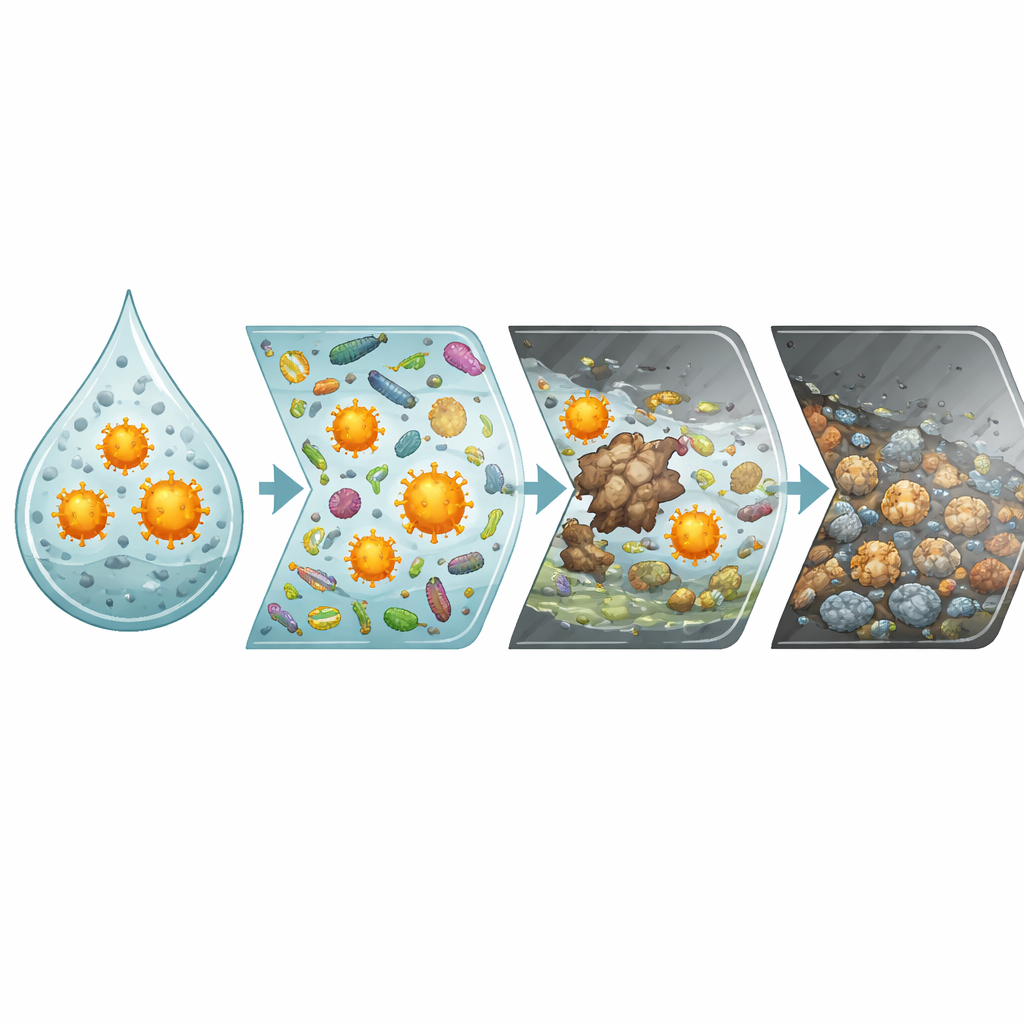
To pinpoint what in wastewater was doing the damage, the scientists varied the abundance of microbes and suspended solids. When they diluted the sewage to lower microbial counts, viral RNA decayed more slowly. When they filtered the water and used a chemical to suppress microbial activity, decay slowed even more. Suspended solids—tiny bits of organic and inorganic matter—also mattered: higher solid levels tended to go hand in hand with faster RNA loss. However, solids can both help and hinder detection. Viruses can stick to particles, which sometimes concentrates them and improves detection, but the same particles can carry enzymes and other substances that break RNA down or interfere with lab tests. Overall, the strongest driver of RNA loss was active microbial life, with solids adding additional, context-dependent effects.
A Miniature Sewer to Mimic the Real World
Static test tubes cannot fully capture what happens as wastewater flows for kilometers through pipes lined with biofilms—slimy layers of microbes and debris. To bridge that gap, the researchers built a lab-scale sewer simulator: a long coiled tube through which spiked wastewater circulated continuously at a controlled temperature. In this system, viral RNA disappeared faster in sewage than in dechlorinated tap water, and decay increased with travel distance and over time as microbial communities and pipe-associated films developed. These patterns match field observations that viruses tend to vanish more quickly in complex, "dirty" water than in cleaner sources.
What This Means for Reading Signals From Sewers
For public health officials, the key message is that wastewater virus measurements are shaped not only by how much people are shedding, but also by what happens to that genetic material inside the sewer network. Warm temperatures, active microbial communities, and particle-rich water can all erode the RNA signal before it reaches the treatment plant sampler. If these decay processes are ignored, infection levels in the community may look lower than they really are, especially in places with long pipe systems or in hot climates. By quantifying how quickly coronavirus-like RNA decays under different conditions, this study provides building blocks for better models that adjust wastewater data for in-sewer losses, making sewer signals a more reliable tool for tracking outbreaks and guiding public health responses.
Citation: Jung, J., Kim, L.H., Kim, S. et al. Environmental and microbial factors shaping SARS-CoV-2 RNA decay in wastewater: insights from batch tests and a lab-scale sewer pipeline simulator. Sci Rep 16, 14177 (2026). https://doi.org/10.1038/s41598-026-44857-y
Keywords: wastewater surveillance, sewer virology, viral RNA decay, COVID-19 monitoring, microbial processes