Clear Sky Science · en
Mechanical properties analysis of geopolymer concrete based on the sugarcane bagasse ash using machine learning
Turning farm waste into stronger, cleaner concrete
Concrete is the backbone of modern cities, but making ordinary cement releases huge amounts of carbon dioxide. This study explores a way to cut that pollution by turning an agricultural waste—ash from sugarcane processing—into a key ingredient of a new kind of concrete. It also shows how modern data tools, including machine learning, can help engineers quickly predict how strong this greener concrete will be.
Why a new kind of concrete matters
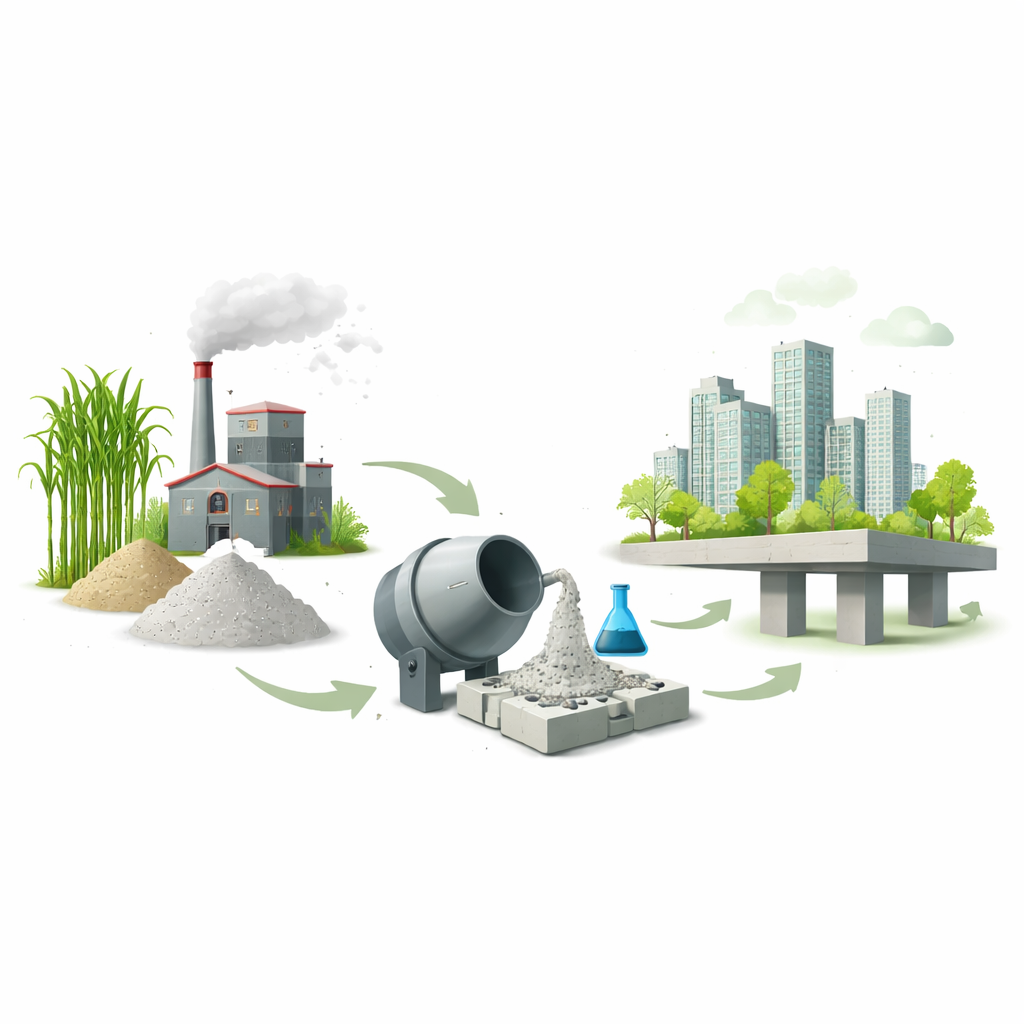
Traditional concrete depends on Portland cement, whose manufacture is energy-intensive and responsible for a significant share of global CO2 emissions. In recent years, “geopolymer” concrete has emerged as a promising alternative. Instead of relying on cement, it uses industrial by-products rich in silica and alumina—such as fly ash from power plants—activated by alkaline solutions. This chemistry produces a hard, stone-like binder while potentially cutting emissions by 22–72%, all without sacrificing strength or durability. The twist in this work is to replace part of the fly ash with sugarcane bagasse ash, a waste produced in vast quantities in sugar mills and often dumped in landfills or released as fine, polluting dust.
From sugarcane fields to building blocks
India, one of the world’s largest sugarcane producers, generates millions of tons of sugarcane bagasse ash each year. Chemically, this ash is rich in reactive silica and other oxides, which means it can behave much like traditional cement additives if used correctly. The researchers collected fly ash and sugarcane bagasse ash from local sources, blended them in different proportions, and mixed them with standard sand and gravel. They then added sodium hydroxide solution at various concentrations to trigger the geopolymer reaction, cast test specimens, and cured them. The main goal was to see how much fly ash could be replaced by sugarcane ash while still achieving high compressive, flexural, and tensile strength—the three key measures of how concrete performs under different kinds of stress.
Finding the sweet spot for strength
The team tested mixtures where sugarcane bagasse ash replaced 0–50% of the fly ash and varied the strength of the alkaline solution. They found that both the amount of bagasse ash and the sodium hydroxide concentration strongly influenced performance. An especially successful recipe used 30% sugarcane ash and a medium-high activator concentration. After 28 days, this mix reached a compressive strength of about 47 megapascals, firmly in the range needed for structural applications and higher than the control mix without bagasse ash. Similar upward trends appeared in bending and splitting tests, though strengths leveled off or dipped slightly at the highest ash contents. The results suggest there is an optimum balance: enough bagasse ash to enhance the internal binding structure, but not so much that porosity and incomplete reaction start to weaken the material.
Letting algorithms learn from concrete
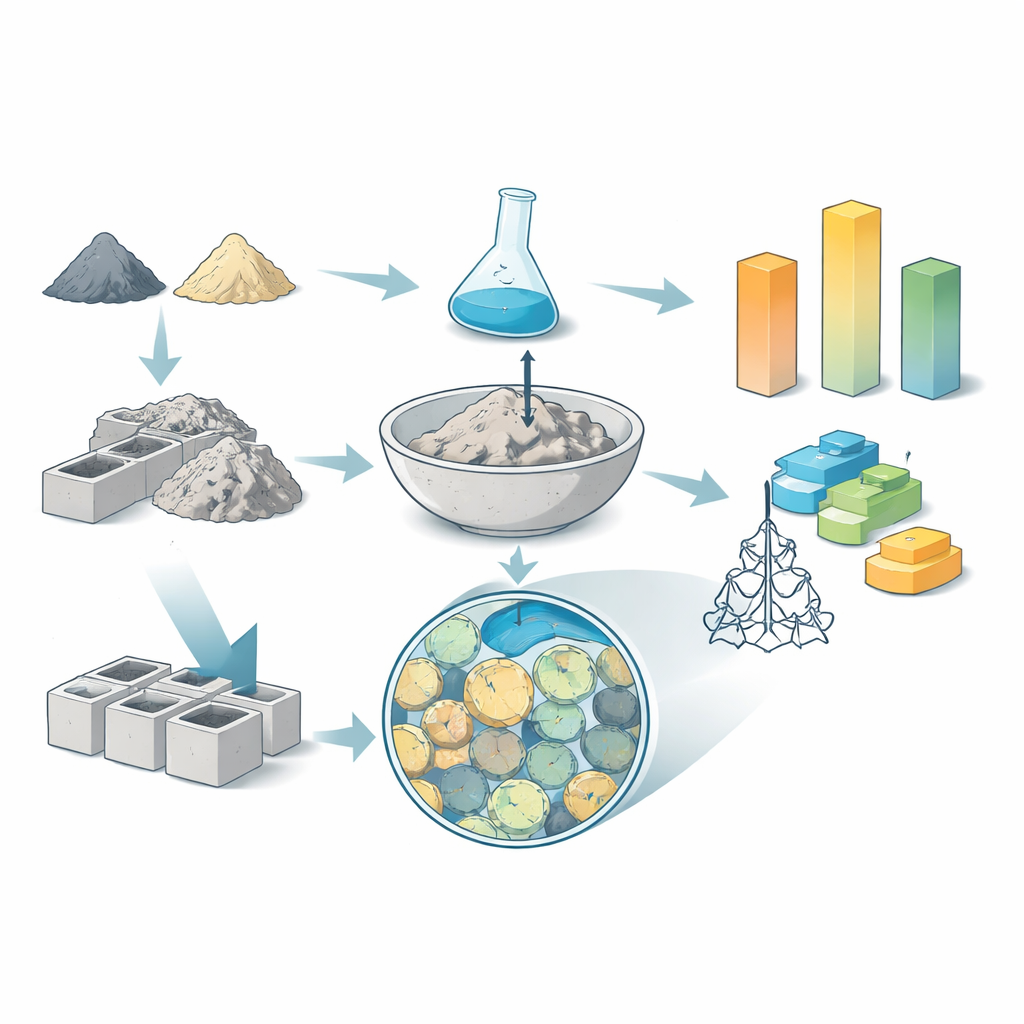
Measuring concrete strength in the lab is time-consuming and costly, especially when many variables—such as ash type, replacement level, and chemical concentration—are changing at once. To speed this up, the researchers trained three types of machine learning models to predict strength from the mix design: an artificial neural network, a random forest, and an XGBoost model. While the neural network fit the training data well, it stumbled on new data, a classic sign of overfitting. XGBoost, a powerful boosting method, was almost perfect on the training set but also lost accuracy on test cases. The random forest model struck the best balance, maintaining high predictive power on unseen data for all three strength measures, making it the most reliable choice for practical forecasting.
What this means for greener building
This work shows that sugarcane bagasse ash, once treated as a disposal problem, can serve as a valuable ingredient in high-performance geopolymer concrete. At the right mix proportion and activator level, it not only diverts waste from landfills and reduces carbon emissions but also delivers concrete that is as strong—or stronger—than conventional mixes. Coupling these greener recipes with robust machine learning models allows engineers to estimate strength quickly from the mix design alone, potentially shortening development cycles and cutting testing costs. For the layperson, the takeaway is simple: agricultural leftovers and smart algorithms can work together to build cleaner, stronger structures for future cities.
Citation: Pratap, B., Kumar, S., Gupta, K.K. et al. Mechanical properties analysis of geopolymer concrete based on the sugarcane bagasse ash using machine learning. Sci Rep 16, 14485 (2026). https://doi.org/10.1038/s41598-026-44848-z
Keywords: geopolymer concrete, sugarcane bagasse ash, sustainable construction, machine learning, fly ash