Clear Sky Science · en
Elucidating the potential mechanism of short-chain chlorinated paraffins in breast cancer via computational prediction integrating network toxicology and molecular docking
Everyday Chemicals and Hidden Health Questions
Short-chain chlorinated paraffins are workhorse chemicals found in plastics, lubricants, and flame retardants, and traces of them now turn up in air, water, food, and even human blood and milk. At the same time, breast cancer remains the most common cancer in women worldwide, with many cases not explained by known risk factors. This study asks a pressing question for public health: could long term exposure to these industrial chemicals subtly disturb the biology of breast tissue in ways that favor cancer, and if so, through which molecular routes inside the body?
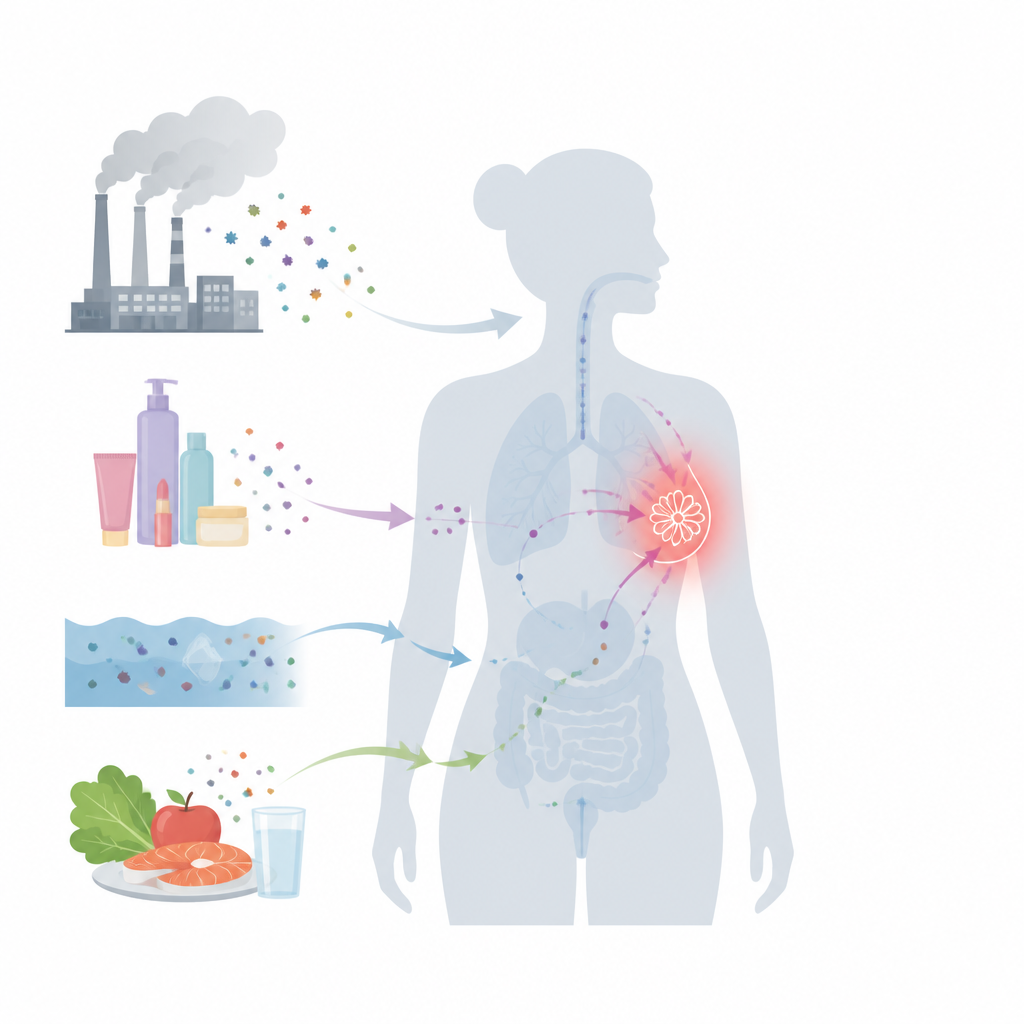
From Factory Use to Human Exposure
The authors begin by setting the stage for why these chemicals matter. Global production of chlorinated paraffins exceeds two million tons per year, with China as a major producer and user. Because these substances are persistent and accumulate in living organisms, people are exposed at low levels over many years, mainly through diet and contact with treated products. Earlier research has linked such exposure to liver, kidney, and nerve damage, and has hinted at ties to several cancers. Yet, for breast cancer in particular, the precise biological connections have remained unclear, leaving a gap between population studies and the molecular activity happening in cells.
Using Digital Maps of Biology
To explore these hidden links, the team turned to powerful computer based tools instead of lab animals or cell dishes. First, they chose a representative short-chain chlorinated paraffin molecule and used online toxicity platforms to predict how it behaves in the body. Then they searched large biomedical databases to find human proteins that this chemical is likely to interact with, and separately, genes that are strongly linked to breast cancer. By overlapping these lists and adding gene activity data from breast tumors and normal breast tissue, they distilled hundreds of candidates down to 140 proteins that sit at the intersection of chemical exposure and breast cancer biology.
Finding the Most Influential Molecular Players
Next, the researchers treated these 140 proteins as a social network, asking which ones are the most connected and influential in known cellular pathways. This network analysis highlighted a small group of hub proteins involved in inflammation, hormone signaling, and tissue remodeling. Among them, PTGS2 (also known as COX 2) and MMP9 stood out. Both are already known to shape how breast tumors grow, invade surrounding tissue, attract blood vessels, and respond to treatment. The study found that genes for these proteins are abnormally active or suppressed in breast cancer samples compared with healthy breast tissue, underlining their importance in the disease process.
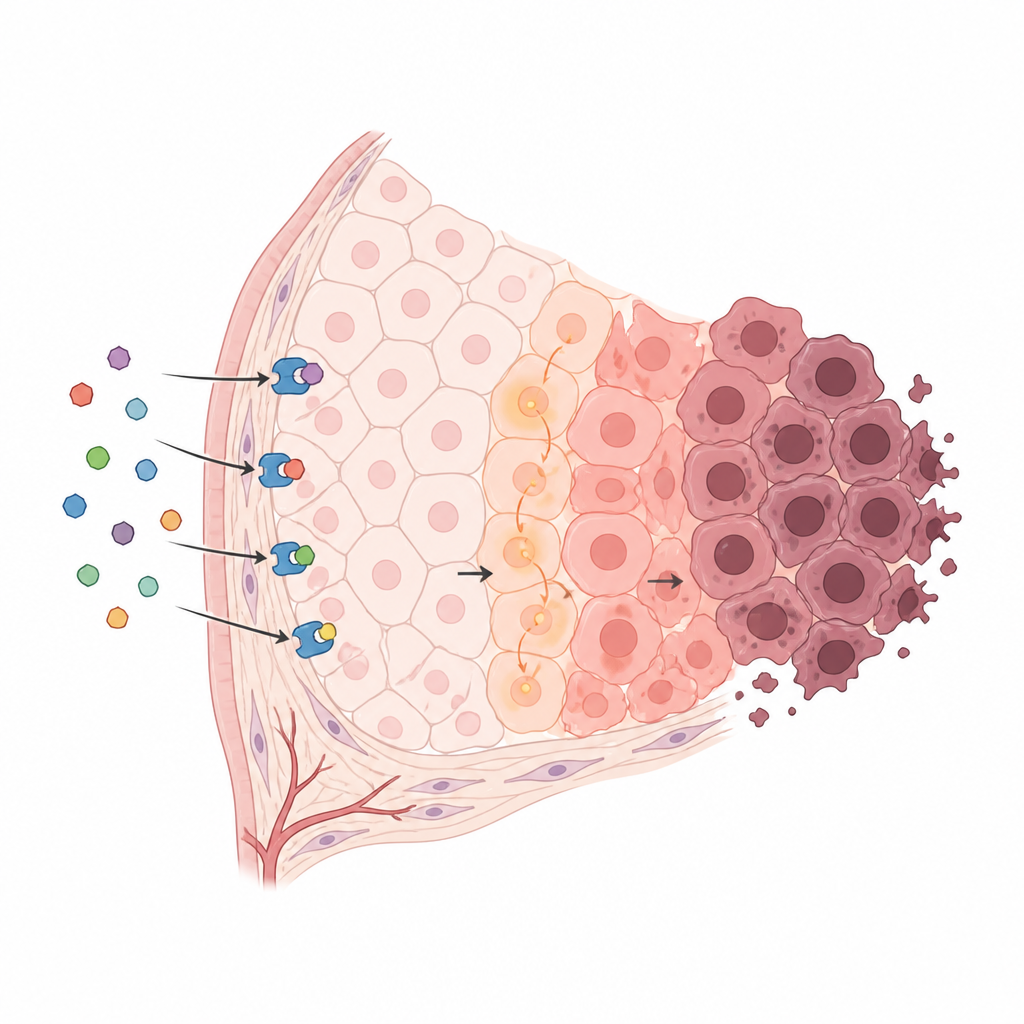
Simulating Chemical Binding Inside Cells
To test whether the chosen paraffin molecule could realistically latch onto these key proteins, the team ran detailed three dimensional docking simulations. These models predict how well a small chemical can fit into the crevices of a protein, much like a key fitting into a lock, and estimate the strength of that interaction. The paraffin showed strong predicted binding to PTGS2 and MMP9. The researchers then pushed further, running time based molecular dynamics simulations that follow the motions of atoms over tens of nanoseconds. These runs suggested that the complexes between the paraffin and both proteins remain stable, especially for MMP9, meaning that the chemical could plausibly alter how these proteins behave inside cells.
What This Means for Everyday Health
In plain terms, this work does not prove that these chemicals cause breast cancer, but it does outline a believable chain of events. According to the models, short-chain chlorinated paraffins could bind to proteins like PTGS2 and MMP9 that help govern inflammation, hormone responses, blood vessel growth, and tissue breakdown in the breast. Disturbing this network may nudge cells toward unchecked growth, invasion, and resistance to treatment. The results form a testable hypothesis for future laboratory and population studies, and they support efforts to limit exposure to persistent industrial chemicals while scientists clarify their long term health effects.
Citation: Si, S., Liu, J., Li, Z. et al. Elucidating the potential mechanism of short-chain chlorinated paraffins in breast cancer via computational prediction integrating network toxicology and molecular docking. Sci Rep 16, 15792 (2026). https://doi.org/10.1038/s41598-026-44845-2
Keywords: short-chain chlorinated paraffins, breast cancer, environmental exposure, computational toxicology, protein interactions