Clear Sky Science · en
Mode localization in chiral periodic approximants of Fibonacci magnonic superlattices
Waves Without Wires
Electronics today rely on moving electric charges, which wastes energy as heat. An emerging alternative is to process information with ripples in magnetization called spin waves. This paper explores how carefully patterned magnetic films can trap and guide these waves in a highly controlled way, opening paths to ultra‑low‑power filters, switches, and logic elements for future information technology.
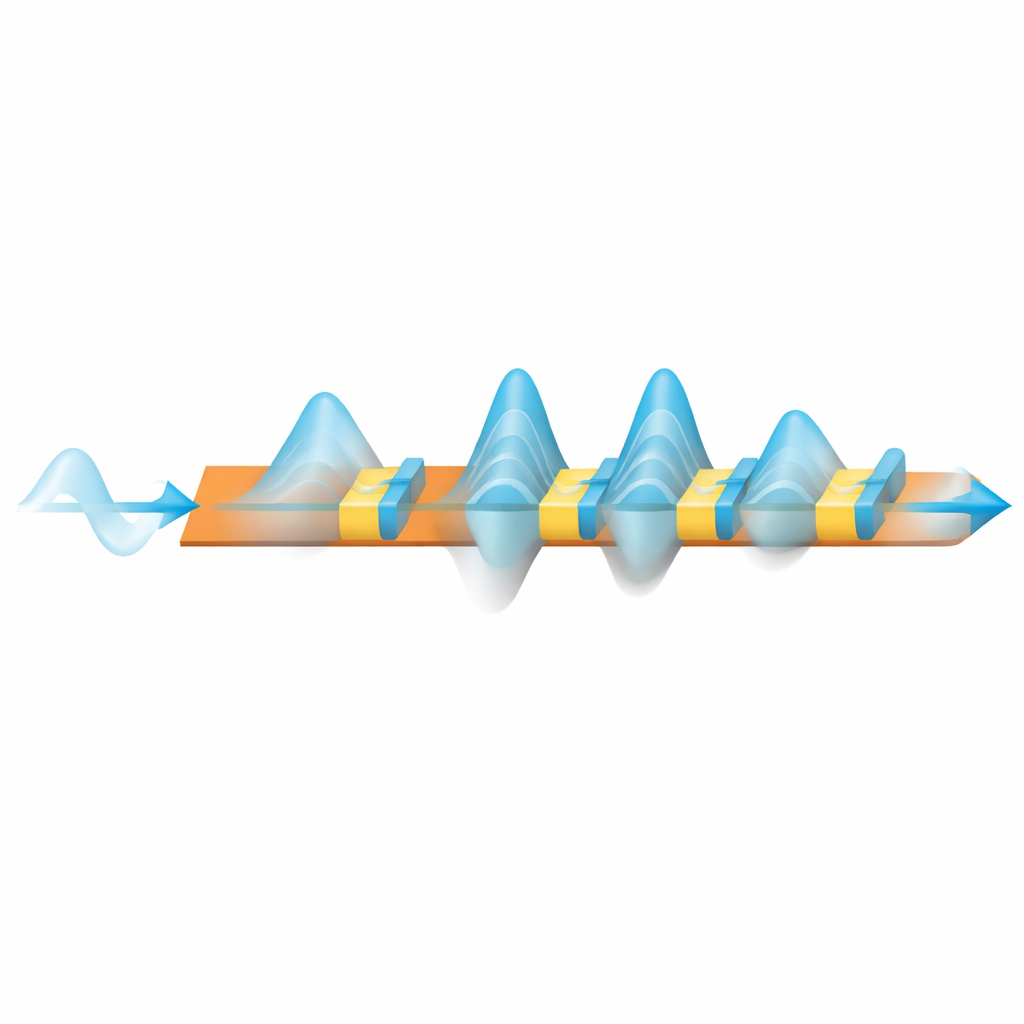
Building a Special Kind of Magnetic Pattern
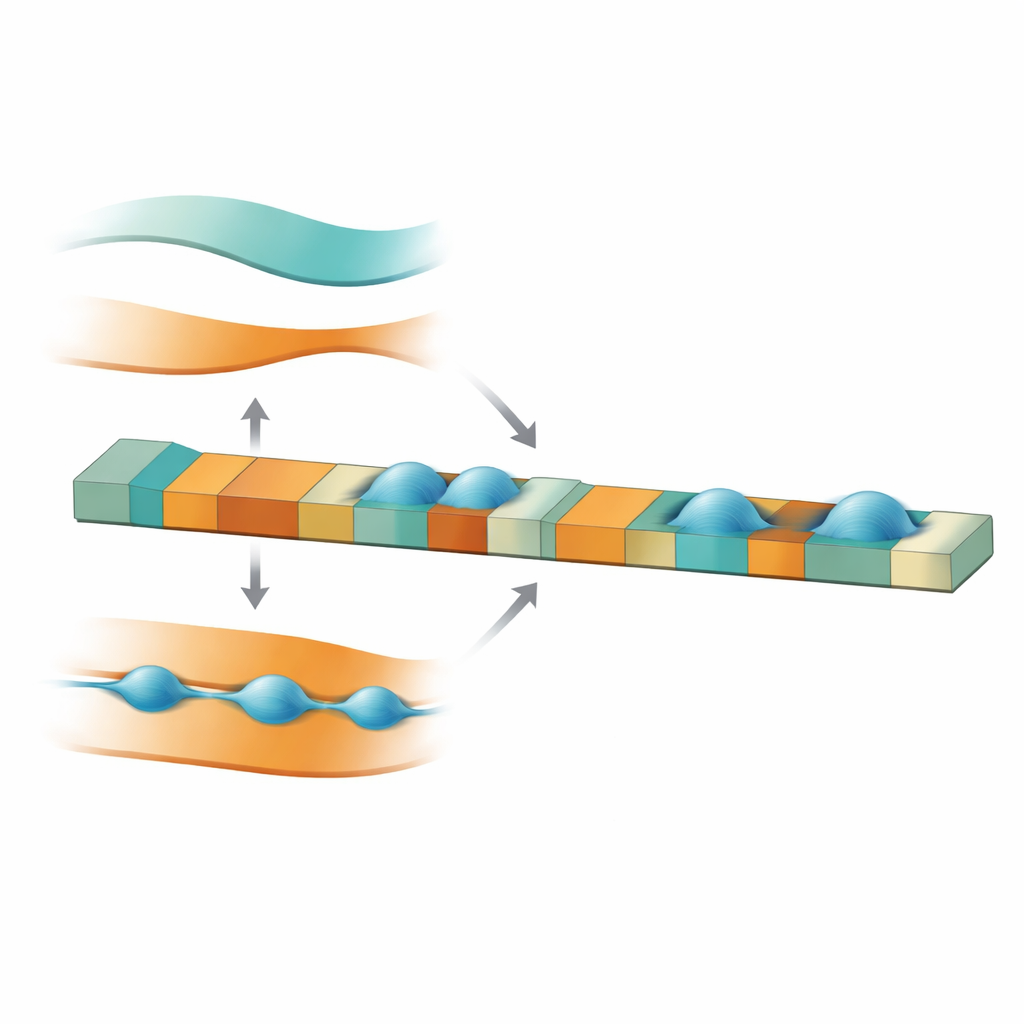
The authors study thin magnetic films decorated with narrow stripes of different materials laid out in a pattern inspired by the Fibonacci sequence. Unlike a simple repeating pattern, this “quasiperiodic” arrangement never exactly repeats, yet it is not random either. In their designs, seven Fibonacci‑determined stripe widths are bundled into a large unit cell, and this cell is repeated along one direction. Some stripes sit on heavy metals that twist the spins in a chiral way; others only alter how strongly the spins prefer to point perpendicular to the film. By choosing which stripes have which properties, the researchers create a built‑in landscape that varies smoothly but in a deterministic, encoded fashion along the film.
How Spin Waves Get Trapped
Spin waves moving along these patterned films do not all behave alike. Certain combinations of stripe width, magnetization strength, and perpendicular preference carve out “safe harbors” for waves at particular frequencies. In these regions the local conditions lower the natural oscillation frequency, acting as potential wells that draw in and confine the waves. The calculated spectra show so‑called flat bands at low frequencies: ranges where the allowed spin‑wave frequencies barely change as their wavelength varies. Flat bands are a hallmark of strongly localized modes—waves that sit in one place rather than travel freely—because their energy no longer depends on motion through the lattice.
The Role of Chirality and Magnetic Contrast
The team compares three families of structures that differ in how chirality and material contrast are distributed. In one, only certain stripes carry a chiral interaction with the heavy metal; in others, two magnetic materials with different magnetization strengths share a common base layer. Across these cases, both analytical plane‑wave calculations and full micromagnetic simulations agree: when perpendicular preference and magnetization contrast are strong, the structures host many sharply defined flat bands. The associated spin‑wave patterns cluster beneath specific groups of stripes, dictated by the Fibonacci layout. In chiral variants, the preferred direction of propagation shifts, enriching the spectrum but preserving the basic localization mechanism.
A Tunable Window for Quiet Waves
A key insight is that the flat bands always appear within a frequency window set by two simpler reference systems: uniform films built from each constituent material separately. The lowest and highest minima of these two “background” dispersions define a band of frequencies where only parts of the patterned film can sustain waves. Within that window, regions whose local properties match the lower‑frequency film host strong oscillations, while the others remain largely silent. This mismatch produces selective localization without needing disorder. Because the positions of those reference minima shift when an external magnetic field is applied, the entire window—and with it the flat‑band regime—can be widened, narrowed, or shifted simply by turning a knob on the applied field.
Why This Matters for Future Devices
For a non‑specialist, the main message is that a clever magnetic pattern can make waves behave like parked cars instead of traffic: they sit in well‑defined spots and hardly move. By encoding that pattern in a Fibonacci‑based design, the authors gain many distinct “parking places” whose positions and strengths are set deterministically by structure, not by randomness. At the same time, an external magnetic field lets engineers open or close the frequency window in which this trapping occurs. Together, these features suggest that Fibonacci magnonic superlattices could form the backbone of compact, reconfigurable signal processors—acting as tunable filters, multiplexers, or logic gates that manipulate information with very little energy loss.
Citation: Flores-Farías, J., Contreras-Gallardo, P., Brevis, F. et al. Mode localization in chiral periodic approximants of Fibonacci magnonic superlattices. Sci Rep 16, 10924 (2026). https://doi.org/10.1038/s41598-026-44837-2
Keywords: spin waves, magnonic crystals, flat bands, quasicrystals, Fibonacci patterns