Clear Sky Science · en
Persistent cycles and network resilience: a hypernetwork-based framework for temporal graph analysis
Why loops in networks matter
From airline routes to power grids and email exchanges, many systems around us can be described as networks whose connections change over time. When part of such a system fails—an airport closes, a server goes down, a power line trips—its ability to keep people, goods, or information moving depends on whether there are workable detours that still respect the order in which events happen. This paper introduces a new way to spot those quiet “backup loops” in time-varying networks and shows that they are powerful clues to how resilient a system really is.
Watching connections as they change
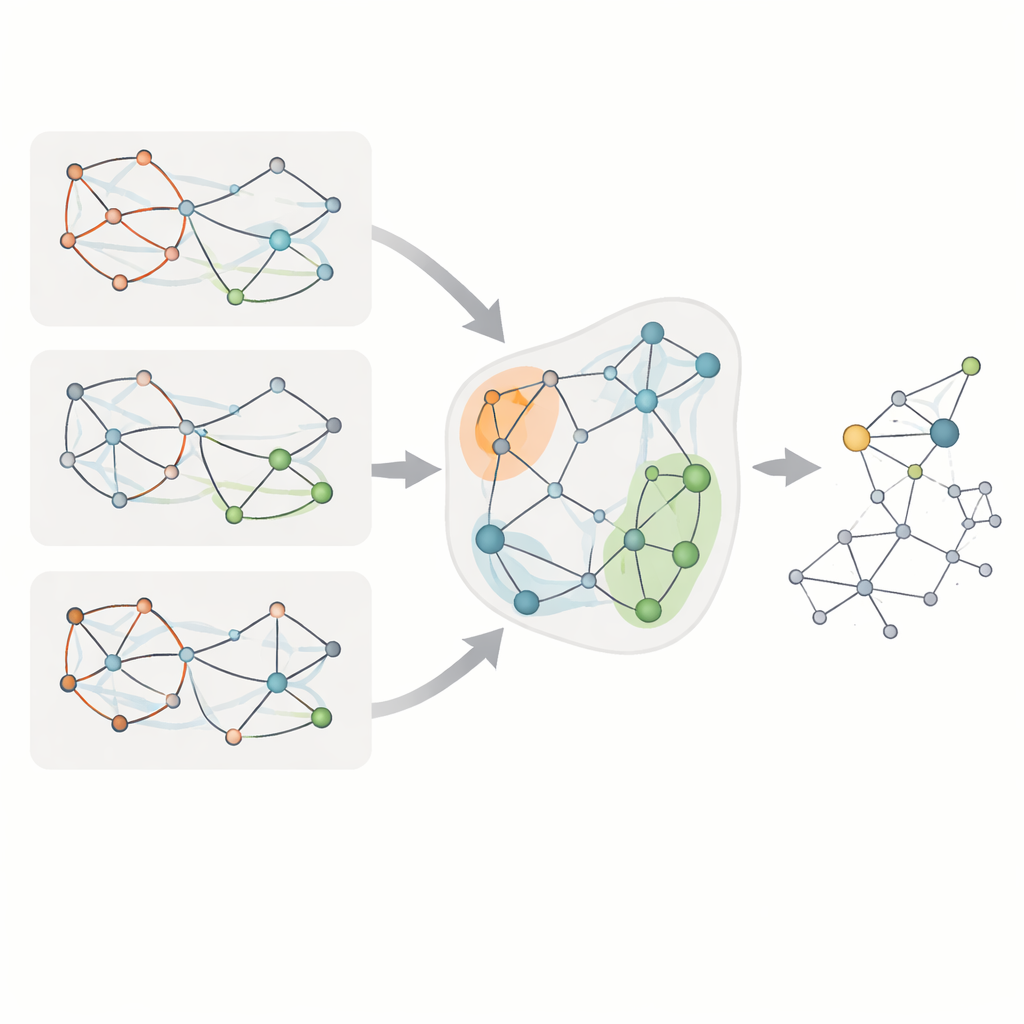
Most traditional studies of resilience squash time into a single static picture: they combine all interactions over some period and then analyze that frozen snapshot. While convenient, this can be misleading. In real life, two links that never exist at the same moment cannot form a usable detour. The authors instead treat each dataset—such as face-to-face contacts, flights, brain activity, emails, power lines, and trade flows—as a series of short time windows. Within each window, they record which nodes are connected, then examine how these local structures appear, disappear, and reappear as time moves on.
Finding the loops that keep coming back
A basic unit of backup in a network is a cycle: a closed loop of connections that lets you leave a node and come back by a different route if something fails along the way. The key insight of this work is that not all loops are equally useful. Some show up only once by chance; others recur again and again, offering reliable alternatives when disruptions strike. The authors detect cycles in each time window, then track whether the same set of nodes forms that loop across many windows. The more often a particular cycle recurs, the higher its “persistence,” meaning it is repeatedly available as a potential detour under realistic timing constraints.
Turning loops into higher-level building blocks
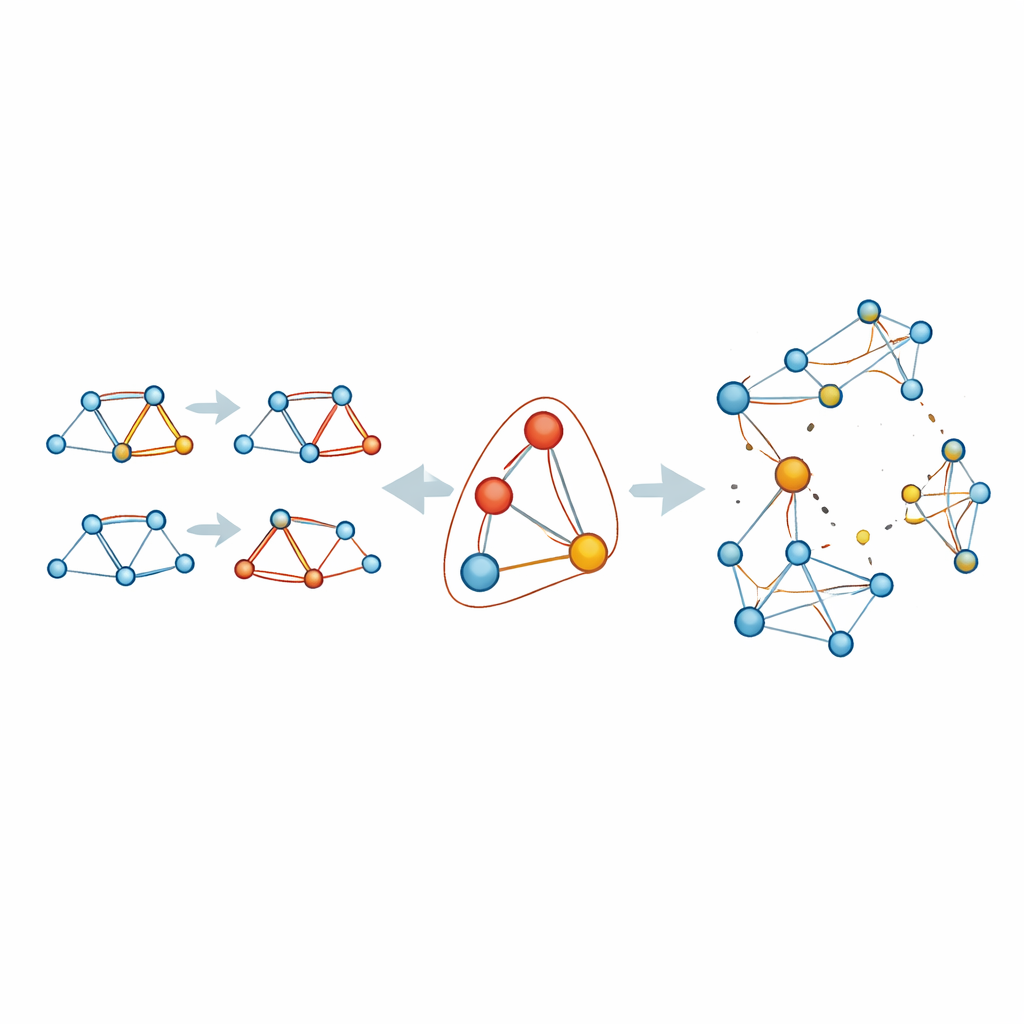
To compactly represent these recurring structures, the study treats each persistent cycle as a group object, called a hyperedge, that links all its participating nodes together. Collecting all such groups produces a “hypernetwork” sitting on top of the original network, highlighting which sets of nodes repeatedly form closed loops. From this, the authors define two simple node scores. The Temporal Cycle Number counts how strongly a node is involved in persistent cycles across time. The Temporal Cycle Ratio then compares that loop participation to how active the node is overall, spotlighting nodes whose interactions are especially efficient at creating durable backup loops rather than just many fleeting contacts.
Testing stress in real-world systems
To see whether these loop-based scores truly signal resilience, the authors run controlled disruption experiments on six very different temporal networks: human contact at a conference, air traffic, brain recordings, corporate email, an electrical grid, and international trade. They simulate targeted attacks by removing nodes in order of various rankings—classical centrality, temporal path measures, and the new cycle-based scores—and measure how much the network’s ability to move things quickly in time-respecting ways degrades. Across all six systems and under the chosen time-window settings, removing nodes that are deeply embedded in persistent cycles tends to cause larger efficiency losses than removing high-degree or path-important nodes, and does so in a way that is robust to changes in how time windows are defined.
Why this matters and what it tells us
The study finds that a relatively small set of persistent cycles forms a kind of hidden backbone that supports dynamic connectivity. Nodes that anchor these recurring loops behave as “cycle anchors”: if they are taken out, many of the time-respecting detours vanish, and the system becomes fragmented more quickly. Comparing closed loops with simpler open patterns that do not form a full cycle shows that it is genuine closure—not just repeated activity—that best predicts vulnerability. For a lay reader, the main message is that resilience in dynamic systems is not only about having many connections or popular hubs, but about having stable, repeating loops that can quietly take over when something breaks. Identifying and protecting these persistent cycles could help engineers, planners, and scientists design networks that stay functional even when the unexpected happens.
Citation: Li, B., Abinova, A. & Li, S. Persistent cycles and network resilience: a hypernetwork-based framework for temporal graph analysis. Sci Rep 16, 14506 (2026). https://doi.org/10.1038/s41598-026-44835-4
Keywords: temporal networks, network resilience, feedback loops, higher-order structures, infrastructure robustness