Clear Sky Science · en
Recycling waste concrete into alkali-activated geo-binders for sand stabilization
Turning rubble into useful ground
Old concrete from demolished buildings usually ends up as bulky waste, even though cities constantly need stronger, more stable ground for roads, embankments, and foundations. This study shows how that rubble can be ground into a fine powder and reused to strengthen loose sand, creating a sturdier base for construction while cutting climate impacts and supporting a more circular use of materials. 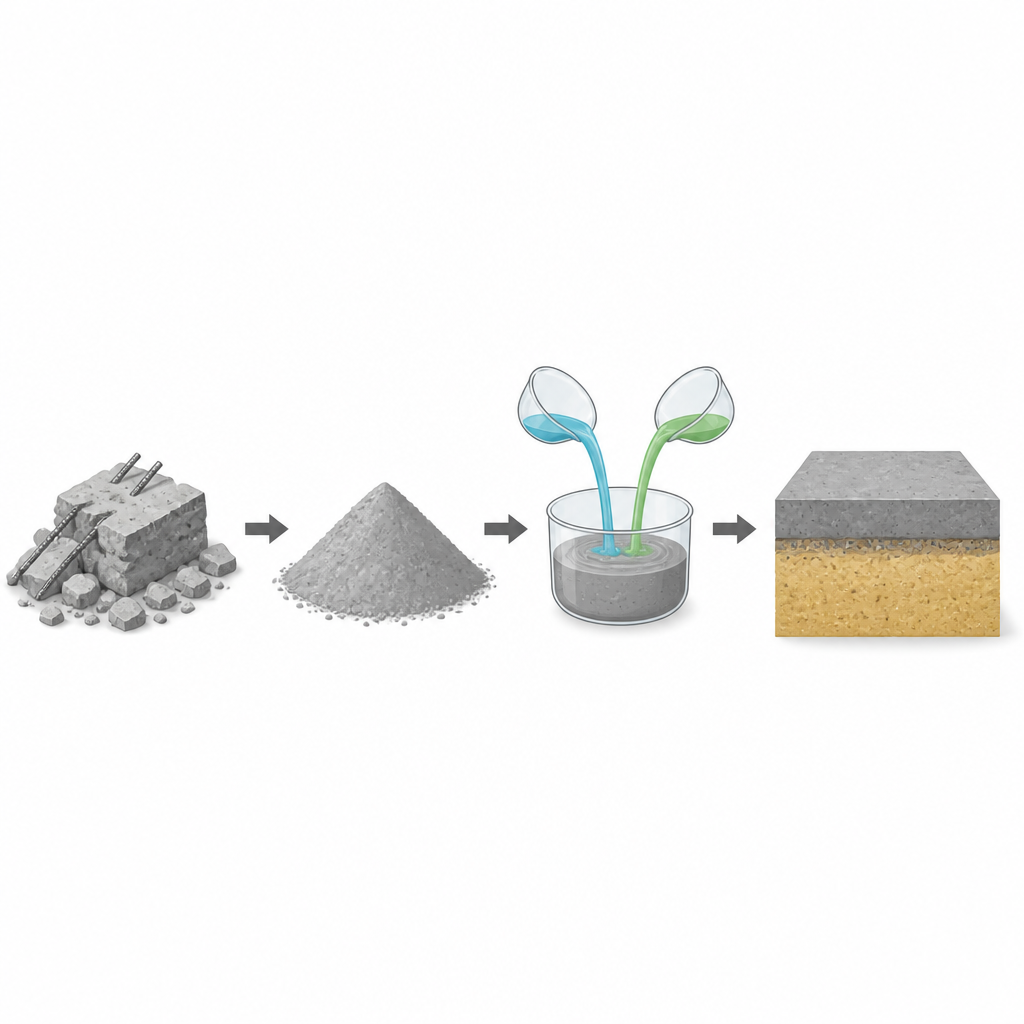
From broken concrete to binding powder
The researchers started with ordinary concrete, crushed it, and milled it into a fine waste concrete powder. They mixed this powder with silty sand and then added a chemical solution made from common industrial chemicals containing sodium and silicate. In this highly alkaline environment, parts of the old cement in the powder dissolve and re-form as new binding gels that glue the sand grains together. By adjusting how much powder was used, how strong the solution was, and how much extra water was added, the team created dozens of different mixtures to see which ones produced the strongest stabilized sand.
How strong and stiff the new ground can become
Strength tests showed that the treated sand could become impressively solid. In the best case, with 20 percent waste concrete powder, a relatively strong activating solution, and no extra water beyond the chemical mix, the material reached an unconfined compressive strength of 3.1 megapascals after 28 days under room-temperature curing. This level of strength is in the range used for real-world soil improvement works. Even weaker recipes still improved both the resistance to sliding and the apparent cohesion between grains when compared with untreated sand or sand improved only by compaction. Measurements of stiffness confirmed that lower water contents and higher chemical concentrations generally produced a stiffer, less deformable stabilized layer.
Looking inside and predicting performance
To see what was happening at the microscopic level, the team used electron microscopes and X-ray techniques. They observed new gel-like phases rich in calcium, aluminum, silicon, and sodium forming bridges between sand grains, filling gaps, and binding particles together. These gels are known to be responsible for strength in modern low-clinker and alternative cements. Alongside the lab tests, the authors built two types of mathematical tools to predict strength from mix proportions and curing time. A simple linear equation captured most of the trends, while a more advanced machine-learning model called gradient boosting did even better, explaining about 95 percent of the variation in strength across all recipes. 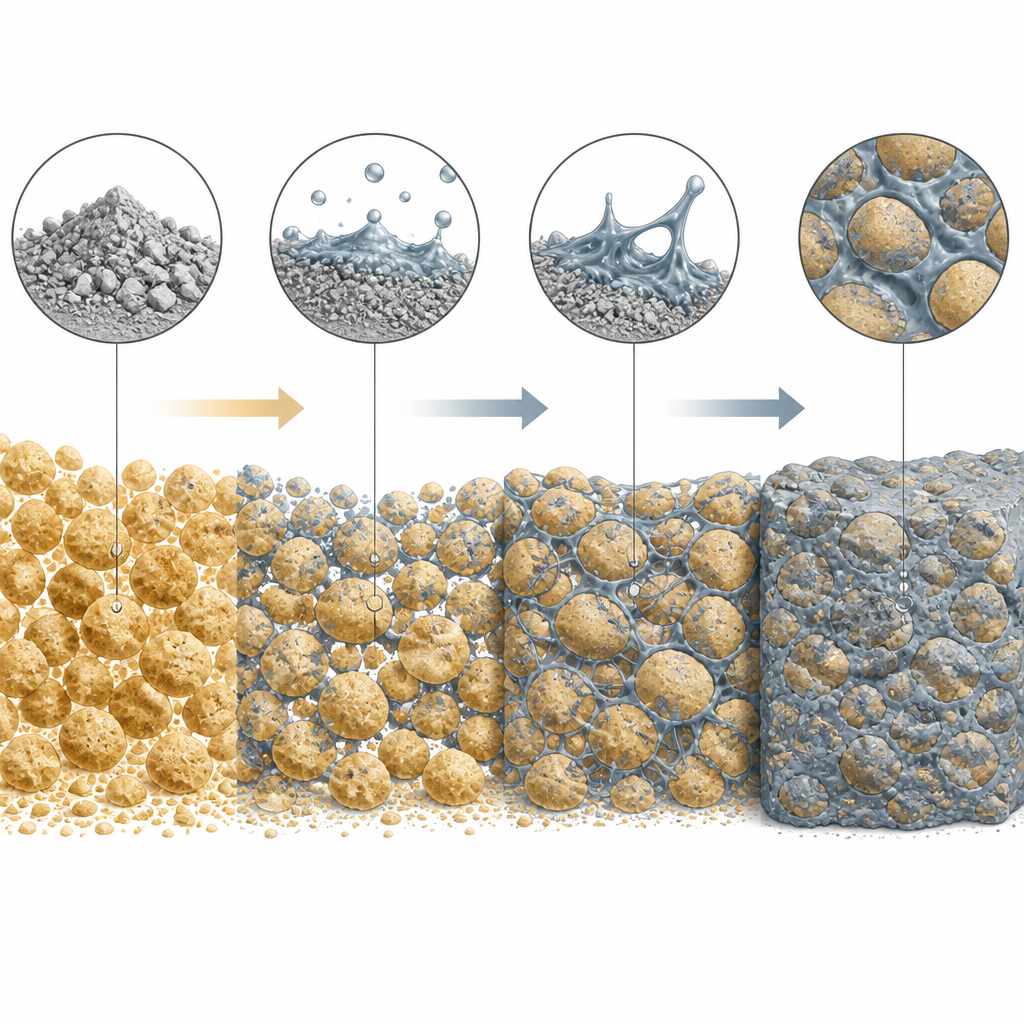
Checking the climate cost
The study also compared the environmental footprint of this waste-based treatment with that of conventional soil stabilization using ordinary Portland cement. For each cubic meter of stabilized soil providing similar strength, the waste concrete system was estimated to emit about 47 kilograms of carbon dioxide equivalent, versus about 58 kilograms for the cement-based method. Most of the climate burden in the new system came from producing the sodium silicate solution, suggesting that further gains are possible if that ingredient can be sourced from lower-impact or waste-derived routes. The analysis did not include long-term behavior of leftover alkaline liquids, so the authors note that careful design and monitoring would still be needed in practice.
Why this matters for future building
By showing that finely ground waste concrete can act as a stand-alone binder for sand, this work points to a way of turning a huge demolition waste stream into a useful resource for ground improvement. The approach can reduce reliance on fresh cement, cut greenhouse gas emissions, and allow engineers to build on weak sandy soils with less need for importing new materials. With further refinement of the activating chemicals and tests on more varied real-world wastes, this strategy could help make both building foundations and waste management more sustainable.
Citation: Bahmanpour, A., Ghahremani, M. & Fattahi, S.M. Recycling waste concrete into alkali-activated geo-binders for sand stabilization. Sci Rep 16, 15812 (2026). https://doi.org/10.1038/s41598-026-44832-7
Keywords: waste concrete, soil stabilization, alkali-activated binder, circular economy, life cycle assessment